Showing posts with label Civil War to Civil Rights. Show all posts

Saturday, March 21, 2015

Walking through 1965 on an Alabama Highway: Day 1

"...privileged to see life in a vital
totality never otherwise experienced."
"Outside in the backyards I had just passed other youngsters engaged in their game 'State Trooper' in which half the number lined up locked arms, and proceeded to march singing 'We Shall Overcome,' then were set upon and beat down by the others wielding sticks and branches. In situations like these, one must observe the tragedy: that the misdeeds of our immature society are imprinted in the minds of innocent children."
Carl Benkert, Freedom Songs: Selma, Alabama, 1965

We were marching down the road. Seriously. We were marching down a rural Alabama highway. Hundreds of us. Marching.

Selma is a convoluted sight. At once, it engenders hope and sorrow. And today as we began the 50th anniversary commemoration of the third march from Selma to Montgomery, a march instigated by a simple instance of police violence against a young man in Marion, Alabama, it was a particularly striking town.

Brown Chapel is in the heart of the projects, a national jewel nestled among families just trying to eek by. As we began to trudge down the street, a drum line and Boy Scout Troop from the Atlanta-area leading the way, some of the young residents of the Carver Projects scribbled on a woman's yellow t-shirt. Back at home, her classroom of young scholars had used Sharpies to write messages of encouragement on their teacher's shirt. And now, in the heart of a community ravaged by decades of systematized racism, Selma's own children were excitedly doing the same, filling the empty space.

Near the road, the hulks of proud middle-class homes sat burned, their walls scorched and charred above boarded-over windows. Selma is a still stark scar of a long-ago wound, the remnant of a promise of freedom in 1863 not quite fulfilled.

We turned the corner, a stop light that looked like it dated from the 1960s still dangling over our head. And believe me, I know stop lights. Crouse-Hinds back home in Syracuse makes them. It's not ambiance, though. This is no living history village. It hangs like that because it's likely never been replaced, another sign of the scars and heartbreak, privation and damage done by a war left unfinished for 15 decades.

Up and over The Bridge. If there is only one bridge worth mentioning in America, and perhaps there is only one bridge worth mentioning in America, it is that bridge. There young men and women, peaceful fathers and grandmothers alike bled for freedom, walked for freedom, chanted for freedom, prayed for freedom. And the irony of it all was that the bleeding and walking and chanting and praying should have been unnecessary.

"The right of citizens of the United States to vote," the echo of a war to destroy slavery still resounds, "shall not be denied or abridged by the United States or by any State on account of race, color, or previous condition of servitude."

A ways up the road, as feet tramped along U.S. Route 80, I pressed play on my iPhone. The interpretive staff wanted to inspire the marchers, put spring in their step. And being the technophile, it was left to me to ultimately engineer the task. Out from a speaker on my hip piped the voices of Common and John Legend. Had we cleared it with Columbia Records? No. Does it matter? No. Any company named after the very embodiment of freedom herself has no right to complain when the song Glory floats above a reenactment of the march from Selma to Montgomery.

The pace livened. The interpreters smiled. Behind me, I heard a middle-aged white school teacher singing along with the refrain, half under her breath as if embarrassed that she cared enough to know every last word.

The song trailed off. I flipped off the speaker.

A few dozen feet ahead of me, I heard the silence almost immediately broken by a voice, a young black woman on the verge of striking out on a life of her own.

"No Justice?" she called.

From around her came the obvious reply, reflexively: "No Peace!"

Again and again she repeated it. And the reply got stronger. When she lengthened her words, they lengthened hers. Staccato yielded staccato. Legato yielded legato.

Marching somewhere just a few feet ahead of me were a handful of seniors from the Ferguson-Florissant School District. They're the same age Michael Brown was on August 9th of last year. They have every right to chant. They have every right to be angry. They have every right to be afraid. The world, this American landscape pockmarked by 400 years of systematized racial violence and the half-effective backsliding outcomes of a war fought to destroy that system in the 1860s, seems dead set against them.

"No Justice?"

The cries continued.

"No Peace!"

Echoing through the air.

"No Justice?"

They were a warped refrain of sorrow.

"No Peace!"

A sad reflection on where our nation sits. We might have marched so far since 1863, but we have so much farther left to march.

Tuesday, January 20, 2015

We Will Now Rejoin Your Civil War (Already In Progress)

The long struggles started by the Civil War
continue in America's streets even today, from
St. Louis, Missouri to Staten Island, New York.
And the protest sign is still the greatest weapon,
like this example at the Newseum in Washington.
I celebrated Martin Luther King Jr. Day with a mouse and keyboard. I love diving neck deep in historical documentation for no good reason. Falling down the research hole can be so much fun, particularly when it's looking for one elusive piece of evidence.

This time, it was chasing an elusive section of a United Auto Workers protest sign used at the March on Washington in 1963. I found a photo of the corner, a chunk of text.

The idea that the Civil War led toward the Civil Rights movement 100 years later is almost painfully obvious. The fitful, ineffective and aborted experiment that was Reconstruction laid the groundwork upon which Randolph and Rustin erected the grand protest of 1963. Everyone on the rostrum called back to Lincoln, to the Civil War, to Emancipation.

The March on Washington was a non-violent battle in the long Civil War, just another skirmish like the ones fought in Gettysburg or Sharpsburg or Chattanooga. And everyone on the street knew it.

From what I can tell, the "official" posters produced by the march organizers, the signs announcing "We March For...Now!" and "We Demand... Now!" far outnumbered any others. But there were others. Some were hand-drawn. Some were banners brought by delegations, announcing that this church or that labor union was here to be heard.

And then there are the UAW signs. The language is far more strident than any of the others. The language is biting, snide and sarcastic. It's the language of a people oppressed for far too long to worry about being polite.

The March on Washington in August 1963 was
a definite echo of the Civil War.
The sign I went searching for underlined the 100-year disconnect in American society. And finally I found the whole elusive poster in an Associated Press photograph published by the Washington Post. "We seek the freedom in 1963," the UAW poster reads, "promised in 1863."

Emancipation was incomplete. It was never fully deployed, thanks in part to the failure of America's reconstruction experiment in 1877. And the March on Washington was just another battle of the Civil War.

I carefully traced the poster into a vector image. I'm a compulsive history. I collect things. Luckily, in this modern age, that doesn't always mean stuffing photocopied images into filing cabinets in the office. My filing cabinets are digital and they take up less real estate.

But to celebrate Martin Luther King Jr.'s Birthday this week, I wanted to share that poster with you, along with a few more that I've been converting over. They're hosted below on Flickr, in vibrant color and at high resolution. Use them however you see fit: in a classroom, in a frame on your wall or perhaps in the streets protesting today. After all, the African-American Civil Rights movement is still going on. And so is our Civil War.

Thursday, June 6, 2013

Meanings: Where This Is All Headed

Human tragedy, human triumph and continuing struggle, each of its own epic
proportions.  One convoluted war holds inside the tripartate meanings of sorrow
for 620,000 lost, joy for 4 million saved and the uneasiness that
the struggle for freedom would still continue 150 years later.

I've started to see the giddy reaction across the internet as June's dates fall off of the calendar and July looms. Folks are excited about the guns, the battles, the tactics, the camping, the reenactments, the fun, the festivities and the revelry.

But we, a community of people who all find a fascination in this awkward and cumbersome truth that we call "the Civil War," need to remind ourselves that it all had meaning, it all had a higher purpose and a greater outcome that hung in the balance.

Let's not let the fact escape us this time that battle doesn't happen in a vacuum. Armies don't appear out of thin air. They are things that are formed with a purpose and goal. That goal can shift and change as a war progresses, which is a key thing to understand as well. Events need context, and not just the context of the battle before and the battle after. They need placement within a narrative flow of history, the "why should I care?" of the present must meet the "you should care because" of the past and the two need to cogs must mesh. If we can't help America find that sort of real, personal relevance, preserving the special places of the Civil War will always be a game of diminishing returns.

For me at least, this time, 50 years on, must be about meaning and not simply memory. But more on that distinction (as well as Bill Clinton, Medgar Evers and Robert E. Lee) next week.

Tuesday, July 17, 2012

The Willard Hotel: Let Us Die To Make Men Free

The Willard, circa 1919
the Smithsonian
Everyday I head into work, I pass by the Willard InterContinental building between 15th and 14th streets NW in downtown D.C. Even though Washington, D.C. has changed greatly since the Civil War, the Willard has, in its various different forms and structures, always been there – since even before the Civil War. In its long storied history, the Willard has been there for its fair share of historical events.

It was there when Abraham Lincoln was whisked into the city from Baltimore, under the cover of darkness, on February 23, 1861. The president-elect’s traveling companions, hearing the rumors and fearing assassination attempts, quietly escorted Lincoln to a suite of rooms he stayed in before his official inauguration on March 4. The Willard was also the scene of a last ditch peace conference earlier in February, as former President John Tyler presided over a group of delegates from all over the country, except the deep south, hoping to avoid war. Of course, we all know, the conference failed, as all the while southerners were meeting in Montgomery, Alabama to form the Confederacy.

My favorite historical happening that occurred at the Willard during the Civil War is none of those. It was a simple act, after all: A woman merely wrote down some lyrics to a popular melody after she awoke early from her slumber. Those lyrics, though, were none other than the tune, “The Battle Hymn of the Republic” and the woman was none other than the famous American poet, abolitionist, and writer, Julia Ward Howe.

Mine eyes have seen the glory of the coming of the Lord:
He is trampling out the vintage where the grapes of wrath are stored;
He hath loosed the fateful lightning of His terrible swift sword:
His truth is marching on. 

She penned those famous lines during one November morning, or at least, that’s how the story goes. While many remember the first couple of stanzas, one of my favorite stanzas actually comes near the end:
He died to make us free....
the LOC


In the beauty of the lilies Christ was born across the sea,
With a glory in His bosom that transfigures you and me:
As He died to make men holy, let us die to make men free,
While God is marching on. 

Let us die to make men free. That pretty much sums up the entire war right there. Though, the story doesn’t exactly stop with Howe. A little more than 100 hundred years later, another man on a quest to make men free, stayed at the Willard. Martin Luther King, Jr. spent a night at the Willard devoting the evening to polishing the “I Have a Dream” speech in his hotel room. The next day, standing in front of the Lincoln Memorial, King evoked Lincoln’s imagery and words in one of the greatest demonstrations for human rights in United States history. King, like Lincoln and the many others who passed before him, would ultimately die to make men free as well.

Thursday, June 21, 2012

Lost and Found: Where the Iconic Meet

Gilded icons: brilliant,
striking and with deeper
meanings. / CC Cea
I know exactly when I began believing in the Muppets again. I am a child of the '80s. I was five years old when Jim Henson died. I remember watching the TV with my Mom crying beside me as Frank Oz's Fozzie, Richard Hunt's Scooter and Dave Goelz's Gonzo read to their friends the condolence letters sent by thousands of grieving fans. I remember the slow building of "Just One Person."

But somewhere along the way, I lost the Muppets. Or they lost me. "Or did something break we can't repair?" Every time I heard Steve Whitmire's voice come out of Kermit's felt maw, my heart sank. That wasn't my frog, my Kermit. For over a decade, for the better part of my childhood, the loss of Jim Henson was palpable. I held a grudge against something, someone, for taking away this frog (and the person who he embodied) I cared deeply for away from me.

Then I saw the newest Muppets movie. It was good, but it was still Steve Whitmire. It was a different Kermit, with a different voice and a different personality. Then this new voice told Miss Piggy, "it's time for our song." The crowd in the Muppet theatre applauds, and a familiar banjo patter begins. "Why are there so many songs about rainbows?" Kermit asks in song.

I burst into tears. More of the characters joined in. Eric Jacobson's Miss Piggy, Bill Barretta's Swedish Chef, John Henson's Sweetums all sing along with Kermit on the most iconic of Muppets songs. My heart broke. I sat in the theatre, next to my Mom, and cried. At that moment, Steve Whitmire became Kermit. I couldn't hear the difference in his tone or inflection. He was that frog and the frog was him.

The iconic power of the song, the raw emotional pull of its lyrics about dreams being possible coupled with its lilting banjo line, transformed a ping-pong ball adorned felt puppet into a being, a real living thing. And the iconic power of that song and it's message of hope and perseverance transformed Steve Whitmire's voice into Kermit the Frog's voice, lost for me since Jim Henson died in 1990.

Icon comes from a Greek word meaning image or likeness. But the iconic moments in our lives have more to do with the Greek Orthodox Christian interpretation of that word. Wander through the market stalls of any of the former Soviet satellite states and you will find vendors peddling small hammered metal trinkets with beautiful Eastern European depictions of the Madonna and Child or any one of a number of Saints. The icon has deep spiritual meaning. It plucks at the heart somehow. It represents a larger truth, be it God or the simple beauty of man's artwork, to the believer and unbeliever alike. It encapsulates the essence of something larger than just the sum of its parts, something greater than the wood, tin and paint from which it is made.

Interpreters share many stories. We tell tales of valiant soldiers and courageous protestors, civilian bystanders and student sit-ins. But the stories which resonate the most with an audience are those that touch the heart. Looking for the passingly iconic in history is not hard. Many things in history represent something larger than just the paper they are written upon or the ink spilled to craft them. But looking for the icons which transcend, those which possess the power to pluck the strings of any soul requires skill, practice and a bit of luck. They often hover around those magical human things we call dreams and love.

In the realm of the Civil War and Civil Rights, the transcendentally iconic often lies where these two worlds collide. It is the image of the Rev. Dr. Martin Luther King Jr. standing in the, "symbolic shadow," of the Great Emancipator in 1963. It is the farm owned by a black man where, in 1863, the future of black men's right to citizenship in the nation would hang in the balance during bloody combat. It is the bridge named for a Confederate general and slaveholder where in 1965 the sons and daughters of former slaves were mercilessly beaten for wanting something as simple as a right to vote that had been promised to them a century before.

How do you find the iconic? Sometimes it is as simple as looking for the intersections of history, where two tales crash into each other, forging a broader transcendent meaning. Sometimes it takes stepping outside of your own frame of view, to see the world from a broader perspective. Keep looking. The deep, iconic and meaningful connections are out there waiting to be found and shared.

Or as Kermit the Frog said once. And another Kermit the Frog still says today:

“Someday we'll find it
The Rainbow Connection
The lovers, the dreamers, and me.”

The Iconic floats over New York's streets. / CC Musicwala

This piece originally appeared as part of the pre-course reading material for the recent Civil War and Civil Rights training course I helped organize and conduct at work with the NPS. But that course only reached 19 students over the course of four days. Sometimes icons need to be shared with the wider world.

Thursday, May 31, 2012

"The People for Whom He Saved the Union": Ninety Years Ago in DC

Reading the official Facebook page of one of my favorite history authors yesterday, I saw a pithy note about a "day of note." Ninety years ago this week, President Warren Harding dedicated the Lincoln Memorial at the west end of the National Mall in Washington, D.C.

If ever there was a landscape where the story of the Civil War and the story of Civil Rights have collided in technicolor majesty, it is on those steps. I pointed out as much a couple weeks ago. And author Sarah Vowell pointed out yesterday the first time that Memorial was the scene of Civil Rights strife - the very first day it was open. From its beginning, the temple dedicated to Lincoln has been the scene of conflict over the paltry detail of the color of the skin of some Americans, the very, "people for whom he saved the Union."

It's a throw away line, the detail that the dedication of the Lincoln Memorial was a segregated affair. I've used it as a stark underline of the point that the Civil War was the beginning of an end to racial strife, not an end fully achieved. But to be honest, I've never dug that deeply into the hearts and words of the black folks who experienced that ultimate snubbing, that theft of the Great Emancipator's shrine from under their noses.

The snub was palpable to Black communities across the country, both those dotting the District and those lying hundreds of miles away. In Saint Paul, Minnesota, The Appeal indignantly told its predominately black readership that, "Colored Americans were segregated in the seating of the audience during the dedication."

The Memorial as it appeared on the
front page of The Afro-American
Shelby Davidson, the executive secretary of the Washington, D.C. branch of the NAACP sent a somewhat-public letter to the organization's national headquarters. Dignitaries. white and black, were given tickets for the event's platform. "Platform seats reserved for white were in chairs and within hearing distance of the speakers," The Appeal reprinted Davidson's words on June 10th, "while back of those seats were those reserved for colored people, roped off from those occupied by the whites and placed about a block from the Memorial in the grass and weeds, with rough hewn benches without backs or supports."

Adding insult to injury was the fact that flanking the black dignitaries. "placed at the entrance to these seats were marines who were distasteful, discourteous and abusive even to swearing in the presence of our women who accompanied their husbands to the celebration." Baltimore's Afro-American on June 2nd recounted the experience of Whitfield McKinley, "well known local real estate dealer," who was ordered by one of the armed Marines to sit on his assigned bench. When McKinley responded that he'd, "think about it," the Marine gruffly responded, "Well think damned quick."

The Afro-American, with no lack of bravado, recounted how, "a near riot ensued and the crowd demanded the transfer of the marine elsewhere." When a nearby officer declared that the Marine were, "the only thing to do to keep the colored people in their place, twenty-one persons arose as one and left the enclosure."

The Saint Paul Appeal, addressing African-American citizens of the state who had sent her sons eastward to be slaughtered at places like Fredericksburg and Gettysburg fighting for the freedom of the slave, noted that, "it is a wonder that Lincoln did not turn over in his grave."

In Salt Lake City, Utah, The Broad Ax told its black readership that the Washington branch of the NAACP had petitioned President Warren Harding to unseat the Superintendent of Capital Grounds and Buildings, the man responsible for the segregation of public spaces in the District. The incident at the Lincoln Memorial wasn't the first, but, "the second of its kind in less than two months, the first being the placing of segregation placards in Rock Creek Park." The Broad Ax reprinted the NAACP's stern warning to the Republican Harding:

It would be a rude awakening and a painful disillusionment to us to realize that the party was approving and following a practice which was an incident to the institution of chattel slavery.

For black citizens across America reading similar details in their own local newspapers, the fact that the Lincoln Memorial was segregated spoke all too loudly. It told them where the White House and the rest of America stood on their equality. The promises which Lincoln made in 1863, through a Proclamation destroying slavery and an immortal address Lincoln gave at Gettysburg, rang hollow and empty as they echoed through the halls of that marble temple. Lincoln didn't need to be standing over a kneeling slave for 1922's black folks to see what their predecessor Frederick Douglass had noted in 1876: that Lincoln was, "preeminently the white man's President." White America had gone out of their way to claim him as their own, snatched from a black populace questing for some icon around which to rally.

If we stop imagining the Civil War in 1865, we aren't getting the whole story. If we stop in 1877, we're only a few steps down the highway of the Civil War. The dedication of the Lincoln Memorial was a battlefield in 1922, in some sense just like Shiloh or Petersburg, where men faced off over the momentous concept of freedom and liberty. This week the 90th anniversary of that battle of wits, minds and words passed by like an historical speed bump. How many more opportunities to remember the other battles of the Civil War, the ones that took place in the hundred years after the white men put down their swords and shook hands, will we leave by the wayside before we realize they are integral parts of the Civil War story as well? Wars don't end, they linger for decades, even centuries. No place was that more clear than on a day in late May 1922, when the war erupted once again on the Mall in Washington.

Tuesday, May 15, 2012

Meet Mr. Everyman: Everyone His Own Interpreter

Note: I originally wrote this piece for a NPS training course on Civil War to Civil Rights; I think it correctly characterizes some of my views on the theme(I love it!). Today, I thought I'd share the piece (albeit with a few edits) here as well. Enjoy.

In 1931, Carl Becker, president of the American Historical Association, the largest professional organization of historians, gave a speech in which he tried to distill history to its very essence. In that address, “Everyman His Own Historian,” Becker declared that history reduced to its lowest terms was the “memory of things said and done.” Using that simple definition, Becker argued that everyone, no matter whether they had professional training or expertise, was in some way, at some point in time, an historian. Everyone at some time in their lives did as a historian does – asks a question about the past and researches it, using evidence to come up with the most logical conclusion.

I would make the same argument for interpreters. If we reduce interpretation to its very essence, that interpretation is the facilitation of personal and meaningful connections, then similarly everyone is her own interpreter. Everyone at some point in their lives finds some sort of meaningful connection to some familiar landscape that matters to them.

What do I mean by that? Well, first off, I truly believe that everyone, no matter who they are or where they come from, can find deep meaning and true personal relevance in every historical site that is worthy of preservation. Interpreters are simply there to help them and (in some instances) get out of their way. Historic sites, at their very core, speak of human universals.

But if everyone is his own historian and interpreter, why do we need professional interpreters and or historians? This is of course a logical extension of Becker’s argument. But Carl Becker, realizing this, did not despair. He realized that historians help to serve Mr. Everyman’s emotional needs and work towards his emotional satisfaction. The historian (and interpreter) help to facilitate a connection between Mr. Everyman and the past he craves to connect with. They act as a guide and adviser to Mr. Everyman, offering advice and guidance on what might help him find meaning. As one Civil War blogger has succinctly said, “Everyman’s his own historian, but not every man is very good at it.” The interpreter helps to solve that.

Carl Becker’s piece taken as a whole was an eloquent plea for historians to be responsive to society, to the very people for which they ostensibly wrote history. That is my plea as well – we have to be responsive to the whole society we interpret for – the whole American public and not just those who already visit our historic sites. How do we, as an interpretive corps, accomplish this task? For the National Park Service, it means connecting two core historical eras they interprets – the Civil War and the struggle for Civil Rights. These two historical periods are messy. They frequently intersect, overlap, and cross paths repeatedly. They bounce off of each other too, traveling in different directions for years before finally crossing paths again. Yet too often, our interpretation of these sites is segmented, partial, and too narrow in its focus. Sometimes we miss the bigger picture, too wrapped up in our site’s specific details to see the broad forest of meanings.

Whichever area you interpret; it is history all the same. And I love history. But I love interpreting history even more. Playing with contradictions on a landscape, warping time and chronology, considering multiple and radical points of view and pitting them against each other – these are magical and transformative things you can do while interpreting that historians often frown upon when creating history. But that doesn’t matter. Interpreting is all about helping Mr. Everyman find meaning in a place and promoting his care for it. It’s not about pounding into a visitor’s head what important thing happened at this battlefield, why this historic site is important, or some broad historical thesis about why the events happened the way they did.

It is about the visitor discovering personal value in the landscape. It is about every person becoming their own interpreter.

Wednesday, November 23, 2011

Walking Out on the Meaning: Dedication Day 2011

A Wednesday "Extra!" for you about this past weekend's events in Gettysburg...


I am a nerd. Last year on November 19th I was stuck in Las Vegas, attending the NAI conference (the same one Jake and I have been grousing about for the last two weeks). This was the first Dedication Day event I had missed since first coming to Gettysburg in 2003. I was upset. I was disconsolate. I trudged the strip dejected. I toured the Atomic Testing Museum, which was fascinating but unfulfilling. I am one of those dorks who doesn't understand how anyone can schedule anything other than a trip to Gettysburg on November the 19th. The glitz of Vegas only underlined this cold fact.

Like a scene out of the best Ray Bradbury
short story ever: Downwind from Gettysburg.
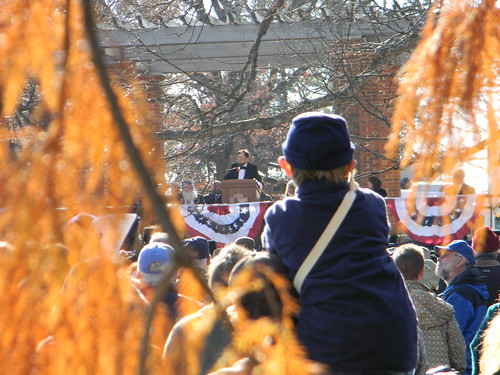
This year, I was excited to once again be in Gettysburg on a chilly November day to celebrate the speech Lincoln gave 148 years ago. The crowd was massive, larger than a typical Dedication Day. This was almost certainly due to the fact that the event fell on a Saturday this year and ended up as a double-bill with the popular-if-gaudy Remembrance Day. I have deep problems with R-day. But I have deep reverence for Dedication Day. It was nice to see some different visitors exposed to the solemn events in the cemetery and not simply the pompous ones along Baltimore Street.

A massive crowd saw Stephen Lang speak. Surprisingly, Lang's speech was good. I thought he made some excellent connections and tried to delve into a deeper meaning of that place. It certainly was not the typical exercise in expounding how little appreciation young people have for history, something which not only comes off as holier-than-thou but is often preaching directly into the choir loft when directed at a Dedication Day crowd.

Why does this video an audience member uploaded
to YouTube abruptly end after Jim Getty speaks?
But I noticed something. When Lang finished, what happened to that massive crowd? About 1/4 of it vanished, trickling away from the cemetery. Next, after a few other pieces of business, Jim Getty was introduced portraying Abraham Lincoln. Jim does a fine job as Lincoln, although I personally find his reading of the Address a bit flawed (my problem has to do with syllabic emphasis, and points out just how pedantic my knowledge of this stuff can be sometimes).

What happened after Getty closed? Another chunk of the crowd evaporated into the cold November air, streaming away. What was left looked like a typical Dedication Day crowd. Only about half of the people in the audience as there ceremony began were still there.

But why does this matter? Simply because of the deep meanings and resonances which unfolded next, after so many had left. The final activity of the day, before the Gettysburg High School band played "America the Beautiful," was a simple ceremony. Sixteen members of the audience were asked to stand as their countries of origin were announced: Armenia, Canada, China, Cuba, Dominican Republic, Germany, India, Kenya, Somalia, Thailand and the United Kingdom. Then Philadelphia district director of U.S. Citizenship and Immigrations Services Tony Bryson rose and approached the podium. He asked the candidates to raise their hands. He swore them in as citizens.

But why was this so meaningful?

No better definition of
the meaning of the Civil War...
Tony Bryson is black. He is an African American. His administration of the oath followed Lincoln's admonition to the nation that it should bloom with, "a new birth of freedom." We were at a commemoration of a speech which helped to redefine a national war fought so that men who look like Mr. Bryson were not held in coffles but were seen as citizens. This man who 150 years ago would have been looked upon by a majority of the American populace as sub-human and inferior, as something less than a citizen, was administering the oath of citizenship to new Americans of every stripe. That is the fundamental definition of an American revolution.

Lincoln's dream of a, "new birth of freedom," was palpable in the cold November Saturday morning. If only more people had bothered to stick around to see it.

Thursday, October 13, 2011

The Race of the Interpreter: "I'm Not Going To Spend My Life Being A Color..."

I am often put into an interesting place when recounting the tales of history. My passion is the history of race and abolition, the Civil War and the development of Civil Rights in the wake of the memory of our great fratricidal conflict. I'm white. Yet I am never afraid to broach the subject of race. Stephen Colbert's character on The Colbert Report often mentions that he doesn't, "see color." I would never be that bold. But I will say that I try to ignore color when I am interpreting to an audience. Put an audience of white visitors in front of me and I'll still tell them about the black characters in the drama of American history. Put a group of black visitors in front of me and I'll help them to see the landscape through any historical eyes, black or white.

Perhaps I'm naive, but I don't think there is such a thing as white history and black history. I think there is history. Some of the characters are white and some are black. All are intriguing.

I am not so naive to think that race has had no bearing on history. In fact, that's quite a bit of what I study. I delve deep into the minds of racists wearing hoods and lighting crosses on Civil War memorial landscapes. Likewise, I try to see the world from the lenses of racial egalitarians on quests to destroy a vial system of slavery based solely on a slight difference in pigmentation. I look at the evil and good in human character. But I can draw inspiration from the black characters in these narratives just as easily as white, in spite of my own skin color.

Why do I bring this up? I've been mulling the concept of black history for a while. Back in January, Kennesaw Mountain National Battlefield Park released a report on prospective black visitors to their site. One of the questions and a few of its answers have stuck in my mind, rolling around.

The survey leaders from Kennesaw State University posed the following question to their focus groups: "If you visited Kennesaw Mountain or another Civil War site today, what would be your expectations regarding the historical and cultural interpretation of the American Civil War?" Two answers stick out to me.

Imagery. We need to see people who look like us - Black people - to feel comfortable. They need to be part of the staff and decision-makers.

&

We keep getting people from, no offense, these big universities up north somewhere to come down and to tell us about the south. We need to invite people who look like African Americans – not just our White friends… We need people from the Talladegas, the Tugaloos, the Tuskegees, because they have kept a record of this history… We really need to bring the people who have lived these experiences.

I've asked the question of who owns black history before. The question still resonates with me. I understand the desire for diversity in the workplace and the world. I want to see every color everywhere. That's the very definition of America.

But can a white face tell a story about a black face and black hands? What did these respondents mean when they said, "we need to see people who look like us," and, "we really need to bring the people who have lived these experiences." In the case of the Civil War and slavery, those who, "lived these experiences," are long lost to us. Instead, we have their stories left. Why does it matter who tells that story?

The report's compilers suggested that Kennesaw, "consult with researchers, local historians and experts at HBCUs for consultancy opportunities to uncover African American history." HBCUs are wonderful resources. I had the pleasure of visiting Tuskegee University last year and sitting down for a chat with a brilliant student Park Ranger with a true passion for Booker T. Washington and the Civil Rights movement of the early 20th century. But even he would not have said that black colleges are the sole arbiters of the history of Americans of African descent.

This past summer, as part of my experimental programming on John Brown, my tour explicitly featured one white and one black character. The twin pillars of Thomas Boerly and Dangerfield Newby can help illustrate the pure tragedy of John Brown's Raid on Harpers Ferry. But I saw tears in the eyes of white folks over Newby's struggle against slavery to free his wife and children in bondage in Virginia. I saw tears in the eyes of black folks as I narrated the tale of Thomas Boerly, struck dead in the streets of Harpers Ferry while trying to defend his family from harm as his adopted home came under attack.

There are no black tears. There are no white tears. There are only tears. In the end, it shouldn't matter whether the characters in our stories are black or white. It should matter that they're human and that their struggles move our souls. Likewise, it shouldn't matter what color skin our interpreters have, but instead we should judge the content of their tales and their ability to move us.

Thursday, July 14, 2011

Locks and Cash: Whose Black History? (Part 2)

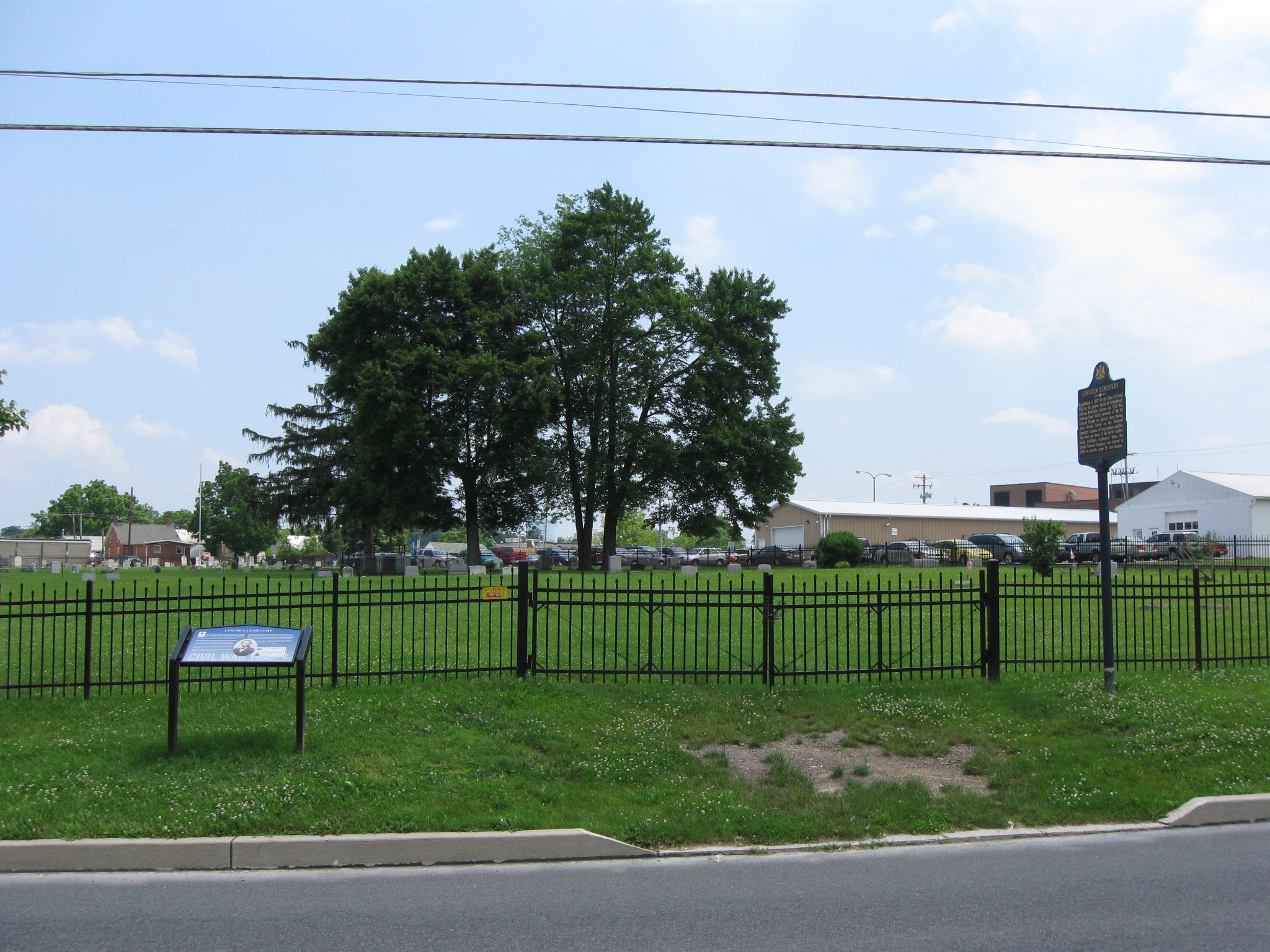
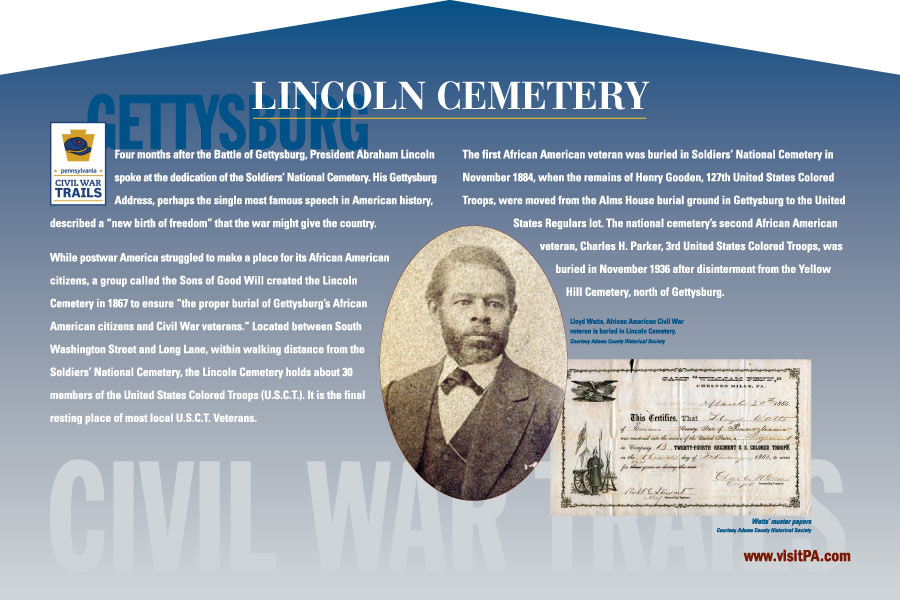
Lincoln Cemetery lies at the corner of Breckinridge
Street and Long Lane. / CC / Bobby Housch
A few weeks ago, the Hanover Evening Sun ran an article on the Lincoln Cemetery in Gettysburg and the locks which hang on its gates. This is by no means a new item of interest. The locks have girded the gates of the cemetery for three years. Still, the article (no longer on the Evening Sun's website but archived here in a PDF) raises a few interesting questions about the delicate balance between preservation and interpretation.

The caretaker of the cemetery told the Sun that when the cemetery was, "opened to the public," that the, "heavy traffic and lack of discipline and respect has caused graves to sink and stones to be pushed over." The lock went on the gates. Now only those with a, "sincere interest," are allowed to tread into the hallowed ground.

Lincoln Cemetery is the descendent of the original Good Will Cemetery, which served as a burial plot for the county's United States Colored Troops who were denied burial at the Soldier's National Cemetery just a stone's throw away. The history of the small plot is integrally linked with the story of freedom and the meaning and legacy of the Civil War. It is perhaps the most important ground in Gettysburg to visit when you are trying to unravel the legacy of war and the impacts of the conflict on America's black community.

But it's tough to visit the ground. A lock stands in the way. The caretaker asked the rhetorical question in May: "We have to decide, do we preserve the history that reflects the black citizen?... Or do we leave it open to be vandalized and trampled?"

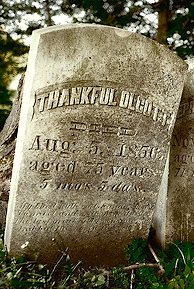
"Thankful"-ly, someone has uploaded photos
from "my" cemetery on findagrave.com
I understand the struggle to restore a cemetery.  A cemetery restoration, involving resetting more than 20 stones, was my Eagle Scout project. But the reason you restore any landscape is two-fold. You want to preserve the place, but to a specific end: enjoyment and appreciation. I wanted people to see Blocktown Cemetery and appreciate it. I wanted people driving by to wonder, "What is that?" and stop for a stroll through the area. I know, someday, Thankful Olcott's tombstone will tumble forward again. And I have faith that another historian or Scout will come along and fix it so another generation can enjoy it once again. That's how preservation works.

Is destruction really all that leaving the graveyard open will accomplish? Is vandalism and trampling the only outcome of the locks being left off the gates? Couldn't leaving the graveyard open to visitors to wander between the stones also help to foster a new found appreciation for the men and women buried there and their struggles?

Visitors are supposed to show a, "sincere interest," in black history before they can enter the sainted ground. But how do you develop that interest when the majority of black history in Gettysburg has been effaced from the landscape? Slivers and nuggets still exist here and there, but the majority of the African-American story in the town has been wiped clean from the slate with the concerted focus on three days in July. This is absolutely wrong. The story of Gettysburg's black community, a community which has remained more-or-less intact within the Third Ward for over 150 years, begs to be told to every succeeding generation.


Lincoln Cemetery's Civil War Trails marker.
Lincoln Cemetery is the chief tangible reminder we have on the landscape that a black community existed in Gettysburg in the 19th century. The home of Jack Hopkins, prominent member of the black community in 1863, crumbles to dust on Washington Street. The photos of Mag Palm, holding her hands defiantly for the photographer just as they had been tied by men trying to drag her south to slavery, appears in numerous places around the town; her photo often goes conspicuously uncaptioned. Basil Biggs' integral role in reburying the union dead after the battle, the men who had died to ensure his freedom and the payment for whose burial he would use to build a new and prosperous life, is a miniscule footnote if mentioned at all.

Where else can a casual visitor, who might not have a, "sincere interest," when they walk in through the gate gain that interest before walking back out?

I understand that, just like the African American Civil War Museum, it is the prerogative of the cemetery to do as they wish with their property. But how productive is that lock? How damaging will that $200 price tag end up being for the AACWM? Isn't it imperative that the Civil War story of the Americans of African descent be told to ever broader audiences? Don't we need to win converts to the fold of black history and not simply preach to the choir again and again?

Lincoln Cemetery was, "restored to preserve the only concrete history of the colored troops," in Gettysburg.

At the Memorial Day celebration held in the cemetery, my pastor and friend Rev. Joseph Donella gave the keynote address. In part he said that the black community's, "dead heroes belong to the whole nation. What they suffered in life and death, then, needs to serve as our reminder. Let us not look to the past, to recapture hostilities and wayward sins. Let us remember, what they dared not forget, our dignity is preserved by collaboration in community."

Wandering thoughtfully among those stones is the best reminder any of us might find.

Thursday, July 7, 2011

Beyond the Battlefield: A Simple Matchbook and a Rabbit Hole

A couple months ago, at the annual spring Gettysburg antique show, I found a small display of Civilian Conservation Corps items. Pennants and coins, matchbook covers and pins all displayed on a piece of foam-core. One caught my eye. For $10, I became the proud owner of a matchbook cover, never used, from a CCC Camp in Gettysburg. Company 1355 was stationed at Camp NP - 2 - Pa., now known as the Boy Scout / youth camping area at McMillan woods. I was thrilled.

The piece is an interesting artifact, but nothing too curious. There are artifacts from the CCC across America, from roads and public works projects to family photo albums and mementos ferreted away in attics as reminders of America's last great economic troubles. This matchbook is not necessarily odd.

Until you realize a key fact about Company 1355: the men were members of one of the Civilian Conservation Corp's all black units. These men were stationed at Gettysburg, Lincoln's home of a, "new birth of freedom."

Baltimore Afro-American - 10 February 1934
The decision seems not to have been made lightly. Its meanings were readily apparent to the region's African-American community. When a previous CCC company was stationed at Gettysburg, the Baltimore Afro-American was keen to point out that CCC men were now working, "where Abraham Lincoln delivered his famous Gettysburg address."

The men of camp 1355 were part of the work crew which reset, "several thousand headstones," in the National Cemetery in 1935. The Afro-American declared the soldiers who rested there as, "Civil War heroes." Working in the cemetery, undoubtedly, in between good-natured jests which workers trade on long days, the men of 1935 must have thought about those men of 1863 who were buried there, Lincoln's, "honored dead." They must have thought about their lives as black men in an America whose future was uncertain.

Did they gain strength to journey on from the soldiers' willingness to die for the future of a race of men? Can we still gain that strength for our lives today?


Baltimore Afro-American - 9 November 1935

Thursday, June 9, 2011

Interpreting Beyond the Battles: Could We Start with the Klan?

Jake has been having fun imagining and observing how battlefields can move beyond what I've called "Three Days in July" syndrome.

You might have noticed in the blog's background image the masthead of the Gettysburg Times, special Ku Klux Klan edition. Intriguing, isn't it? While doing research a number of years ago, I came across an amazing photo of the Gettysburg battlefield in the collection at Gettysburg National Military Park.


That image was so tantalizing, and has led down a rabbit hole of research. Suffice it to say for now that the Second Klan had a pervasive presence in Gettysburg and southern Pennsylvania. I'll unwrap how entrenched the Klan was as we move along. Right now, let's focus on that photo.

Detail depicting Oak Ridge Observation
Tower before it was modified in the 1960s
In 1925, the Pennsylvania Klan held its annual convention in Gettysburg in September. The Times called the Klan's parade through town a, "gorgeous display," and a, "monster procession." The Times headline trumpeted that, "vary-colored robes, capes and gowns present spectacle as Knights, Klanswomen and Junior Members march under warm September sun before large crowds along sidewalks."

The procession marched out to the site of their rally for the weekend, the sweeping fields of the Forney Farm. They ringed the field with automobiles, using their headlights to illuminate the scene well into the night. They straddled the land where just over fifty years before men of Iverson's Brigade had marched and bled and died fighting for a nation which stood on the cornerstone of the utter subjugation of African-Americans. Now, a second time, an army descended upon that hill to advocate for the superiority of whites over blacks, this time adding Jews and Catholics to the list of undesirables.

Imagine that story on the landscape. Imagine telling that story right along with the story of the battle. It points to the continuum of the war, to the evolution of thought and the eventual consequences of the actions of the men who fought on that land.

The distinctive monument of the
83rd NYSV, surrounded by Model-Ts
And there are plenty of tangible reminders out on the field. In the background of the photo, you can pick out a number of recognizable features that visitors can easily find on today's landscape. The Oak Ridge Observation tower figures prominently in the skyline, before it was neutered to half its height. To its right, you can see the monument of the 83rd NYSV with the eagle spreading its wings above its pinnacle. Following the ridge line you can easily find the blurry soldier with an upturned rifle of the 11th Pennsylvania's monument.

You can imagine standing at one of those monuments, describing the scene to a group of visitors. Let them touch the monument. Then show them the photograph of the rally.

One marcher with the Klansmen
sports a sign reading "Spirit of 1861."
The rally was huge. Groups from across Pennsylvania descended upon the fields of Gettysburg. The paper described the town as being festooned with red, white and blue to welcome their heroes. The Klan parade trekked through the streets of the borough, wending down Carlisle street and into the Diamond, then to Baltimore street. They turned onto High Street for a block, and then back north on Washington Street. The imposing group of hundreds of hooded figures skirted the core of the black community of Gettysburg as they marched in military lines.

One of the marchers carried a sign declaring that the gathering was celebrating the, "Spirit of 1861." But which spirit was that which this group of white clad ghosts was celebrating? Was it the spirit of 1861 which tore a nation apart over the brutal question of chattel slavery? Or was it the spirit which set out to preserve that nation and eventually morphed into a quest to rid the nation of the terror of human bondage?

The most curious thing to me, though? Front and center in the image is a line of Klan dignitaries, colorful hoods standing atop their heads. And who accompanies these men? For all the world, they look to be standing beside veterans of the Civil War. Those look suspiciously like uniforms of the Grand Army of the Republic.

Are these GAR members alongside the Pennsylvania Grand Dragon and assorted other officers?
How did these men, standing on the Gettysburg battlefield, rectify their participation in the pageant with Lincoln's, "new birth of freedom," declared half a century earlier? It's that sort of question which I think many people who visit Civil War battlefields would find not only interesting to ponder and reflect upon, but indeed crucial to understanding the road we've taken from the Civil War to Civil Rights.

And isn't that what this whole place is about, Charlie Brown?

This isn't the end of the story, but the beginning. I'm still digging. The Klan activity in this county in the '20s is intriguing. And it all takes on new meaning when you look at it in the context of the town as national emblem. The shifting memory of this place, and the political use to which the battlefield has been leveraged, is just as much an important story as the battle itself. Afterall, it had just as much to do with the shaping of the nation.