Showing posts with label Civil Rights. Show all posts

Thursday, March 26, 2015

We've Got A Movement Down in Selma: Day 5

My friend and sister TK marching
for her uncle's memory.
"My people, my people, listen. The battle is in our hands. The battle is in our hands in Mississippi and Alabama and all over the United States.... And so as we go away this afternoon, let us go away more than ever before committed to this struggle and committed to nonviolence. I must admit to you that there are still some difficult days ahead. We are still in for a season of suffering...."

One of my friends, a young woman who is like a sister after 54 miles of walking, got overheated as the speakers were on the rostrum yesterday afternoon. Together we had walked from Selma to Montgomery, a family welded together one the road. Quite a few miles back we had discussed her high school in Little Rock and the idea of ownership of powerful places. She was befuddled by the fact that some people think her high school — where nine brave sets of feet marched into a schoolhouse and changed history in 1957 — shouldn't continue its powerful mission to push America's youth forward. They think it's too important for students anymore; it should be an historic site and nothing more.

Meanwhile, as historians are asserting control over her school, the place goes to ruin because it can't be a living landscape. A stagnant pool of water breeds mosquitoes out front of the historic steps. But try as they might, teachers and students can't get anyone to get the water flowing, make the place healthier and more welcoming to the students who call that place home. It's because those steps, that building is historic. And in 1957 there was no positive flow system on that now-stagnant pool.

Standing on the street in front of the Capitol building in Montgomery, I get the feeling those historians have. I feel like, in some sense, I can understand the impulse. I feel like those steps are mine, my inherited heritage as an American. I've written about this before, running right back to the very roots of the blog. That story sings to my soul. This march has been a pilgrimage for me. I was so excited to be standing at the head of the column, leading "We Shall Overcome" through a bullhorn as my voice slowly went south from shouting. And hearing the speeches, seeing the spectacle, feeling the power were going to be the highlight of an arduous journey.

Then I saw my friend, her skin flush, looking like she would collapse in an instant. And I forgot where I was. She's family, my sister. I used my magical flat hat and badge to help part the crowds. We set her on a sunny hill. And I hoisted a protest sign to block the sun from her face.

From then on, the speeches didn't matter. The day melted away. Friend after friend came to the hillside. Some were veterans of a 54-mile march. Some had only traveled the last 3 miles with us up Dexter Avenue But they were all family. Some were marching to remember family members who died 50 years ago during the movement. Others were here to be witnesses. Still more just were looking for an activation, for a moment where they've find what they were fighting for. They were looking for their Selma.

I could say it's because I was wearing that damned uniform, that magical hat. But if I said that I'd be lying. I wasn't a park ranger yesterday. I might have had the arrowhead on my shoulder, but it wasn't some sense of duty making me fan folks, talk to them, joke with them about how much Bernice King's cadence is copied from her father's recordings. It was because we're family now. Toss that hat aside, throw the badge away? I'd still have ignored the speeches and helped my friends.

When she arrived, I promised my friend's mother that I'd make sure she got home safe. And yesterday afternoon her mom picked her up in the parking lot of the Lowndes County visitor center a bit battered and wilted, but none-the-worse for wear.

As we said goodbye, I joked. "And get that reflecting pool in front of the school fixed!"

"I don't know about that," she replied.

"Just rattle the cages," I said, "Make some noise."

"That's right," she said, her mother visibly not quite understanding anything that was going on, "I'm an activist now. I can change it."

My heart broke open at that moment and poured out of my eyes. We all changed the world this week. And we'll keep changing it. We are family in no light sense of that word.

We've got a movement going down in Selma.

Sunday, March 22, 2015

Like An Idea Whose Time Has Come: Day 2

Rain can't dampen the spirit
or the message of the Selma 50th Marchers
"They told us we wouldn’t get here. And there were those who said that we would get here only over their dead bodies, but all the world today knows that we are here and we are standing before the forces of power in the state of Alabama saying, 'We ain’t goin’ let nobody turn us around.'"

I met Edith today. We were walking down the road and Edith was with us. She didn't say much. She just sort of gurgled, dangling from a sling on her mother's chest.

Edith is a baby making the march from Selma to Montgomery. That in and of itself is a fascinating idea. Her mother is white, a kindhearted woman from the Midwest whose sister is rolling a stroller along for support. But Edith seems happiest walking with her mother, bouncing along in time to mom's rhythmic steps along Route 80.

Edith's father is from Kenya. They call their children, "Amerikenyan." I like the ring of that.

Edith wouldn't exist if it weren't for the men and women who plunged across Lowndes County in 1965. Her mother has fair skin; she has a dapled brown face and a beautiful little smile. But Edith was a crime at one point in the eyes of some Americans: miscegenation. Wandering down that same stretch of highway we walked today 50 years ago, Edith's very existence was crime in Alabama. And Maryland. And Virginia.

But no one was holding Edith's skin against her today. She was part of our family.

And we are a family now. It's odd to think of that idea from an interpretive perspective, but there are very few other words which truly fit. Wandering down the road and chatting about our world, our society, our nation, our lives with these couple hundred complete strangers feels like a family reunion.

And even the traffic passing by joins in. Some honk, some wave. Trucks yield to the demands of the students as they crank their arms through the air, begging for just one more blast of an air horn. Almost everyone is thrilled to see us. Rubberneckers abound in the westbound lanes, traffic crawling by us in both directions, brown arms protruding from windows and wagging through the air furiously in joy.

There are a few who aren't joyful. Some fair faces scowl. A couple make lewd gestures at men and women who only wish them well. I hope they grouse because they are late for a doctor's appointment or their son's birthday; I fear their anger bubbles up from an entirely different wellspring.

Ranger Anthony building a house of the mind as the march
spilled into Lowndes County and its toughest 24 mile stretch.
Nearly every face that snarls when we wave or sing seems to look like mine. Nary a black face seems upset to see hundreds of engaged citizens recreating an historic trek across an historic landscape to dramatize a still sadly shameful condition.

But we march for them, too. That's the nature of believing in freedom. It's about extending it to all, not just some. The American song is sung by a rich chorus of voices. And every throat should be free to warble notes with the rest, as long as they aren't attempting to silence their fellow singers out of spite, anger or hatred.

And we're marching for Edith. She'll be back in just a couple decades to do it all over again.

Saturday, March 21, 2015

Walking through 1965 on an Alabama Highway: Day 1

"...privileged to see life in a vital
totality never otherwise experienced."
"Outside in the backyards I had just passed other youngsters engaged in their game 'State Trooper' in which half the number lined up locked arms, and proceeded to march singing 'We Shall Overcome,' then were set upon and beat down by the others wielding sticks and branches. In situations like these, one must observe the tragedy: that the misdeeds of our immature society are imprinted in the minds of innocent children."
Carl Benkert, Freedom Songs: Selma, Alabama, 1965

We were marching down the road. Seriously. We were marching down a rural Alabama highway. Hundreds of us. Marching.

Selma is a convoluted sight. At once, it engenders hope and sorrow. And today as we began the 50th anniversary commemoration of the third march from Selma to Montgomery, a march instigated by a simple instance of police violence against a young man in Marion, Alabama, it was a particularly striking town.

Brown Chapel is in the heart of the projects, a national jewel nestled among families just trying to eek by. As we began to trudge down the street, a drum line and Boy Scout Troop from the Atlanta-area leading the way, some of the young residents of the Carver Projects scribbled on a woman's yellow t-shirt. Back at home, her classroom of young scholars had used Sharpies to write messages of encouragement on their teacher's shirt. And now, in the heart of a community ravaged by decades of systematized racism, Selma's own children were excitedly doing the same, filling the empty space.

Near the road, the hulks of proud middle-class homes sat burned, their walls scorched and charred above boarded-over windows. Selma is a still stark scar of a long-ago wound, the remnant of a promise of freedom in 1863 not quite fulfilled.

We turned the corner, a stop light that looked like it dated from the 1960s still dangling over our head. And believe me, I know stop lights. Crouse-Hinds back home in Syracuse makes them. It's not ambiance, though. This is no living history village. It hangs like that because it's likely never been replaced, another sign of the scars and heartbreak, privation and damage done by a war left unfinished for 15 decades.

Up and over The Bridge. If there is only one bridge worth mentioning in America, and perhaps there is only one bridge worth mentioning in America, it is that bridge. There young men and women, peaceful fathers and grandmothers alike bled for freedom, walked for freedom, chanted for freedom, prayed for freedom. And the irony of it all was that the bleeding and walking and chanting and praying should have been unnecessary.

"The right of citizens of the United States to vote," the echo of a war to destroy slavery still resounds, "shall not be denied or abridged by the United States or by any State on account of race, color, or previous condition of servitude."

A ways up the road, as feet tramped along U.S. Route 80, I pressed play on my iPhone. The interpretive staff wanted to inspire the marchers, put spring in their step. And being the technophile, it was left to me to ultimately engineer the task. Out from a speaker on my hip piped the voices of Common and John Legend. Had we cleared it with Columbia Records? No. Does it matter? No. Any company named after the very embodiment of freedom herself has no right to complain when the song Glory floats above a reenactment of the march from Selma to Montgomery.

The pace livened. The interpreters smiled. Behind me, I heard a middle-aged white school teacher singing along with the refrain, half under her breath as if embarrassed that she cared enough to know every last word.

The song trailed off. I flipped off the speaker.

A few dozen feet ahead of me, I heard the silence almost immediately broken by a voice, a young black woman on the verge of striking out on a life of her own.

"No Justice?" she called.

From around her came the obvious reply, reflexively: "No Peace!"

Again and again she repeated it. And the reply got stronger. When she lengthened her words, they lengthened hers. Staccato yielded staccato. Legato yielded legato.

Marching somewhere just a few feet ahead of me were a handful of seniors from the Ferguson-Florissant School District. They're the same age Michael Brown was on August 9th of last year. They have every right to chant. They have every right to be angry. They have every right to be afraid. The world, this American landscape pockmarked by 400 years of systematized racial violence and the half-effective backsliding outcomes of a war fought to destroy that system in the 1860s, seems dead set against them.

"No Justice?"

The cries continued.

"No Peace!"

Echoing through the air.

"No Justice?"

They were a warped refrain of sorrow.

"No Peace!"

A sad reflection on where our nation sits. We might have marched so far since 1863, but we have so much farther left to march.

Tuesday, January 20, 2015

We Will Now Rejoin Your Civil War (Already In Progress)

The long struggles started by the Civil War
continue in America's streets even today, from
St. Louis, Missouri to Staten Island, New York.
And the protest sign is still the greatest weapon,
like this example at the Newseum in Washington.
I celebrated Martin Luther King Jr. Day with a mouse and keyboard. I love diving neck deep in historical documentation for no good reason. Falling down the research hole can be so much fun, particularly when it's looking for one elusive piece of evidence.

This time, it was chasing an elusive section of a United Auto Workers protest sign used at the March on Washington in 1963. I found a photo of the corner, a chunk of text.

The idea that the Civil War led toward the Civil Rights movement 100 years later is almost painfully obvious. The fitful, ineffective and aborted experiment that was Reconstruction laid the groundwork upon which Randolph and Rustin erected the grand protest of 1963. Everyone on the rostrum called back to Lincoln, to the Civil War, to Emancipation.

The March on Washington was a non-violent battle in the long Civil War, just another skirmish like the ones fought in Gettysburg or Sharpsburg or Chattanooga. And everyone on the street knew it.

From what I can tell, the "official" posters produced by the march organizers, the signs announcing "We March For...Now!" and "We Demand... Now!" far outnumbered any others. But there were others. Some were hand-drawn. Some were banners brought by delegations, announcing that this church or that labor union was here to be heard.

And then there are the UAW signs. The language is far more strident than any of the others. The language is biting, snide and sarcastic. It's the language of a people oppressed for far too long to worry about being polite.

The March on Washington in August 1963 was
a definite echo of the Civil War.
The sign I went searching for underlined the 100-year disconnect in American society. And finally I found the whole elusive poster in an Associated Press photograph published by the Washington Post. "We seek the freedom in 1963," the UAW poster reads, "promised in 1863."

Emancipation was incomplete. It was never fully deployed, thanks in part to the failure of America's reconstruction experiment in 1877. And the March on Washington was just another battle of the Civil War.

I carefully traced the poster into a vector image. I'm a compulsive history. I collect things. Luckily, in this modern age, that doesn't always mean stuffing photocopied images into filing cabinets in the office. My filing cabinets are digital and they take up less real estate.

But to celebrate Martin Luther King Jr.'s Birthday this week, I wanted to share that poster with you, along with a few more that I've been converting over. They're hosted below on Flickr, in vibrant color and at high resolution. Use them however you see fit: in a classroom, in a frame on your wall or perhaps in the streets protesting today. After all, the African-American Civil Rights movement is still going on. And so is our Civil War.

Thursday, August 16, 2012

"...our hearts tell us there is something else out there.": Prowling the Halls of the MIB

In the basement corridor of the Main Interior Building in Washington, D.C. is the most beautiful painting I've even seen. I've gotten the chance on a couple of occasions, while visiting the Department of the Interior Headquarters for meetings and whatnot for work to wander down outside of the cafeteria to see the mural. It is pure beauty, mostly forgotten and ignored by the folks who work in that building everyday. I get these weird looks while I stand in awe of the massive canvas, like I shouldn't stop and stare. I don't care. I take pictures. I gawk. My mouth hangs agape.

An Incident in Contemporary American Life by Mitchell Jamieson, installed in 1942, is my favorite painting. And true to form, my love has as much to do with the subject as the art. The floor-to-ceiling mural, so vivid you could step into it's muted colors, is an amazing window into the past. And that moment is a quintessentially American day in 1939 when Harold Ickes stood up for equality of opportunity. He offered up the Lincoln Memorial as an altar of freedom from which Marian Anderson would sing after the Daughters of the American Revolution refused to let her use their stage because of the color of her skin.

But Ickes and Anderson have nothing to do with this painting. If you look at this massive image of the painting from the DOI website, you can see that the black songbird and the Secretary are specks on the stage in the distance.

The painting is about the act of listening, of observing. The painting is about the people, the ordinary people, who witness grand moments in history. They're white, they're black. Unlike the crowd at the dedication of that vast temple to liberty, the crowd Anderson's concert was integrated. And in each face, a story starts to bubble to the surface. This man looks on in hope, that one bows his head in sorrow. This woman eagerly listens to the wafting music, that gazes into the eyes of her child. Is she dreaming of a future? Or is she fearing that the world he grows up in won't be much different than the one she has?

History is made by people, not the ones on stages, but the ones in the crowds. And every member of that crowd has a story. A painting is not am image, it is only paint on canvas in coordinated brush strokes. The mural of history is exactly the same. If we pause to look at all those brush strokes at once, give them all their individual due in the grand larger picture, history becomes beautiful and complete.

And if we put our noses right up to that canvas, like I did last time I was in the basement outside of the cafeteria, and look at one of those simple brushstroke, it too speaks volumes.


Thursday, November 24, 2011

Forever Free: The Dakota People's Civil War

Who marched atop these walls?  Who built them?
Who marched inside?  Who sat inside as captive?
As I mentioned last week, I left Fort Snelling after our tour as part of the National Association for Interpretation annual conference unfulfilled. The potential for high-drama and deeply meaningful connections was palpable on that landscape. The audience, a crowd of interpreters, were begging for meanings. One African American woman in the group, after the site administrator mentioned in passing Dred and Harriet Scott being held at the site, asked about the nature of the labor used to build the fort. I was sitting in the row behind her. I could not see her face. But from the inflection in her voice, I could tell exactly what the unstated question behind her spoken one was: "Were slaves used to build Fort Snelling?"

She was desperately trying to imagine her personal story within the context of that historical landscape. She wanted to know how people with her color skin might have figured into the sweeping narrative that is the fort. She wanted to know what this place meant to her today, the impact and implications it has had on who she is, where she stands in American society and how American society sees her.

The administrator did come around to the answer she wanted: "The first soldiers stationed at the fort built it." She did coax out of him the fact that no slave labor built the original walls of Fort Snelling. But only after goading. And with that cold answer, the site lost much of its potential meaning for her. She was not given the opportunity to care. She was not given a moment to see herself in that place.

My blood boiled; it always does when things like this happen. It's why people don't like visiting historic sites along with me anymore. I start stewing with every missed meaningful connection I see.

So, how do you make Fort Snelling relevant? Where is that deeply meaningful story? How can you overcome the fact that black hands did not lift stones into place to build that fort and still make this place relevant to this one particular woman?

Military executions are commonplace in Civil
War narratives, but the largest mass execution
in U.S. history happened in 1862, when the
U.S. Government hanged 38 Dakota Indians.
Here's a hint: Happy Thanksgiving! You can use America's other most maligned ethnic group, pushed and prodded westward across the American landscape for centuries - the American Indian. The other American holocaust, the destruction of North America's native peoples, is linked indelibly with the American holocaust which I study most: slavery.

In 1862, the Dakota people (part of the Great Sioux Nation) noticed that Minnesota had been drained of its male population. Men from every walk of life in the newly minted western state had struck eastward, heading to the fertile farmlands of Virginia and the silt-doused banks of the lower Mississippi valley to reap a harvest far different than the one they had pulled in years past from the fields around St. Paul. In the army, these men would sow and reap death and destruction in a war begun because of one concept: slavery. That one odious word holds so much power. The image of whips and cotton fields, of bleeding scarred sable skin and hounds baying in a dark wood immediately leap to mind when that simple word is uttered. It is the ultimate American evil.

The Dakota people, however, were experiencing another American evil. Their lands and livelihoods had been systematically chipped away by unbalanced treaties with white settlers from the east, until they were left with a thin strip of farmland running across Minnesota. For a people who thrived off of a physical connection to the sacred land, being separated from their holy ground was the greatest of injustices. Boxed in, but seeing the opportunity afforded by the strong and able-bodied white fighters being a thousand miles away, the Dakota seized the initiative. They rose up in rebellion and attempted to seize their lands back. They failed, but not before over 600 men, women and children had been killed on both sides. White Minnesotans lay dead in the dust in the fall of 1862.

In fields in Maryland, white Minnesotans lay wounded and bleeding. The fruits of their suffering was a transformation of the goal of the war. Those soldiers in blue suits now would march to free 4 million held in chains, prisoners in a brutal system of oppression. Lincoln declared that, "the executive government of the United States, including the military and naval authority thereof, will recognize and maintain the freedom of," the former slaves, "and will do no act or acts to repress such persons, or any of them, in any efforts they may make for their actual freedom." The Federal soldier was now marching explicitly for freedom.

Looking at this photo of the
internment camp, it is hard to not draw
comparisons to the horrors of Andersonville.
But along the Mississippi in Minnesota, the military authority was doing the exact opposite for the Dakota Indians. A massive internment camp, which some modern historians have eerily demanded be called a concentration camp, was established by Federal soldiers. About 1,600 men, women and children were held in the stockaded prison through late spring of 1863. The tribe starved, suffered and sickened, all under the watchful eyes and keen rifles of Federal soldiers. While in Virginia and Tennessee, the blue uniform began to be seen as a symbol of hope for an oppressed people yearning to breathe free, on the edge of the prairie in Minnesota the blue uniform was the very tool of oppression.

As a culture, we often flatly look at the Federal cause during the war as wholly just. Lincoln becomes a great emancipator, free from any fault thanks in no small part to a bullet fired by John Wilkes Booth. But in 1862 and 1863, just as an American revolution in thought and definitions of freedom was taking place in the halls of Washington and the sea islands of the Carolinas, another race of people stood behind barricades erected by Lincoln's troops. The Dakota's freedom was stolen from them by forces dressed the same as those marching to preserve the freedom of the slave.

The war was about freedom. But so often in America, our struggles for the freedom of one group ignore completely the plaintive cries of another. The American story is one of piecemeal progress. We take slow steps, grasp at handholds and toeholds as we climb the peak to a more perfect union. But, we can only keep climbing toward a land where all are truly forever free.

The American dream is one of fits and starts, not a smooth line of progress. It has been a very bumpy road. We can only endeavor to make it a little smoother. That's the meaning which lies at the heart of Fort Snelling.

Descendents return to Fort Snelling to commemorate their ancestors' struggles at this
monument inscribed with the words, "Remembering and Honoring."

Thursday, October 27, 2011

"Sit Down Together at a Table of Brotherhood": Martin Luther King Jr. Memorial

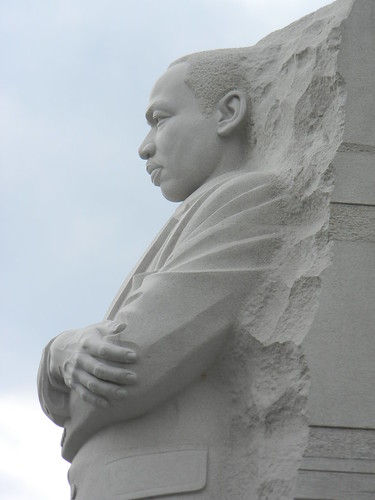
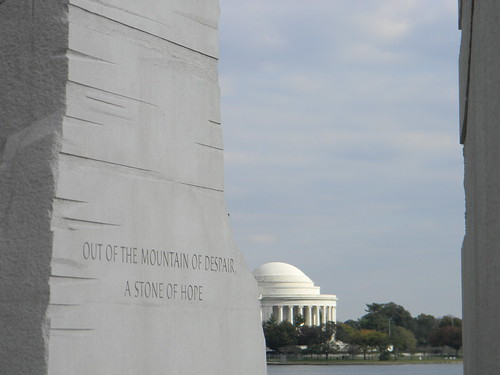
The Stone of Hope: a kind King
As we walked along the tidal basin back toward the Smithsonian Metro Station, I began to cry. Just a few tears, here and there, welled in my eyes. It wasn't the monument or the quotes. It wasn't the deep feelings I had looking at his face. It was overhearing a simple conversation. Two 30-something black women in a group of tourists were talking to one another about photos.

"You need to get your picture taken, girl," one asks the other.
"Why?" she responds, "I've got plenty of pictures."
"To prove you were here," the first woman responds.

That hit me. This place was special and meaningful, far above the power of even its creators to see. The very act of visiting the huge stone monolith needed to be documented and shared with those at home, like evidence of a hajj to a sacred spot where all yearn to stand.

During our visit we walked past an older couple, old enough to have been dating as King embarked on his final campaign for the sanitation workers of Memphis in '68. The woman pushed the gentleman in a wheelchair, both looking up reverently at King's face as they moved forward. His black hand rested on her white skin perched gently above his shoulder.

A Family and a King quote
In front of the monument a huge crowd gathered. Many were black, many were white. Everyone seemed enthusiastic to be there. They were elated just to be standing on that spot. Above the crowd arms reached, holding aloft smart phones and cameras.

Along the walls behind King, next to quotes about strength and weakness, about war and peace, about violence and justice, families posed to have their photos taken. Others studied the quotes, pondering for long minutes. Along the pathways, lining every inch of curb, groups sat. They were talking.

Stepping into the Lincoln Memorial is often like a walking into a wall of silence. Crossing the plain of the columns on the east front, the air becomes deathly still in reverence to Lincoln's gaze. But walking onto the plaza surrounding King's feet, a low murmur permeates the scene. It is not irreverent. It is simply people being people. Some I overheard discussing King or their lives or the meaning of the place. Others were planning where to eat dinner or hashing out the best route to their next stop. Some were simply taking a moment to sit a breathe, looking across the tidal basin toward the white dome in the distance. But everyone was using the park, not simply soaking it up as a static visual landscape to be consumed. They were active participants in the place.

Walking around the site, my girlfriend Jess noticed something I missed. "Look at all the disposable cameras," she remarked. She was right. There were so many people not with the latest Nikon or Kodak camera slung around their neck, or an iPhone snapping quick shots of King, but with $5 and $10 disposable film cameras. "Those people aren't here 'cause they want to be," Jess mused, "they're here because they need to be. They saved money for the Greyhound down from where ever because they had to see this. It is a need, not a want."

Not Diversity: Only A Manifestation of America
All around us, people were there because they each knew they had to be. This diverse crowd was wonderfully unlike anything I've experienced in a National Park before. The crowd didn't feel artificial like it usually does when I visit Civl War parks, with the visitors around me being very white and typically old. It didn't feel like the Martin Luther King Jr. home in Atlanta, where I felt what I can only describe as the good kind of discomfort of being the only white person in the entire park on the first day of my two-day visit. Comedian Stephen Colbert has called Washington, D.C., "the chocolate city with a marshmallow center." The neighborhoods ringing The Mall and the Federal center of the city are predominately black. The crowds on The Mall and in the Smithsonian museums (not to mention the representatives in the hallowed halls on The Hill) are predominately white. Stepping out of Smithsonian Metro Station onto the Mall or walking the few blocks down while waiting for a pull time at NARA, l'Enfant's "grand avenue" feels too lily white for a city with such rich diversity teeming in every street to the north and east.

But at the King memorial, it doesn't feel artificial. It doesn't feel like I'm alone and different. It doesn't feel like anyone is missing. The only thing surrounding me at the King Memorial this past Saturday was what defines America: ordinary people of every stripe and any color.

The most amazing thing, though, is looking beyond King's gaze. Across the tidal basin lies the Jefferson Memorial. On one side of the water stands the author of the immortal, "promissory note," that men are entitled to, "life, liberty and the pursuit of happiness." On the other side, just a stone's throw and two centuries away, stands the man who made it his life's goal to see that the, "promissory note," would be cashed for a race of men yearning to breathe free.

"We hold these truths to be self-evident..."

Thursday, July 7, 2011

Beyond the Battlefield: A Simple Matchbook and a Rabbit Hole

A couple months ago, at the annual spring Gettysburg antique show, I found a small display of Civilian Conservation Corps items. Pennants and coins, matchbook covers and pins all displayed on a piece of foam-core. One caught my eye. For $10, I became the proud owner of a matchbook cover, never used, from a CCC Camp in Gettysburg. Company 1355 was stationed at Camp NP - 2 - Pa., now known as the Boy Scout / youth camping area at McMillan woods. I was thrilled.

The piece is an interesting artifact, but nothing too curious. There are artifacts from the CCC across America, from roads and public works projects to family photo albums and mementos ferreted away in attics as reminders of America's last great economic troubles. This matchbook is not necessarily odd.

Until you realize a key fact about Company 1355: the men were members of one of the Civilian Conservation Corp's all black units. These men were stationed at Gettysburg, Lincoln's home of a, "new birth of freedom."

Baltimore Afro-American - 10 February 1934
The decision seems not to have been made lightly. Its meanings were readily apparent to the region's African-American community. When a previous CCC company was stationed at Gettysburg, the Baltimore Afro-American was keen to point out that CCC men were now working, "where Abraham Lincoln delivered his famous Gettysburg address."

The men of camp 1355 were part of the work crew which reset, "several thousand headstones," in the National Cemetery in 1935. The Afro-American declared the soldiers who rested there as, "Civil War heroes." Working in the cemetery, undoubtedly, in between good-natured jests which workers trade on long days, the men of 1935 must have thought about those men of 1863 who were buried there, Lincoln's, "honored dead." They must have thought about their lives as black men in an America whose future was uncertain.

Did they gain strength to journey on from the soldiers' willingness to die for the future of a race of men? Can we still gain that strength for our lives today?


Baltimore Afro-American - 9 November 1935

Thursday, May 19, 2011

Civil War Conclusions: What PBS' Freedom Riders can teach us

I am going to have a theoretical conversation with my good friend Mr. Strawman today...

Twitter user KismetNuñez draws her own distinct
connection between the Civil Rights revolution
of the 1960s and the banner under which
slavery made its last stand in the US.
We often have a deep problem in the Historical community. We that have gone through training and courses in "real" history, who have been trained in the academy don't know how to react when we get into the "public" history world. We step out on battlefields (or killingfields) and decide we can't trust our audiences to understand our evidence. So, we hit them over the head with a two-by-four of rhetoric. We have this deep impulse to tell people what to think about what they see on our landscapes.

The impulse makes sense. We care about these places. We care about them for specific reasons. So we lay out a brilliant thesis, we build the evidence to support that thesis and then we spring the conclusory trap and tell the audience what they should take away from the resource.

Civil War sites are certainly not alone in this impulse, but they're some of the most typical. I go on tours whenever I visit a battlefield, just as closely watching how an interpreter crafts the tour as much as what they say. Tours are organizied, far and wide on Civil War landscapes held by local communities and on the national level, around a thesis statement. "General Phineas P. Humperdink stopped the Federal assault with a charge and turned the tide of the battle."

But that's not a theme, and certainly doesn't speak to a visitor. It's an academic thesis. A theme is far more broad. We should want people to walk away feeling a site, not necessarily having been slapped in the face by an encyclopedia's worth of facts. A theme is "human suffering," or "heartache," or "pride," or "sacrifice." It is a human universal: understandable by anyone anywhere.

"But," you argue, "they're not smart enough to get it."

I think you're wrong, Mr. Strawman.

I watched American Experience's documentary Freedom Riders on Monday night. As it started, I was browsing Facebook and saw a #hashtag for the documentary: #FreedomRiders

So I watched in my living room, sitting on my couch alongside a racially diverse crowd of thousands. We cried together. We gasped together. We cheered together. Watching on Twitter was like seeing it in a crowded theatre. It was like following along with a Ranger on an interpretive program on a physical landscape.

But the genius of Freedom Riders was its structure. It has no narrator. It has no guiding voice. It is a carefully chosen oral history narrative, without a swift two-by-four of a conclusion.

So, did we get it? Let's judge by the tweets... (after the jump)