Showing posts with label Anniversary. Show all posts

Tuesday, July 23, 2013

Finding The Good: An Emotional Anniversary

I am an exacting judge of interpretive product. I realize this. My boss and I have had a few discussions about how both of our standards, sometimes, might be just a bit too high.

I still am not convinced that pure and utter excellence is not too much to ask for on every interpretive program. All too often, though, I don't find it.

When I do see amazing moments, it thrills me. I get outrageously excited. Through my entire experience as a visitor at the sesquicentennial celebration at Gettysburg, two programs stand out as verging on that sort of gleaming excellence.

The first one was on the afternoon of July 3rd. Standing at the wall, where fifteen decades before the United States was saved and slavery's ultimate demise was clinched, it would have taken effort to not offer up some meanings. They could have been rote, expected meanings. But what happened instead was something personal, something pressing beyond the simple bounds of battle mechanics and "boxes on a map."

Ranger Caitlin Kostic was offering up a moment in time. She tried to help us live as Hays' brigade, if just for a brief moment. She wasn't trying to "teach" anything. Her aim wasn't to have us walk away with knowledge, but with a feeling, a visceral moment of the fear that rippled through those men's hearts on the afternoon of July 3rd so many years before.

She helped that field sing in a way I have rarely seen displayed by LBGs, historians and rangers alike. Her short program was the embodiment of a future for military interpretation, not bogged down by excessive quotes and mechanics, but embedded in human experience and universal emotion.

By Thursday, I was spent. Monday had found me spending six solid hours leading tour groups across the campus of the College. Tuesday I wandered from site to site from noon to (literally) midnight. Then Wednesday was the sapping heat at the Angle.

But I'm a sucker for civilians. I am convinced, as I've said time and again, that the last great frontier of Gettysburg research lies in the experience of civilians and their interaction with the military landscape. So a tour focusing on the civilians, starting at the Brien Farm, was too good to pass up.

Ranger Jared Frederick led us on a short walk down the ridge line where Ijust had stood the afternoon before.

When I am on an interpretive program, my mind usually races in a continual internal monologue of, "what would I do." It can be amazingly painful when you see an interpreter tripping and missing the obvious meanings, missing the opportunities.

I leaned to a friend as Jared was speaking about the Bliss Family's farm burning on July 3rd. "That farm. The damage claim he's using covers the things you can replace, the crops, the fences, the barn. What about the family photos? The heirloom quilt?"

Then something happened that barely ever happens. Jared said nearly the same thing I had whispered. He described the Bliss' beloved collection of books and family photos, the things that when tragedy strikes can't be replaced.

My heart soared. Jared saw it. He saw where his audience could find themselves in the story, in the Bliss' experience. He put their life into terms we could understand. Not flank movements, not laundry-list damage claims, but sorrow and loss.

It happened again and again as Jared walked us down the ridge.

He let the landscape drag him around by the nose (or rather by the heart). Each place we were standing dictated the perfect story as he guided the experience. He pointed; he made sure he had things to point at. Not one of his stops felt jury rigged or awkward. Everything just fit.

Gettysburg came to life for me for a few brief moments on this most meaningful of anniversaries thanks to Caitlin and Jared. Brother and sister, you speak my mind.

Tuesday, July 2, 2013

To My Great Great Grand Uncle - On the Occasion of the 150th Anniversary of your Death

To: My Great Great Grand Uncle
From: John

On the Occasion of the 150th Anniversary of your Death

Dear William Henry,

I'm writing this standing near the spot where you died, exactly 150 years ago nearly to the second. Im typing on a tiny screen, a technological marvel that lets me share the stories of men like you with the world instantly.

They've put up a monument to you and the 17 other men who died along with you along the banks of Plum Run creek. We call this place "The Valley of Death" now. I think you among all people who have walked this green earth would understand why.

I mourn your death. I don't rightly understand why, to be honest (no offense). You've been dead a century and a half, anyone who ever loved you and hugged you and lectured you and scolded your transgressions and looked up to you as their honest son or brother is long gone.

I never knew you. And yet I mourn.

I stand in front of this cold slab of marble and bronze and I can't help but cry. I still can't tell exactly why.

God, how things have changed since you died. No, not simply since. Because you died. Men walk free because you died. Out nation is whole because you died. I can stand here and mourn you today a free man in a free nation that is always trying to extend that freedom to the darkest corners of our own nation and the globe because you died.

I wish I had known you. Not a day goes by living in this town I don't wish I could have met you. I live just up the road from where you die; your blood in this soul brought me to plant my feet here.

I am who I am because of you.

I don't know why you fought. It pains me that I don't know. Maybe it was to free 4 million men held beneath the cruel yoke of a terrible and deadly institution. You certainly grew up in a hotbed of progressive thought on who in America should be free an why we all should fight for that freedom. Maybe not.

Maybe it was because you wanted adventure. You certainly found it here, a terrible, horrific adventure from which you couldn't escape. A British author, in a children's book he wrote long after your blood mingled with this dust, wrote that, "to die will be an awfully big adventure." Maybe it was.

Maybe it was to defend your nation. You did, after all, join the U.S. Regulars, not some fly-by-night volunteer unit from Madison County. I've always thought that meant something, like you had more of a dog in this fight than just defending home or hearth. You defended that Constitution, that Declaration, that beautiful flapping flag.

I do know you wavered. I've read your private letters, and for that I apologize. Hopefully you won't mind the prying eyes of a nephew descendent glancing at your words. I know you thought about desertion in 1862.

I respect you all the more for that. Fear is natural. It's the right reaction to war. I'd be more worried if you weren't fearful, weren't scared, didn't have trepidations.

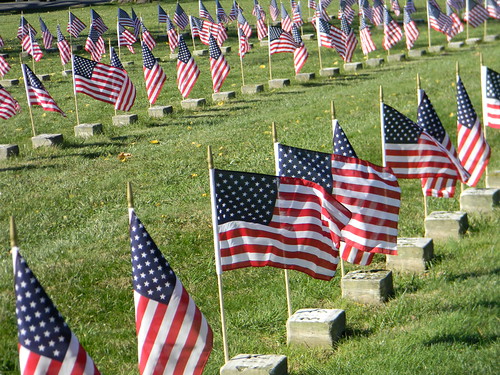
The flag I put on your monument on Memorial Day is gone, someone plucked it from its perch here. Memorial Day is the day we've set aside to honor you and all the other sainted dead who have died defending our nation.

I forgot to get a new one at the store, so I visit flag-less today. I hope you don't mind. I'm here. I hope that's enough. It's beginning to rain, big salty drops on the screen of my phone and I don't think they're coming from the clouds, but they're making it very hard to type.

So I will close for now, thanking you for everything you gave that this nation might live.

Your nephew,
John


Thursday, June 13, 2013

George C. Wallace: Schoolhouse Door to Gettysburg

George Wallace as he appeared on the
Huntley-Brinkley Report in 1963.
In the days after his famed stand in the schoolhouse door, Alabama Governor George C. Wallace attended to the business at hand on his desk in Montgomery. Wallace served as chief executive in an office in the first home of the Confederacy. One of the things awaiting Wallace on his return from Tuscaloosa was a letter from Paul L. Roy of Gettysburg.

Roy was editor of the Gettysburg Times, and was endeavoring to get letters from each governor sending their tidings of goodwill to Gettysburg on the hundredth anniversary of the momentous battle. The idea was pure. And most governors responded with purity.

Governor Endicott Peabody of Massachusetts wrote to Paul about how, "All Americans look to the green meadows of a peaceful Gettysburg today and pray for the continued and strengthened union of all the states." Pennsylvania Governor William Scranton chimed in, noting that, "Our American family is the family of mankind, and our neighbors are our brothers, whatever race or accent. Those who fought at Gettysburg waged their lives in a bloody tenant of this democratic maxim. It prevailed, and America has grown great under its guidance."

In Montgomery, George Wallace prepared to write his own letter. In Tuscaloosa, he had just made a potent statement about his vision for America. "The unwelcomed, unwanted, unwarranted and force-induced intrusion upon the campus of the University of Alabama today of the might of the Central Government," Wallace read to a crowd gathered in front of the University's auditorium, "offers frightful example of the oppression of the rights, privileges and sovereignty of this State by officers of the Federal Government."

In his own letter, Texas Governor John Connally wrote to Editor Roy that, "Today we live in a changing world which generates perplexing problems. We must not condemn these changes, nor attempt to still the hands of the clock."

On televisions around the country, Americans were still watching Governor Wallace speak his words in the schoolhouse door. "My action," he told the nation through the sleek television microphone hanging from his neck, "seeks to avoid having state sovereignty sacrificed on the altar of political expediency." Americans were hearing the rhythmic harping of Wallace against, "the might of the Central Government," and, "unwarranted actions of the Central Government," and, "illegal usurpation of power by the Central Government."

Arkansas Governor Orval Faubus wrote to Editor Roy before Wallace made his stand, before Kennedy made his speech that same night, before Medgar Evers lay in a pool of blood in his driveway just a couple hours later. But his state had known strife over school integration as well. "I think it is also an appropriate time to re-dedicate ourselves," he assured the editor and his readers, "to those principles of freedom and democracy which Abraham Lincoln so aptly expressed in his now famous and immortal Gettysburg Address." If America was to deal with the real enemy, the world's, "external dissension," it would mean quitting petty squabbles and realizing together that , "we must remain united if we are to endure as a nation."

Letterhead for the State of Alabama rolled through a typewriter in Governor Wallace's office. Hammered out on that 26-key-piano was a familiar tune.

"We must do our part to see that we remain a nation united in peace, retaining individual rights and liberties." Individual liberties, that was, save for those of Vivian Malone Jones and James Hood when they wanted to register as students at the University of Alabama. "Individual liberties must be safeguarded, for without freedom and liberty for each of us, we are traveling down the dead-end road of destructive centralization."

Wallace made a second stand in June of 1963, this time in the pages of the Gettysburg Times. And it wouldn't only be in the folds of the newspaper that Wallace would make his stand. The Governor had plans to make a special trip to Pennsylvania the first week of July.

In the Times' press room in the borough, Governor George C. Wallace's words rolled off the line inside the newspaper's anniversary edition. There his words were printed for all to read in stark lines of black and white, much like the nation that his words envisioned.

Tuesday, June 11, 2013

Memory and Meaning: Civil Rights in Lee's Backyard

I walked up the long winding path named for Mary Custis and her family home. As I ascended the steps I stopped to quickly pay my respects to Robert Todd Lincoln. But he wasn't my quarry for the day. As I came to the top of the steps, Robert E. Lee's home hove into view. I've been inside Lee's house a few times. Each time has been interesting, but relatively hollow. Those four walls lack the raw power that the surrounding acres seem to ooze.

There is a supreme irony that Lee's palatial home and estate became the resting place for thousands of soldiers who died under the flag of the nation he fought to destroy. Arlington has always seemed to me like the ultimate act of comeuppance.

I hadn't taken the day off of work to wander through the halls of Lee's mansion, though. I walk around the house to the back. Two neat stuccoed buildings flank a courtyard. Back there, I feel a bit more comfortable. Ostentatious shows of wealth and privilege tend to chafe me. When I find myself at a big, fancy function, I tend to talk to the folks serving drinks and hors d'oeuvres more than the folks wearing slick suits and speaking smartly.

Behind Lee's house are the quarters where his slaves lived. The sorrow that the ground right behind Lee's mansion must have felt could fill volumes. That ground must have soaked tears from the vocal sobs of families torn asunder and men dreaming of freedom that might never come. Some of that sorrow was pent up in hearts, unexpressed lest retribution come at the slightest mention of unhappiness at centuries of systematized forced labor.

I kept wandering westward, through Mary Custis' rose garden and the ossuary full of unknown Federal dead, sacrificed on the altar of the freedom of 4-million slaves. I settled into a seat in the Old Amphitheater and waited in the sun. A woman brought programs around. Jake sat next to me and we wondered why there was so much security. Jake pointed at the program.

"It's because Secretary Holder is here," he said.

I moved his finger. "No," I said, "Bill's coming too."

It was a surprise for both of us. We weren't there to hear President Clinton speak, we were there for Medgar Evers. Fifty years ago, as the clock rolled over from June 11th to June 12th, Medgar Evers was unloading t-shirts from his car after a Civil Rights rally when an assassin behind a nearby bush shot and fatally wounded the 37-year-old activist and father. Kennedy's televised words of assurance that Civil Rights would be ensured were still echoing across America. And now a gunshot was echoing across America too.

I sat transfixed by Clinton during the other speakers' words. I was paying attention in the same way he was paying attention: I was processing and thinking. Every so often, his hand went into his coat and drew out his pen. He would look up at whoever was speaking, think for a moment, then scribble a line or two on his draft.

Then the 42nd President rose to speak.

"But I think we should also try to avoid... the trap that all of us, particularly those of us who are no longer young, fall into when we remember. I am elated that the NAACP is trying to make sure that a younger generation of America knows and remembers, but we must avoid the temptation to confuse memory with meaning. There was meaning in Medgar Evers' life and death."

My ears perked up at the idea. Memory, commemoration, what we were gathered to do that day was not enough. Remembering, Clinton said, was not simply the answer. It was the meaning behind the past that mattered more. It was the opportunity to find inspiration to modern action in those who came before, not simply chant the old stories once again.

"When the chaplain was up here speaking at the beginning of the program, I thought all over again, it gave me chills, what we said to African-American soldiers from World War II: 'you go fight, get yourself killed, we'll give you a medal, bury you in Arlington. But if you're lucky enough to live, don't come home to the south and expect to be able to vote. Much less run for office and get elected, even if you live in a town where there are more African Americans than whites.'"

My mind skipped back to Lee's slave quarters, to the black men and women that worked the fields of Arlington and waited on Mary Custis in her palatial mansion house overlooking the fetid swamp that was (and sometimes still is) Washington City. Did some poor, enslaved black man till a field or harvest grain where Medgar Evers would one day be buried? What if he had known that long after he was dust, and his children were dust, a man would be assassinated because he thought that no matter what color your skin you should be thought of as a man first and foremost? And that man would be buried in Arlington National Cemetery as a war hero.

"The meaning of Medgar Evers' life and death is that he embraced the fundamental struggle that the great southern writer Eudora Welty said grew out of our sense of place which shapes us all psychologically, the struggle between those who believe their lives only count if they control the lives of others around them and those who feel better when they share the life around them with others, between those who think they really only count when they can dominate and those who've got sense enough to know that things only really work when they cooperate."

Change is hard. America tried to change in 1863. She desperately tried, as Lincoln signed the Emancipation Proclamation, as black men poured into the ranks, as the fight for Union morphed into a fight for freedom. And a century later, Medgar Evers crawled bleeding to his doorstep from his car, a stack of blood-soaked t-shirts scattered across the driveway in his wake reading, "Jim Crow Must Go." As Secretary of the Navy Ray Mabus noted earlier in the ceremony, "Medgar Evers, a century after the Civil War, died fighting that same battle, died to make men free. While African Americans were the obvious beneficiaries of his life's work, in a real sense, he set us all free."

Clinton continued: "It is easy to be for yesterday's change. It is easy to sanctify somebody's bones. And soon enough, we'll all be where people can sanctify ours. But the meaning of Medgar Evers' life was that he came home, and even though he had a gorgeous wife and beautiful kids and an unbelievable life to look forward to, he said, 'It can't be that I was a soldier in the American Army and I stood up for freedom and I can't vote, my neighbors can't vote. We're going back into a system that favors control over sharing, domination over cooperation and that'll never do.'"

"So the meaning of Medgar Evers' life is for all of you to say when you're confronted with any challenge today, look for the control side, look for the cooperation side and choose the right side."

I looked up at the Interpreter-in-Chief, making meaning and not simply recounting the facts of the past. I smiled. This wasn't simply commemoration or memorial for that man, that man who spent 8-years at the helm of a nation built of contradictions and fighting to overcome them everyday. This was a rededication, not of a grave or a monument, but of himself and through him ourselves to the great task remaining before us which Medgar Evers left tragically unfinished as he lay dying in a driveway in Jackson, Mississippi fifty years ago. Where does our world need change today?

That's meaning.

And a Clinton spoke, thousands of black Civil War soldiers, long gone, stood to applaud their comrade Medgar, a fellow martyr for freedom. And as Clinton, a native son of the south, spoke, Robert E. Lee rolled over in his tomb in Lexington. The nation he forsook 150 years ago, today honors a man he might very well have enslaved, all in his own backyard.

That's meaning.

Thursday, June 6, 2013

Meanings: Where This Is All Headed

Human tragedy, human triumph and continuing struggle, each of its own epic
proportions.  One convoluted war holds inside the tripartate meanings of sorrow
for 620,000 lost, joy for 4 million saved and the uneasiness that
the struggle for freedom would still continue 150 years later.

I've started to see the giddy reaction across the internet as June's dates fall off of the calendar and July looms. Folks are excited about the guns, the battles, the tactics, the camping, the reenactments, the fun, the festivities and the revelry.

But we, a community of people who all find a fascination in this awkward and cumbersome truth that we call "the Civil War," need to remind ourselves that it all had meaning, it all had a higher purpose and a greater outcome that hung in the balance.

Let's not let the fact escape us this time that battle doesn't happen in a vacuum. Armies don't appear out of thin air. They are things that are formed with a purpose and goal. That goal can shift and change as a war progresses, which is a key thing to understand as well. Events need context, and not just the context of the battle before and the battle after. They need placement within a narrative flow of history, the "why should I care?" of the present must meet the "you should care because" of the past and the two need to cogs must mesh. If we can't help America find that sort of real, personal relevance, preserving the special places of the Civil War will always be a game of diminishing returns.

For me at least, this time, 50 years on, must be about meaning and not simply memory. But more on that distinction (as well as Bill Clinton, Medgar Evers and Robert E. Lee) next week.

Thursday, May 2, 2013

Pennsylvania at Chancellorsville, But Headed Back Home

With the anniversary of the battles around Fredericksburg this week, the Civil War world's eyes seem to be turned toward Chancellorsville and the battles there. Almost as a reflex, my mind has gone there too. I've been thinking about Simon Stein Wolf, the Gettysburgian who faced death at Chancellorsville only to find it terribly displayed in the days after. So today another excerpt from my manuscript, to start re-conceptualizing Chancellorsville through the eyes of a Pennsylvania College dropout:

Far to the south of Gettysburg, in the tight thicket of trees and underbrush outside of Fredericksburg, Virginia, First Lieutenant Simon Stein Wolf, his younger brother Private Henry Wolf and the rest of Company A of the 148th Pennsylvania Infantry faced a maelstrom. Surrounded by enemy firing, with smoke billowing from every direction, the regiment fell back across a field north of Chancellorsville, rebels hot on their heels.

Dulce et Decorum? / PD LOC
The 23-year-old Simon Stein Wolf had spent a year at Pennsylvania College in 1860 as a sophomore, studying Cicero and Plato, Conic Sections and Analytical Geometry. But college life had not fit him, and he returned home to Rebersburg toting his books in his hands. Among them was an autograph book, packed with the signatures of the friends he made in that one short year of life in Gettysburg. In the book’s pages Professor Charles F. Schaeffer transcribed a passage from 2nd Timothy in German, which Wolf could have easily picked his way through hailing from deeply Deutsch Centre County. For there is one God, and one mediator between God and men, the man Christ Jesus; the professor wrote, Who gave himself a ransom for all, to be testified in due time. Sacrifice and the potential for sacrifice was on the lips and minds of everyone in Gettysburg that spring. Fellow student Joseph Potts Blymyer of the class of 1863 penned a simple Latin phrase from Horace’s Odes, a key text for the Sophomore class, “dulce et decorum est propatria mori.” Death for country would soon leave the realm of the poetic and drift into the real world.

The bawdiest of all of the small inscriptions in Wolf’s cherished book was left by Thomas Duncan Renfrew, graduating senior in the class of 1861 from nearby Fayetteville. Quoting a stanza from Sir Walter Scott’s epic poem The Lady of the Lake, Renfrew mused that although, “Our vicar he calls it damnation to sip / The ripe ruddy dew of a woman's dear lip,” that his friend should, “whoop, Jack! kiss Gillian the quicker, / Till she bloom like a rose, and a fig for the vicar!” The passage, a licentious and devilish song, is piped in Scott’s poem by a soldier.

Both Renfrew and Wolf would soon find themselves standing in Scott’s fictitious soldiers’ all-too-real shoes. Each of the young men joined the fight against the rebellion in the fall of 1862. The following May, the two Gettysburgians were desperately fighting at Chancellorsville as Federal forces streamed back toward United States Ford in front of Robert E. Lee’s dominating army. The Army of the Potomac has been crushed and bloodied. Lee took the opportunity to invade Lincoln’s union.

As the smoke of battle subsided and May crept toward June, each man would return to his native Pennsylvania. Thomas Renfrew and the rest of the 126th Pennsylvania Infantry were mustered out of service by the end of the month. The young man went home and became a teacher in Fayetteville. Simon Wolf’s war would continue through the summer, but his younger brothers’ would not. Henry Wolf died on the 28th of May, 1863. Simon accompanied the lifeless body of his brother home to Centre County, but quickly returned to his unit as Lee’s army began moving northward into Maryland and Pennsylvania. War, it seemed, was coming home, both in the guise of painful pine boxes and in living, breathing Confederate armies.

Thursday, December 13, 2012

Adventus: The Great Coming of 1862

Detail from Thomas Nast's 2-page spread in Harper's Weekly lauding Emancipation.
A couple of weeks ago, I spent a weekend in Harpers Ferry helping to interpret that amazing place for the National Historical Park's annual Christmas 1864 event. One of the greatest joys of my desk job in interpretive training is getting back out into a parkscape to test out new ideas and practices. This time it gave me the chance to experiment out in the field, wearing the olde-timey clothes of the 1860s and discussing how hammers, anvils and black labor won the war through the U.S. Quartermasters Depot at Harpers Ferry. The event is amazingly fun and infinitely powerful in its most intricate moments.

The weekend also gave me the opportunity to once again take on the annual Saturday evening lantern-light tour. Typically, that event focuses on the town's contributions to Sheridan's operations in the field in the last winter of the war.

How can you focus on the U.S. Army
Quartermaster's department when
these
images haunt your nightmares?
But this year felt like it needed to be different. Even though the event was focused on 148 years ago, my mind kept slipping back just two years further. As I planned out the program, I couldn't help but keep coming back to the idea of 1862. On the whole, very little has been focused nationally on the sesquicentennial of the first national crack in the wall of American apartheid, a crack whose size would wax and wane over the course of the next century and a half. It felt like a duty to the slaves who waited anxious in 1862 to tell their story this Christmas.

Mel Day, stalwart coordinator of the living history volunteer program in the park and the woman who taught me much of what I know about how interpretation functions, asked me what I wanted the evening tour titled. "Should I just put it down as, 'Captain Flagg's U.S. Quarter Master City: Approach of Peace 1864,' same as the event?" she asked me over the phone.

"No!" my mouth answered gruffly before I could temper it. I reeled for a minute. What to name it, I thought quickly, what to name it?

"Emerging from the Darkness: Christmas in a Land at War," I heard my mouth say.

"Did you just think that up now?" Mel asked. I answered that I had. "I don't understand how your mind works like that sometimes," Mel said. Sometimes I don't either, I thought.

I started 'reading' the audiobook of Penn Jillette's new book Everyday is an Atheist Holiday on the way in to work that week as well. His first chapter is all about Joy to the World and celebrating the mundane days (and not simply waiting for future redemption) as a way to make life really matter.

Penn's words melded with 1862, and inspired this Park Ranger. My mind was racing. Suddenly, it all fit together.

The opening stop of my tour was simple, but oh so sweet. It was one of those moments. And this is somewhat like what I said that night in the big tent, as my crowd prepared to bundle up and walk into the cold streets and back in time...

-----

We come into this place from the darkness, the cold of winter. The Civil War was a period of intense darkness for America, a time when men killed men and when America tried to tear itself apart over the question of freedom. But this time of year is also considered sacred, and has been by cultures around the globe for centuries. Dozens of cultures, across the centuries, have had a festival in the dark, cold months of the winter.

In the 1860s, in America, one of those festivals was Christmas. 150 years ago right now, America was preparing for another Christmas in a land at war, with sons in fields far flung from home.

The period before Christmas, the four weeks before, are called Advent, which comes from the latin adventus which means arrival or approach, or simply coming. Christians in 1862 were preparing for Christmas in this time of advent.

And one of the ways that Christians prepare for the coming holiday is through songs and carols. Joy to the World is one of those songs. The lyrics were first written in the 18th century by Isaac Watts. The music wasn't added until the the 1830s. Like so many great American songs, we stole that tune. It was cribbed in 1839 from Handel's Messiah by preacher Lowell Mason.

"sins and sorrows" seems the most perfect
literary description of American slavery in
three words I could ever think of.
But Watts' lyrics, Mason's song, isn't about joy in the world right now. It is truly a song of advent, looking forward to a second coming of Christ and joy still coming. "No more let sins and sorrows reign, and thorns infest the ground," is an incantation for a future, not a present.

In December of 1862, there was another advent going on, another expected coming. This advent wasn't waiting for a savior to descend but for a simple document. Months before, in September, Abraham Lincoln had penned the Preliminary Emancipation Proclamation, promising that, "on the first day of January, in the year of our Lord one thousand eight hundred and sixty-three, all persons held as slaves within any State... in rebellion against the United States, shall be then, thenceforward, and forever free."

And America began a long advent, a time of intense waiting.

For some in the South, it was waiting with dread at the potential collapse of their social structure, dread of revolt by a population living in their midst that in places outnumbered whites 3-to-1.

For some in the North, it was waiting with baited breath, incredulous at the thought that, after a long, dark night of injustice, heartache and imprisonment, that slavery could begin ending with the stroke of a pen, if only Lincoln kept his promise.

It was advent. It was a time of waiting for this world of, "sin and sorrow," to pass away and a new, different, uncertain and frightening world of freedom to take its place.

And in that time of advent, there were songs too. Songs of hope and of freedom yet to come.

One of those songs, which slaves would sing in the streets of a Virginia city south of here just a few short years later as United States soldiers marched to their salvation, went like this:

"Slavery chain done broke at last,
broke at last,
broke at last,
Slavery chain done broke at last,
Gonna to praise God 'til I die.

"Way down in that valley
Praying on my knees
Told God about my troubles,
And to help me if He please.

"I did tell him how I suffer,
In the dungeon and the chain,
And de days were with head bowed down,
And my broken flesh and pain.

"I did know my Jesus heard me,
'Cause the spirit spoke to me
And said, 'Rise my child, your children,
And you shall be free.

"Now no more weary traveling
'Cause my Jesus set me free
And there's no more auction block for me
Since He gave me liberty.

"Slavery chain done broke at last,
broke at last,
broke at last,
Slavery chain done broke at last,
Gonna to praise God 'til I die."

Freedom was coming, and America sat waiting in that long, cold advent of 1862 on pins and needles. And that song echoed backwards and forwards through that long, dark winter. Would freedom come? Would this advent end?

So now we step out into the darkness, to find the roots of that freedom. We step out to find the joy of its coming, the sorrow of its coming, the fear at its coming. We step out into the darkness to find uncertainty.

Welcome to the long dark advent of the Civil War. And as we venture into the darkness, we can take that song of hope with us.

"Slavery chain done broke at last,
broke at last,
broke at last,
Slavery chain done broke at last,
Gonna to praise God 'til I die."

Thursday, September 20, 2012

Four Days in Heaven Spending Four Days in Hell

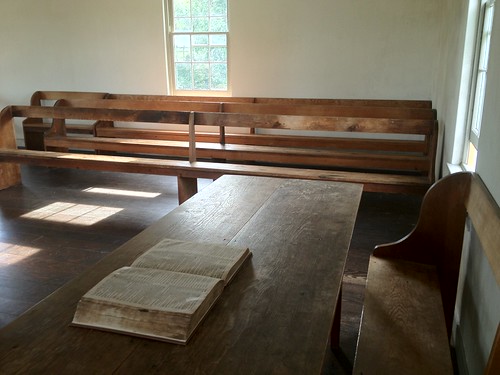
The German Baptist Brethren Bible on the front table inside the sanctuary of the
Mumma Meetinghouse, 150 years after it sat there on the eve of the battle.

I spent four days this past weekend wallowing in the depths of hell. Around me swirled the maelstrom of battle, a spinning vortex of blood, death, destruction and loss. Outside the windows, every patch of ground is a reminder of the sacrifice and heartache.

If you squinted your eyes, or better yet closed them completely, you could see it all.

The Dunker Church (more accurately called the "Mumma Meetinghouse" or "German Baptist Brethren Meetinghouse) is a purely magical place, an amazing environment in which to weave tales of meaning for visitors.

Those tales were ones of fear and trepidation, as pacifists confronted the awful prospect of war. Those tales were ones of hope and heartache, as Emancipation came within a hair's breadth of freeing the men and women enslaved on Sharpsburg's landscape, but not quite close enough in 1863. Those tales were ones of horror and shock, as Civil War photos became portals to the past and the present.

I kept getting asked the question, over and over again, "aren't you tired?"

But the opposite was true. Each interaction with a visitor refreshed me, uplifted me and brought light to my step. By Monday, I could barely hobble out of bed and slide into my green and grey uniform. But the pain was a good one, the aches were almost therapeutic.

My hat / PD NPS Photo
I had forgotten the joy of seeing someone have that moment of new appreciation for a place, whether that place be old friend or new acquaintance.

All told, I spoke to the majority of the people who visited Sharpsburg this weekend and wandered onto the battlefield. The location was prime, the crowd flow was intense, but the opportunities for meanings were limitless. From the fight against slavery to the fight over secession, from smouldering Libya to the streets of New York, the Dunker Church became a time machine allowing all of us to view ourselves from wild perspectives and amazing heights.

Tune in next week, same Bat-time, same Bat-channel and you might get a glimpse at some of the meanings I shared with visitors.

Maryland, it turns out, was an amazing, violent, vibrant, frightening and befuddling place in 1862. It only takes a time machine to visit it.

Tuesday, January 17, 2012

Anniversaries

John here... We're breaking the pattern today. I'll be posting thoughts today, Jake on Thursday this week.

It has been one year since the birth of this blog. Not one year since our first post. If you run back in our roll, the first post was February 1st 2011. Still, this blog was born on this day one year ago, or at least the ethic which leads me to post week in, week out was. I didn't even realize that fact until a few weeks ago.

I was having a conversation with my Favorite Female Wordslinger about my work on the book on Gettysburg College's Civil War history. I've been plugging away at it for just under a year. I've been a little hurt that each time I finish a chapter and offer it to her to read and give me feedback, she rejects it. "Just give me the full manuscript when it's done." I didn't quite understand. So I broached the subject.

"Well, I thought it was just a phase: one of those things you go through, like all the other projects you started and then lost interest in. I didn't think you were serious about it," she candidly replied. She's right. I have projects which I begin research on, only to find a more salacious thread to follow.

It made me stop and think to myself: why have I been this serious about this book project for so long? Why have I been doggedly fixated on posting at least once every week on this blog?

Larsen in Yosemite.
A year ago today, my friend, mentor and boss Dave Larsen died. He was fifty. His heart gave out. Two in the morning, he stood up from his bed and collapsed on the floor. They tried to save him. It didn't work.

I got the text message at about 8:15 that morning from Melinda Day, the wonderful, talented Harpers Ferry historian and interpreter who introduced me to Larsen: "Urgent please call the house phone."

Mel usually doesn't have urgent news, at least not at 8am on Martin Luther King Day. I called as soon as I saw the text on my phone sitting on the bathroom sink overnight. Standing looking into the mirror, I heard Mel's voice. "I have very sad news to tell you. Dave Larsen died last night."

Mel sounded so strong, so resolute. This woman who had worked with Larsen in the National Park Service for decades, who grew up beside him as together with their friends they hashed out what interpretation was and what it could be, was calm. I didn't know how she did it, I still don't. There was an unwavering strength in her tone that morning.

I shattered.

In the days and weeks after the funeral, I realized that Dave had crafted an amazing legacy. His book Meaningful Interpretation is on the shelf of every interpreter worth their salt in America. When he died, the hearts of a good deal of the interpretive world collapsed.

Dave Larsen didn't die a year ago. In some sense, he lives on through the words he wrote, through the ideas he forged, through the way he changed the craft. He changed how we think about what we do.

Dave and I had conversations, long rambling free-form discussions on how interpretation works, when it doesn't work and how it could work someday. I guess to some extent that's what my posts over the last year have been. My sparring partner is gone. So now I try to mull over the ideas myself. I try to roll them around in my brain and see if anything of value shakes out. I don't know if it has or not. I hope so.

Doggedly posting each week, doggedly working on my book? Part of it is trying to have the same sort of impact on the world that Dave did. But part of it is about keeping him alive, too.

On my phone, I saved the last text message I ever got from Larsen. It's simple: "Back in a few."

Wednesday, November 23, 2011

Walking Out on the Meaning: Dedication Day 2011

A Wednesday "Extra!" for you about this past weekend's events in Gettysburg...


I am a nerd. Last year on November 19th I was stuck in Las Vegas, attending the NAI conference (the same one Jake and I have been grousing about for the last two weeks). This was the first Dedication Day event I had missed since first coming to Gettysburg in 2003. I was upset. I was disconsolate. I trudged the strip dejected. I toured the Atomic Testing Museum, which was fascinating but unfulfilling. I am one of those dorks who doesn't understand how anyone can schedule anything other than a trip to Gettysburg on November the 19th. The glitz of Vegas only underlined this cold fact.

Like a scene out of the best Ray Bradbury
short story ever: Downwind from Gettysburg.
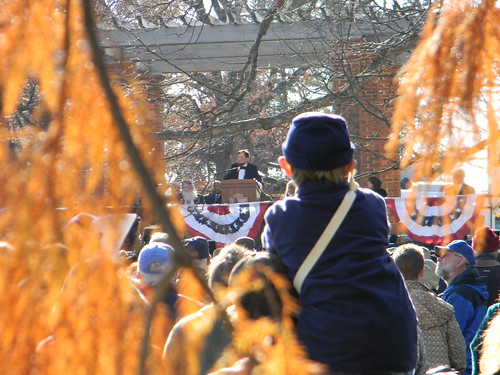
This year, I was excited to once again be in Gettysburg on a chilly November day to celebrate the speech Lincoln gave 148 years ago. The crowd was massive, larger than a typical Dedication Day. This was almost certainly due to the fact that the event fell on a Saturday this year and ended up as a double-bill with the popular-if-gaudy Remembrance Day. I have deep problems with R-day. But I have deep reverence for Dedication Day. It was nice to see some different visitors exposed to the solemn events in the cemetery and not simply the pompous ones along Baltimore Street.

A massive crowd saw Stephen Lang speak. Surprisingly, Lang's speech was good. I thought he made some excellent connections and tried to delve into a deeper meaning of that place. It certainly was not the typical exercise in expounding how little appreciation young people have for history, something which not only comes off as holier-than-thou but is often preaching directly into the choir loft when directed at a Dedication Day crowd.

Why does this video an audience member uploaded
to YouTube abruptly end after Jim Getty speaks?
But I noticed something. When Lang finished, what happened to that massive crowd? About 1/4 of it vanished, trickling away from the cemetery. Next, after a few other pieces of business, Jim Getty was introduced portraying Abraham Lincoln. Jim does a fine job as Lincoln, although I personally find his reading of the Address a bit flawed (my problem has to do with syllabic emphasis, and points out just how pedantic my knowledge of this stuff can be sometimes).

What happened after Getty closed? Another chunk of the crowd evaporated into the cold November air, streaming away. What was left looked like a typical Dedication Day crowd. Only about half of the people in the audience as there ceremony began were still there.

But why does this matter? Simply because of the deep meanings and resonances which unfolded next, after so many had left. The final activity of the day, before the Gettysburg High School band played "America the Beautiful," was a simple ceremony. Sixteen members of the audience were asked to stand as their countries of origin were announced: Armenia, Canada, China, Cuba, Dominican Republic, Germany, India, Kenya, Somalia, Thailand and the United Kingdom. Then Philadelphia district director of U.S. Citizenship and Immigrations Services Tony Bryson rose and approached the podium. He asked the candidates to raise their hands. He swore them in as citizens.

But why was this so meaningful?

No better definition of
the meaning of the Civil War...
Tony Bryson is black. He is an African American. His administration of the oath followed Lincoln's admonition to the nation that it should bloom with, "a new birth of freedom." We were at a commemoration of a speech which helped to redefine a national war fought so that men who look like Mr. Bryson were not held in coffles but were seen as citizens. This man who 150 years ago would have been looked upon by a majority of the American populace as sub-human and inferior, as something less than a citizen, was administering the oath of citizenship to new Americans of every stripe. That is the fundamental definition of an American revolution.

Lincoln's dream of a, "new birth of freedom," was palpable in the cold November Saturday morning. If only more people had bothered to stick around to see it.

Thursday, September 15, 2011

In Another Sesquicentennial

On Tuesday, Jake wrote asking who controls the memory of 9/11. The ownership of memory is such an interesting thing. This tenth anniversary was an interesting event, fraught with conflicted memory and different voices. It was intriguing to watch all of the slight conflicts which emerged last week leading up to the ceremonies on Sunday morning.

It has also been interesting to see the Civil War analogies to which a few folks, particularly John Hennessy and Kevin Levin, have pointed, viewing Civil War memory as an interesting case study of how 9/11 might be commemorated and memorialized in coming decades and centuries.

Coincidentally, I have been picking away for a few weeks now on a small thought experiment, inspired by the hot morning I spent at Manassas in July. What could the sesquicentennial of an event like 9/11, an event we have collectively sworn to "never forget," look like? Envision it as a simple piece of science fiction, like reaching forward through a hole in time 150 years and plucking out a news story on the anniversary commemoration of the attack on the Pentagon. And like all Science Fiction, it is more about the events of the present than the events of the future.

As Rod Serling, master of Science Fiction said in his introduction to the Twilight Zone episode "In Praise of Pip":

"Submitted for your approval..."


"The Defining Moment of Modern America"
Attack Anniversary Commemorations Draw Modest Crowds

Thomas Farquad for the Washington Post, Sunday, September 12, 2151

A crowd of about 650 people gathered at the west wall of the old Pentagon on Saturday morning to commemorate the 150th anniversary of the attack of September 11th, 2001. Dignitaries from District government, as well as the Commonwealth of Virginia were present.

"The men and women who fought the fires in these old walls on that day in September were brave, honest and hard working Americans," Virginia Governor Chauncey Williamson told the crowd. The Pentagon was in Virginia in 2001 when the attacks took place. The District of Columbia Statehood Act of 2076 transferred the land back to District control.

"The attack that happened here sent a shock wave through the world," the Governor remarked, "For two decades, wars were fought over the question of what our nation’s role in the world should be." Governor Chauncey said the unity seen in the years after the attack was a "blessing born from the heart of a tragedy."

District of Columbia Governor Samuel Williams, whose great-great grandfather was mayor of the city when the attacks took place in 2001, said that, "the lessons of so long ago are still relevant today." Quoting President Malia Obama, Williams reminded the crowd that, "America is fundamentally a good nation, with good intentions, good people and good morals. But we drift outside of our boundaries sometimes and need to stop to re investigate who we are."

Carter Smithson said he came to the Pentagon to honor his ancestor who died when the plane hit the building in 2001. Smithson, a clerk at the State Department, was dressed in the uniform of a 20th century army officer. "I represent my great-great-great grandfather today. These are the same types of clothes he wore when he died that day."

Smithson saw the small crowd as discouraging. "I wish more people had come out to commemorate both the awful tragedy and the unity that came out of it." Smithson sees America as a "stronger nation, more united" in the wake of 9/11.

On the opposite side of the park, Gerald Willson talked to the public about those who boarded the planes and fought for their freedom. "They were protecting their way of life," Willson told the crowd. "They were fighting for a cause they thought just."

Willson, an investment banker from Rockville, MD wore a headscarf and carried the chosen tool of the Islamic fighters on board the aeroplanes, a small knife called a "box cutter."

"I do this to make sure that the story gets told," Willson said. "Liberal historians want to focus so much on the causes of the war. They say these men were fighting to destroy America." But Willson feels the men were fighting, "in a revolution to ensure that their nations weren't tampered with." Willson said we need to, "remember the bravery of the people who fought on both sides on nine-eleven."

Anne Gerald, a systems analyst from Arlington saw the event differently. "Today is about the Americans who died here," she commented. "The men on the planes were not freedom fighters like some want to portray them, but simple murderers."

The park along the west wall of the Old Pentagon Commercial Park is open daily, sunrise to sunset and accessible from Pentagon Metro station.

Thursday, August 11, 2011

Manassas: Why They Fought Here

Replica of the flag of Company G, 4th Alabama Infantry at Manassas' 150th Celebration

Another quick observational post on the Sesquicentennial event at Manassas last month. This time, it all revolves around the Confederate living history camp adjacent to the Henry House, and more directly to the exhibit there which the reenactors entitled, "Flags of Manassas." Curiously, the flags of Manassas were only rebel banners, with nary an American flag in sight. But that's another discussion completely.

Near the end of the row of flags was the one pictured above, a first national flag with a large image of a cotton bale emblazoned across its stripes. One of the reenactors informed me it was a replica of the banner carried by the 4th Alabama, company G. The flag later became the regiment's colors. The flag was presented to the men of the 4th Alabama by the ladies of Marion, Alabama. The original is in the Alabama Department of Archives and History.

But what did the flag mean? What was that cotton bale and the large cotton plant on the canton intended to represent?

The ladies of Marion presented the proud banner to their brave men recruited from across Perry County, Alabama. Thanks to some keen numbers crunching by rootsweb user Tom Blake, we can start to get an image of what Perry County looked like on the eve of the war as men joined the army which would fight on the fields of northern Virginia. Perry County had a total of 1,045 slave owners, who held 18,206 humans in bondage. Over half of those slaves were owned by masters with 34 or more humans beings listed as their property. Perry county was a land of plantations and production farming. Commodities flowed from the fields of Perry County, picked by black hands. The flag was simply a, "beautiful device which illustrat[ed] so aptly the product of our lovely country."

So, when the regiment decided to adopt this flag as their regimental banner, what type of statement was that choice making?

To add another plot thickening and tantalizingly juicy detail to the tale, the flag purportedly flapped in the breeze near Thomas Jackson as he received the appellation, "Stonewall." There he stood, like a stonewall, fighting under a banner touting the primacy of the quintessential slave crop. What was this war all about again?

Wednesday, August 3, 2011

Manassas: Consumer Time Machine


Only a quick post this week, as I'm preparing for a few busy days in Dulles at a conference.

One of the interesting bits of interpretation I found at Manassas' Sesquicentennial event was a rarity in my book.  Oftentimes, living history volunteers place the contents of a haversack or a bedroll out on a gum blanket and simply name off the items for visitors.  Beyond this laundry list, the conversations rarely reach into the realm of drawing personal connections with the visitor's daily life or personal experiences.  The intellectual connection is well lain out, but an emotional connection is often fleeting.

But one of the living historians at Manassas hit an interpretive home run.  Look at the exhibit pictured above.  Under the right side of a fly were some original period food containers.  Then, on the left side, was the spread pictured above.  They are modern brands which find their lineage in the Civil War era.Some were regular consumer goods.  Others made their first fortunes from war.  The gentleman who was interpreting the setup was making connections for visitors.  It didn't take a leap to imagine how many of these goods sat on my shelf at home, artifacts of the Civil War in my kitchen cupboard or on my refrigerator shelves.  The connection between the past and the present was palpable in those simple bags of Eight O'clock Coffee and Lea & Perrins Sauce.

Knowing the soldiers and civilians of the 19th century ate some of the same foods I appreciate, the Civil War was alive in the supermarket of my mind.

Thursday, July 28, 2011

Manassas: On The Road Again

A few months ago I took a quick jaunt to Carlisle to see the Pennsylvania Civil War Sesquicentennial roadshow. I was heartily impressed with the quality of interpretation and exhibit design. For a rolling exhibit which needs to fold in upon itself, it was very rich and powerful. Jared Frederick, proprietor of History Matters had a nice roundup of what that exhibit comprises.

After the great experience with Pennsylvania's traveling offering, I was excited to see what Virginia, the heart of the Civil War in the East, had to offer. That's why Michael Lynch's preemptive criticism of the exhibit actually excited me. I believe that coming close to a recovered experience, trying to see the world through a historical actor's eyes, is not only possible but the ultimate opportunity for any historical interpreter to offer their visitors.

So how did Virginia's HistoryMobile stack up to Pennsylvania's? Not very well in my estimation. The exhibit was well intentioned. But the hokey execution of the first gallery cast a long shadow on the rest of the experience. The gallery was a small, dark room. Soldiers voices pipe from the darkness, discussing the coming fight. Then battle breaks out. "Battle" consisted of about a dozen and a half red LEDs embedded in the wall blinking at random intervals. Then the underbrush caught fire and an orange wash rose from one side of the room. Then the lights came up again.

To recover experience, you need to attempt to approximate experience. At a camporee as a Boy Scout, I remember going into a fire safety RV. We sat in the bedroom as simulated smoke poured into the room, setting off a smoke detector and allowing us to safely see how dropping to the ground and crawling to a window could save our lives. The experience was a safe approximation.

A simple smoke machine and some more complex lighting might have gotten the experience just a bit closer to the real. Let the visitor start to feel fear and confusion. Let them feel the distress of a confused soldier. Make realistic muzzle flashes, and not something akin to winking owl's eyes in a carnival haunted house. The battle experience gallery was a relative failure.

The next two galleries show white and black civilian experience in wartime. The first is a sparse parlour, the second an equally sparse slave cabin. Using just a few well chosen stories, the exhibit tries to convey the lives of these actors of the past. But where recovering personal experience is the goal of the first gallery, the next two are more akin to simple exhibitry. In addition, the space is cramped and tight, making soaking up the content along with the 9 other people exiting the battle gallery nigh impossible. Interactive computer panels lined the walls in both galleries, but the content did not differ from one screen to another. For so many different sensory inputs, there was very little information.

The final gallery featured the fates of citizens and soldiers, as the war was both an opportunity to gain and lose something. Walls of faces to flip and discover the fates of individuals was effective, if not novel. But the video in this last room was heartily disappointing. "Our search for a single meaning for all these places will always fail," the video states. In this, it is very much correct. But then it begins shoehorning:


  • "For the descendent of a soldier, they are places of reverence."
  • "For the scholar, places of learning."
  • "For African-Americans and immigrants, they are places associated with new-found freedom."
  • "To some they are testament to the best and the worst of humanity-the wasting effects of war."

Can a white man not feel the power of that new-found freedom? Can an immigrant not feel reverence? Can a scholar not see these places as abominations, symbols of the collapse of the human spirit? Can African-Americans not study these places for the keen excitement of their military tactics? How racist is the thought that just because you look one way or another, you automatically think of a place in a particular way?

What benefit does dictating the meanings that people walk away with after encountering the Civil War in the Old Dominion provide? Wouldn't it be far more effective to offer these visitors the opportunity to draw their own personal meanings from the war? Saying to someone, "You must care about this place because of..." is one of the surest ways to alienate them. If you allow them to explore, though, they will develop their own personal meanings for a place. When they invest their own meanings in something, they keep on caring.

The video makes the blanket claim that the Civil War was, "an event long ago that remains central to Virginia's identity. What happened in our back yards, in our towns, along our rivers and in our valleys-helped launch the American nation on a path to power and greatness." The last line is cutting in its vapid simplicity: "The union once asunder, now changed, inseparable."

What about Reconstruction? What about 100 years of racial segregation? What about the current debate over state or federal supremacy? What about the continued definition and redefinitions of what constitutes a citizen?

I know these sound like trite questions, like I am asking the exhibit to cover that which it never intended to. But then I stepped outside and watched a video on a monitor in an adjacent Virginia Civil War 150th Commission tent. Here was the conclusion that SHOULD have been in that last room in a windy, bright tent, barely visible. Covering 1865 to 2011, the video brought the Civil War full circle, showing the rough and winding path forward from the Civil War to today set to the jarring tune of Jimi Hendrix' 1969 performance of the Star-Spangled Banner at Woodstock. I tried to film it as best I could, but the video came out poorly, so I don't have anything to share. When the Virginia Civil War 150th Commission puts the video up on their site, I'll be sure to link you off to it.

Still, for a minute, just imagine what could have been possible had the organizers just let everyone draw their own conclusions from the exhibit, instead of dictating the acceptable importances of the Civil War? How many more visitors would find the place they fit within the Civil War?

Friday, July 22, 2011

Manassas: Heat of the Moment

"There stand Jackson like Mr. Universe...
Rally on the Virginians."
Before I go any further, I need to make something clear: they tried. Oh, they tried so hard. The deck was stacked against them and they gave it the old Harvard try. Heat, a weekday and more... They tried so valiantly. But they came up short.

I've been going to Civil War anniversary events at Gettysburg for nearly a decade now. They are always simply buzzing with activity. The visitors start in the wee hours of the morning and have a smorgasbord of opportunities to choose from until sundown. There is never a lack of things to do on July 1st, 2nd and 3rd at Gettysburg.

Yesterday I took a day off of work, firmly put on my visitor hat and walked into Manassas expecting much the same thing: buzzing activity from morning until night. What I got was a sparse schedule, full of holes and gaps. The morning began with the grand keynote opening. Baking in the hot sun was fine and planned for. The speeches ranged from adequate (Governor McDonnell) to outstanding (Ed Ayers) to inspiring (Jon Jarvis). The moments were interpretive and meaningful, Ayers especially showing his keen ability to breathe life into the war with a prescient sense of what would work for the varied audience.

I am no crowd counting expert, but spread across the hill could not have been more than a regiment's worth of spectators and dignitaries observing the event. The low-turnout ceremony was both streamlined and meaningful right up until the U.S. Army Drill Team emerged at the end of the ceremony. While spectators melted and wilted in the unrelenting sun, the drill team marched slowly and tossed guns in the air.

What did spinning rifles have to do with Manassas?
Couldn't they have done something more solemn,
akin to the Tomb of the Unknown Soldier?
I thought to myself, "What does this REALLY have to do with the Battle of Manassas?" I watched, less than mesmerized. I have deep respect for the 3rd U.S. Infantry's skill. But what did tossing 1903 Springfield muskets have to do with the ground upon which they were standing? It seemed more gratuitous, frivolous entertainment, ala themepark stunt shows, than measured and meaningful commemorative activity. The program ended with taps. That trumped the disjointed spectacle of the gun juggling, but the sour taste still lingered in my mouth.

The ceremony ended at 11am. Taking a glance at the schedule, no exhibit or events even would open for another hour. The visitor center's air conditioned haven was set to be shuttered for sixty minutes (it thankfully was opened earlier than scheduled). What was the crowd to do?

They boarded the shuttle busses and went back to their cars. They were given no offerings, no direction and no opportunities to engage with the ground beneath their feet. They simply gave up. Within minutes, the majority of the folks standing on Henry House Hill had left.

We stuck around, we dedicated and geeky few, and tried to take in the offerings. The pickings were slim. We could wait for an hour in line to buy postal dedications, eat some food from the concession (which also, thankfully, opened early), browse the family exhibit tent or linger for an hour for the first piece of organized interpretation to begin. Where was the bevy of various real-time and exceedingly powerful programming that a simple 148th anniversary at Gettysburg warrants?

The crowd visiting the Robinson House site.
The most heartbreaking moment for me, though, as a historian of black history, was walking out to the Robinson House site. There was little to entice visitors out on the excruciating walk to the farm site. The weekend's pamphlet said little about the site, the most tantalizingly incomplete being: "Join park rangers and volunteers at the Robinson House site for a glimpse into the life of a free black family at the opening shots of the Civil War." That was enough for me, but only because black history is my bread and butter. The Marine Corps Historical Company's firing demo was much closer and far more showy. I walked alone to the Robinson House while the majority of visitors wandered aimlessly looking for something, anything to do.

I was the only visitor at the site. The only visitor on the right flank of the Confederate line on the 150th anniversary of the battle of Manassas at the exact moment that line was aflame with musketry.

There was one interpreter beneath a small awning, Ranger Lindsey Bestebreurtje. She was patient, kind and exceedingly knowledgeable. She answered all of my questions and made a real interpretive connection between the ground and the ideas. She was the highlight of the day.

But I was the only one who met her, at least for the half-hour I was out on that knoll. I'd doubt many people had the chance to feel the power of that ground, to feel the heartache of the Robinson family as two of their sons were sold South to slavery. As Mr. Robinson hid beneath a low bridge with Federal and rebel forces streaming back and forth around his farmstead, waiting for battle to subside. As one of those young sons lost walked from the gulf coast to Manassas on hearing about the Emancipation Proclamation. Walked.

Descendants of a former slave recite the
Pledge of Allegience:
"...Liberty and Justice for All."
Meanwhile, earlier in the day, some of the descendents of the Robinsons recited the pledge of allegiance. They were introduced quite flatly, with no background as to who their ancestor was or the struggles his family went on to overcome, becoming one of the most prosperous black families in Prince William County. They were introduced by name, read the pledge and sat. I had to seek out that story. I had to hunt it down. Without Ranger Lindsey's help, it would have remained buried.

In the end, I understand it's easy to criticize from a keyboard while sporting a killer sunburn. But serious work deserves serious criticism. We all want the next event, and the next event after that, to be better and more meaningful than the last to a wider and wider audience. These critical posts aren't written with a wrecking ball impulse. Instead, it's more pruning shears, pointing to which buds might be clipped to make the prize winning rose bush even more tantalizing.

I have so much more to share about the day, but that will come as the weeks progress. The HistoryMobile is high on my list of things to discuss, have no worry. There were amazing moments and not so great moments throughout the day. I had only hoped for a larger buffet from which to choose. Too often, we came back with empty plates when we wanted to really begin to understand that important place.

Thursday, July 21, 2011

Going on a Picnic: More Tomorrow...

With the events going on today in Northern Virginia, you can be sure to expect a nice, meaty and substantive post on Tomorrow. Until then... one of my favorite pictoral envelopes from the LOC American Memory / NY Historical Society's online collection. Proof that blue humor is and always has been an American institution:

New-York Historical Society / nhnycw/aj aj89016

Thursday, June 30, 2011

Glorious Fourth: Gettysburg's Joyful Holiday, 1861

I know I promised the second half of my series on who own's black history to you all last week. And I do still promise it to you. But time slipped through my fingers this week, and I would rather devote a few more hours to ruminating on the next installment than to go off half cocked.

But I don't want to deprive anyone of good content this week, so I think we'll take a look back 150 years to what the men and women of Adams County were doing as the July 4th holiday was fast approaching. The Adams Sentinel of July the 10th reported:

A Paper in the Army.

On last Wednesday evening, about dusk, two printers in the army at Martinsburg proposed to get out a newspaper for the 4th. It was approved by the officers, and volunteer printers were called for. They stepped out by dozens, and at 10 o'clock a squad of fourteen entered the office of the "Virginia Republican," a bitter organ of the secessionists, the editor of which had closed the concern and joined the rebel army.- They struck a light, found plenty of paper, ink, &c. and went to work, and by morning had out their paper, "The American Union." It has in it the Declaration of Independence, and a number of patriotic songs, also an account of the advance of the army into Virginia, and other war items, with several other articles. When they entered the office, they found it littered with the evidence of treason, and standing on the press, "locked-up," ready to work, was a form containing several secession songs - one of which they give in the paper. Our townsman, SAMUEL VANDERSLOOT, Esq. was one of the Editors. Among the patriotic songs in the paper, is one written by him, as follows:

"THE AMERICAN UNION."
---
By S. V. Co. E. 2D Regt.
---
Tune- "Wait for the Wagon."

"The Union" is our watchword where'er our footsteps roam.
And with the friends of freedom we always find a home;
Our hearts are with our country, our eyes are on our flag;
And we will plant it North and South on plain or mountain crag.
CHORUS:- Then wait for the Union,
The proud sailing Union,
The imperishable Union,
And we'll all take a ride.

We've left our home and kindred, in quest of traitor hosts,
Resolved that we will bravely die, or drive them from our coasts:
Our fathers fought the mother when she raised the tyrant hand.
And we will whip the brother who wo'd scourge our happy land.
CHORUS- Then wait for the Union, &c.

Our wagons are "substantial," and our horses large and full.
We have pork and beef and crackers, just as much as they can pull;
All our men are "gay and happy" while there's aught of work to do,
And when they get into the battle they will "put the rebels through."
CHORUS- Then wait for the Union, &c.

Our cause is just and holy, our laws "must be preserved."
And in the work of fighting, we cannot be unnerved:
God bless our noble army-in them we all confide-
So jump into the Union and we'll all take a ride.
CHORUS- Then wait for the Union, &c.

Samuel J. Vandersloot, a 25 year old Gettysburg attorney, enlisted as a private the 2nd Pennsylvania Infantry Regiment on April 20th, 1861. Less than a month after he and his comrades published their paper, on the 26th of July Vandersloot was mustered from service at Harrisburg. Five days before, the Army of Northeastern Virginia had its nose bloodied at Manassas. Picnickers, keen on sightseeing and eager to witness the one great battle of the war became entangled on the roads among the retreating Federal forces. Civilian and soldier alike became prey to the advancing rebel forces, some captured and sent South to prison at Richmond. The nation realized this might be a longer war than 90 days. Vandersloot, for his part, escaped his short taste of soldier life unscathed. The unit never saw substantial action before being mustered out.

In Gettysburg on July 4th, 1861, bells rang and cannons fired to celebrate the birth of that nation a scant four score and five years before. After scenes of soldiers marching through Gettysburg's streets, uniforms sharp and crisp, the town processed in hacks and carriages to Spangler's Spring for a picnic, and, "an excellent one it was." One hundred and sixty people, the Sentinel reported, lounged on the meadow and in the shade of the trees on a quite and joyous summer holiday. War was as far as it could be from bucolic Gettysburg.