Showing posts with label Why They Fought. Show all posts

Thursday, July 19, 2012

An 1858 Patent Office Report: The Joy of Being Wrong

The patent volume looked
something like this.
I love being wrong. I think every historian should love that feeling. Finding that one small piece of evidence that puts a crack in your perception of the past and makes you restructure your view of the flow of history is a joy.

I had one of those moments a few weeks ago at Adams County Historical Society, digging through the vertical files for random things. I go digging every week or so, simply immersing myself in the raw material of the past and seeing what floats to the surface.

This particular Thursday night, I found a transcript of an inscription squirreled away in the files. Somewhere in the shelves, stacks and boxes of the Adams County Historical Society sits the actual volume, but where exactly it might be is unclear.

The book, an 1858 Report of the Commissioner of Patents, has a simple inscription in the cover from a wounded soldier:

I was wounded in the battle of Gettysburg on the first day of July, 1863. the ball passed though my thigh. I laid on the field of battle until night. I finally crawled to this house which I found deserted but soon a lot of Nigers Came and Ransacked the house from top to bottom. it was a good thing for them that I was Wounded I would kill a Niger as quick as I Would a frog

Mr. Ross I hope the Government Will Renumerate you for the loss and suffering War has brought upon you and your famly. if you ever feel Disposed to Write to the author of this Direct your letter to Jerry Murphy, Clockville, Madison Co.

At first glance, there's nothing that shocking about this inscription. What makes it fascinating is Jerry Murphy's heading: "Company G, 157 Regt., New York Vol."

Jerry Murphy was wounded somewhere in the fields north of Pennsylvania College as the 157th New York pushed forward into the Confederate lines on the afternoon of July 1st, part of the XI corp's desperate attempt to hold the right flank of the Federal line as Confederates poured down the Biglerville and Harrisburg roads.

He fought for the United States Army at Gettysburg, an army that by 1863 was explicitly fighting for the freedom of four million human beings held in bondage. And Jerry Murphy would kill any one of them, "as quick as I Would a frog."

What does this all mean? Many of the Murphys living in Madison County were either Irish-born immigrants or the sons of Irish-born immigrants, more than likely deposited along the way as the Erie Canal tore across New York in the 1810s and 20s, dug by cheap immigrant labor. Jerry himself was about 21 years old when he was mustered into service on the 19th of September, 1862.

The 157th Monument
at Gettysburg
/ CC Jen Goellnitz
Jerry Murphy joined the army for adventure or cash or the altruistic goal of saving a nation. That's why he marched.

So that's the death of a United States Army fighting for freedom, then, right?

Not so fast. I quickly needed to restructure how I thought about the Federal soldier.

Jerry Murphy's sovereignty ends at his hair follicles and the pores of his skin. The uniform on his back, the gun in his hand, the knapsack on his back all were bought by the United States Government, a sovereign body which, by 1863, was fighting quite publicly to destroy slavery in it's haven: the American South.

So Jerry Murphy's feet might not have been marching for freedom, but his boots were. Every forward step those boots would take into the South was the forward step of a liberating army, whether the feet agreed or not.

Suddenly, the Civil War gets that much more complicated, as men fight for causes that they don't personally agree with. Their uniform fights for one cause, their heart for another. But fight, kill and die they do nonetheless.

Jerry Murphy, who was mustered into service back in New York just as Robert E. Lee's army was beating feet across the Potomac into Virginia and just as Abraham Lincoln was dusting off a revolutionary Proclamation he had been drafting since midsummer, marched for freedom whether he liked it or not.

Wednesday, November 23, 2011

Walking Out on the Meaning: Dedication Day 2011

A Wednesday "Extra!" for you about this past weekend's events in Gettysburg...


I am a nerd. Last year on November 19th I was stuck in Las Vegas, attending the NAI conference (the same one Jake and I have been grousing about for the last two weeks). This was the first Dedication Day event I had missed since first coming to Gettysburg in 2003. I was upset. I was disconsolate. I trudged the strip dejected. I toured the Atomic Testing Museum, which was fascinating but unfulfilling. I am one of those dorks who doesn't understand how anyone can schedule anything other than a trip to Gettysburg on November the 19th. The glitz of Vegas only underlined this cold fact.

Like a scene out of the best Ray Bradbury
short story ever: Downwind from Gettysburg.
This year, I was excited to once again be in Gettysburg on a chilly November day to celebrate the speech Lincoln gave 148 years ago. The crowd was massive, larger than a typical Dedication Day. This was almost certainly due to the fact that the event fell on a Saturday this year and ended up as a double-bill with the popular-if-gaudy Remembrance Day. I have deep problems with R-day. But I have deep reverence for Dedication Day. It was nice to see some different visitors exposed to the solemn events in the cemetery and not simply the pompous ones along Baltimore Street.

A massive crowd saw Stephen Lang speak. Surprisingly, Lang's speech was good. I thought he made some excellent connections and tried to delve into a deeper meaning of that place. It certainly was not the typical exercise in expounding how little appreciation young people have for history, something which not only comes off as holier-than-thou but is often preaching directly into the choir loft when directed at a Dedication Day crowd.

Why does this video an audience member uploaded
to YouTube abruptly end after Jim Getty speaks?
But I noticed something. When Lang finished, what happened to that massive crowd? About 1/4 of it vanished, trickling away from the cemetery. Next, after a few other pieces of business, Jim Getty was introduced portraying Abraham Lincoln. Jim does a fine job as Lincoln, although I personally find his reading of the Address a bit flawed (my problem has to do with syllabic emphasis, and points out just how pedantic my knowledge of this stuff can be sometimes).

What happened after Getty closed? Another chunk of the crowd evaporated into the cold November air, streaming away. What was left looked like a typical Dedication Day crowd. Only about half of the people in the audience as there ceremony began were still there.

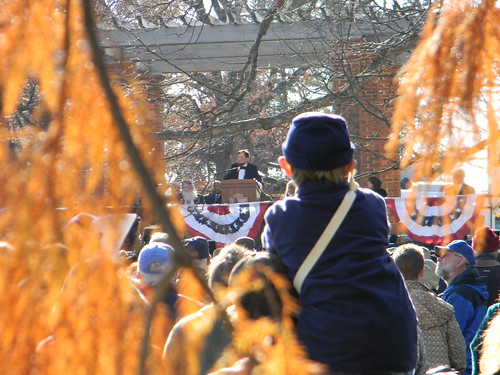
But why does this matter? Simply because of the deep meanings and resonances which unfolded next, after so many had left. The final activity of the day, before the Gettysburg High School band played "America the Beautiful," was a simple ceremony. Sixteen members of the audience were asked to stand as their countries of origin were announced: Armenia, Canada, China, Cuba, Dominican Republic, Germany, India, Kenya, Somalia, Thailand and the United Kingdom. Then Philadelphia district director of U.S. Citizenship and Immigrations Services Tony Bryson rose and approached the podium. He asked the candidates to raise their hands. He swore them in as citizens.

But why was this so meaningful?

No better definition of
the meaning of the Civil War...
Tony Bryson is black. He is an African American. His administration of the oath followed Lincoln's admonition to the nation that it should bloom with, "a new birth of freedom." We were at a commemoration of a speech which helped to redefine a national war fought so that men who look like Mr. Bryson were not held in coffles but were seen as citizens. This man who 150 years ago would have been looked upon by a majority of the American populace as sub-human and inferior, as something less than a citizen, was administering the oath of citizenship to new Americans of every stripe. That is the fundamental definition of an American revolution.

Lincoln's dream of a, "new birth of freedom," was palpable in the cold November Saturday morning. If only more people had bothered to stick around to see it.

Thursday, August 25, 2011

"Gold coast slave ship bound for cotton fields...": Altamont and the American Civil War

Yup, more on this flag...

A couple weeks ago, I put up a post about a flag flying at Manassas during the Sesquicentennial commemoration. It elicited a nice response from a friend of mine, Robby, who hails from the great state of North Carolina. Robby loves to play devil's advocate, so I'm always happy to wade further into a friendly conversation:


...When a historian is unable to understand the southern affinity for the men who fought the war, almost to a person you see the slavery straw man emerge. This action is akin to politicians playing the race card, an easy way out of a confusing and hyper complex situation. In the end, most will not understand the paradoxical nature of southern feelings about the war and its outcome. They will denigrate flags, passion, and the oft-mentioned heritage as hallmarks of a society still stuck in the throes of antebellum histrionics. This is a gross simplification cast as philosophical enlightenment that is in reality a lack of such. Group think feeds group think in the end.

OK, so here's the gist - slavery is at the core of the Confederate cause. It lies somewhere wedged in there wherever you look. It is the fundamental difference between the United States Constitution and the Constitution drawn up in Montgomery in 1861. It is Stephens' "Cornerstone." I take J.S. Mosby at his word in 1907 when he said: "The South went to war on account of slavery." Slavery is the heart of the Confederacy's philosophical reason for being.

Now, it is right that where it gets sticky is in the individual motivations. But here's my deal on that: that uniform is a real sticking point. The uniform of an enforcement officer, military or civilian, is a symbol. Put on a uniform and you are representing something. When a police officer puts on his uniform, he is no longer a citizen; he becomes the voice of the municipality he serves. When a soldier dons his uniform in a war zone like Afghanistan, he becomes the emissary and voice of the United States or Great Britain or wherever he is from. By donning that uniform, he either tacitly admits to agreeing with the policies of his nation or vows to hold his tongue to some greater or lesser extent while that uniform is on his back.

The Rolling Stones perform Sympathy for the Devil
at Altamont in 1969.
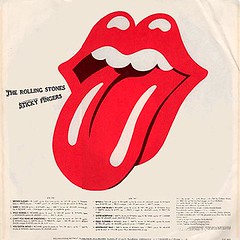
I liken it to putting on a Rolling Stones t-shirt. That set of lips and that tongue have a lot of baggage which donning that shirt conveys. That symbol says, at its base, "Goats Head Soup is a damned good album." But when you put on that shirt, you need to realize that somewhere, sometime, you are going to have to make peace with Altamont. If you put on that shirt entirely ignorant of the Hell's Angels and knives and pool cues, you nonetheless are making some minute statement about that violence by wearing those lips. By wearing the shirt you still telegraph a message. That means that if I were to ask you, "what do you think of Altamont?" the question would be both fair and germane.

The Confederate uniform, that grey or butternut tunic and pants that men wore; that Confederate (1st, 2nd, 3rd... take your pick) National Flag they carried; that rifle issued from the gates of the armories at Fayetteville or Richmond: all were potent symbols of a nation. Anyone carrying those hard iron symbols, wearing those wool symbols on their backs or marching under their symbolic cotton folds was becoming a voice of a nation through their action, regardless of their individual beliefs. Just as when seeing a set of lips on a t-shirt, it is a fair question to ask, "what do you think of Altamont?" when you see a historical figure in a gray uniform, it is a fair question to ask of them, "what did they think of slavery?" They have already opened themselves to the topic and started making a statement by their decision to put on that wool coat.

The Tongue and Lips first appeared on the album
Sticky Fingers, which featured the hit single Brown Sugar,
itself publicly debuted at Altamont in 1969.
When someone walks in front of me sporting a t-shirt with the classic Rolling Stones emblem emblazoned across their chest, I can ask them. They can answer. Soldiers of 150 years ago are another story. We need to use the evidence they gave us to give voice to their rotten throats and mouldering mouths. In the case of the flag of the 4th Alabama, we have a tangible symbol which the men left behind. They chose to represent themselves with that symbol, which helps to answer that simple question, "what do you think of slavery?" They have writ large their answer with a cotton bale and boll. They say with that flag that they valued the crops it yielded. They say with that flag that they valued the wealth and prosperity the institution brought their communities. They say with that flag that they valued slavery. They say with that flag that their cause was the property, "sold in a market down in New Orleans." It was why they fought.

So, what do I think of Altamont? That was some screwed up stuff, man. It never should have happened. It's really tough for me to listen to Under My Thumb now. The Stones' music isn't inherently violent. But the Angels and the crowd in 1969 were spoiling for a fight. Nothing could have stopped it, not even the entreaties of the Jester prancing across the stage. Altamont was an irrepressible conflict.

Thursday, August 11, 2011

Manassas: Why They Fought Here

Replica of the flag of Company G, 4th Alabama Infantry at Manassas' 150th Celebration

Another quick observational post on the Sesquicentennial event at Manassas last month. This time, it all revolves around the Confederate living history camp adjacent to the Henry House, and more directly to the exhibit there which the reenactors entitled, "Flags of Manassas." Curiously, the flags of Manassas were only rebel banners, with nary an American flag in sight. But that's another discussion completely.

Near the end of the row of flags was the one pictured above, a first national flag with a large image of a cotton bale emblazoned across its stripes. One of the reenactors informed me it was a replica of the banner carried by the 4th Alabama, company G. The flag later became the regiment's colors. The flag was presented to the men of the 4th Alabama by the ladies of Marion, Alabama. The original is in the Alabama Department of Archives and History.

But what did the flag mean? What was that cotton bale and the large cotton plant on the canton intended to represent?

The ladies of Marion presented the proud banner to their brave men recruited from across Perry County, Alabama. Thanks to some keen numbers crunching by rootsweb user Tom Blake, we can start to get an image of what Perry County looked like on the eve of the war as men joined the army which would fight on the fields of northern Virginia. Perry County had a total of 1,045 slave owners, who held 18,206 humans in bondage. Over half of those slaves were owned by masters with 34 or more humans beings listed as their property. Perry county was a land of plantations and production farming. Commodities flowed from the fields of Perry County, picked by black hands. The flag was simply a, "beautiful device which illustrat[ed] so aptly the product of our lovely country."

So, when the regiment decided to adopt this flag as their regimental banner, what type of statement was that choice making?

To add another plot thickening and tantalizingly juicy detail to the tale, the flag purportedly flapped in the breeze near Thomas Jackson as he received the appellation, "Stonewall." There he stood, like a stonewall, fighting under a banner touting the primacy of the quintessential slave crop. What was this war all about again?

Thursday, June 16, 2011

"...Sexual Relations with that Woman...": Why the Lee Quote is Still Valid

A quick reflection this week. This started as a comment on Brooks Simpson's comments on Colin Woodward's blog post at his new blog civilwarhistorian highlighting a quote he found in a Massachusetts newspaper. Whew... now that that's out of the way.

The validity of the quote has been called into question, and seemingly thereby its usefulness to the historian. But I object to consigning this tidbit to the dustbin of history.

Did this man shtup his slaves?
Is that really the most important
thing we can discover from this
account? / PD / cwpbh 03116
The quote has now been proven valid and invalid simultaneously. Colin has since posted an update at his blog offering the reading of John Neff (University of Mississippi) that the piece refers to a daughter of Parke Custis and not Robert E. Lee. So, the soldier's reading of the situation was, in essence, dead wrong. Still, there were master-slave relations at Arlington, so the concept is proven somewhat right.

This quote is like a Schrödinger's cat of the Civil War.

Does the flaw within the soldier's words render them an invalid historical source?

Certainly, they cannot and should not be used to prove that Robert E. Lee slept with his house staff. He might have. He mightn't have. We don't know the answer to that one without a solid primary source to the affirmative. This soldier's account is a far cry from a primary source, in essence being hearsay evidence of an account that was itself hearsay. Even if the facts of the case were true, this soldier did not witness the events firsthand. Neither did the woman who claims to be Lee's daughter (for a quite obvious 9-month long reason).

But is there other value in those words? Read them closely:

At the cook house for the overseer’s family I noticed an octoroon, nearly white, with fine features. She told me that her mother, long since dead was a quadroon and Gen. Lee’s housekeeper at Arlington, and to the question, ‘Was your father a colored man?’ she answered without hesitation ‘No,–master’s my father.” And this father and master now leads an army, the sole purpose of which is to establish a government founded on an institution which enslaves his own children, making his own flesh and blood saleable property!
-Soldier in Greenfield, MA Gazette & Courier, 15 June 1863

Look at that soldier's assertion. He wants desperately to believe that Lee would fight to keep his own children in slavery. It certainly has been a long war by 1863, and will only get longer. Villainizing the enemy can get a soldier through the long arduous marches and hot battles. Look at the need of this man to see the war framed starkly in the world of moral crusade, and not a simple war to save the nebulous Union.

The Confederate cause is plain in this soldier's estimation. The rebel armies march for slavery. The rebel officers command their men to victory in order to establish a slave nation. This is what the soldier finds abhorrent in the South. It is what impels him to pick up a rifle and charge into battle. It is the means he chooses to villainize Lee in his own mind. This soldier is fighting for a high ideal, indeed the highest: the freedom of another man.

So is this source invalidated just because the information it contains is false? Definitely not. It just can't be used how everyone immediately expects. The soldier's longing for the validity of the facts is just as useful to an historian. The imaginary Lee this soldier constructs is the embodiment of both the general Confederate beau idéal and the personification of the very thing he is fighting to prevent. The imagined Lee becomes a crystal clear window into this fighting man's motivation.