Showing posts with label Photopost. Show all posts

Tuesday, June 18, 2013

Stormclouds Gather on the Horizon


The first few stanzas of a poem by Howard Glyndon from the folds of The Lutheran and Missionary from late August of 1863:

The days of June were nearly done;
The fields, with plenty overrun,
Were ripening 'neath the harvest sun
In fruitful Pennsylvania!

Sang birds and children — "All is well!"
When sudden, over hill and deil,
The gloom of coming battle fell,
On Peaceful Pennsylvania!

Through Maryland's historic land,
With boastful tongue and spoiling hand,
They burst—a fierce and famished band,
Right into Pennsylvania!

In Cumberland's romantic vale
Was heard the plundered farmer's wail;
And every mother's cheek was pale,
In blooming Pennsylvania!

With taunt and jeer; and shout and song:
Through rustic towns, they passed along—
A confident and braggart throng—
Through frightened Pennsylvania.

Thursday, June 6, 2013

Meanings: Where This Is All Headed

Human tragedy, human triumph and continuing struggle, each of its own epic
proportions.  One convoluted war holds inside the tripartate meanings of sorrow
for 620,000 lost, joy for 4 million saved and the uneasiness that
the struggle for freedom would still continue 150 years later.

I've started to see the giddy reaction across the internet as June's dates fall off of the calendar and July looms. Folks are excited about the guns, the battles, the tactics, the camping, the reenactments, the fun, the festivities and the revelry.

But we, a community of people who all find a fascination in this awkward and cumbersome truth that we call "the Civil War," need to remind ourselves that it all had meaning, it all had a higher purpose and a greater outcome that hung in the balance.

Let's not let the fact escape us this time that battle doesn't happen in a vacuum. Armies don't appear out of thin air. They are things that are formed with a purpose and goal. That goal can shift and change as a war progresses, which is a key thing to understand as well. Events need context, and not just the context of the battle before and the battle after. They need placement within a narrative flow of history, the "why should I care?" of the present must meet the "you should care because" of the past and the two need to cogs must mesh. If we can't help America find that sort of real, personal relevance, preserving the special places of the Civil War will always be a game of diminishing returns.

For me at least, this time, 50 years on, must be about meaning and not simply memory. But more on that distinction (as well as Bill Clinton, Medgar Evers and Robert E. Lee) next week.

Thursday, May 30, 2013

Born in Slavery: One Grave in Chambersburg


A simple epitaph with amazing impact: "Born in Slavery, Died Feb 15 1908." Those words speak and speak loudly. Thomas Burl wanted it to be known for eternity that he was a slave. And he wanted it to be known that he wasn't when he died. That label defined his whole life. It defined who he was when he had the name "slave" forced on him when he was born. And it again defined him through its absence after 1863.

Thomas Burl knew he was free, precisely because he knew the antithesis of freedom. And he died a free man in a free land.

And now, if you wander through Mount Vernon Cemetery in Chambersburg, Burl will still be standing there to remind you what freedom means: put simply, it is the utter absence of slavery.  That's all Thomas Burl needed to know.  He told us through his epitaph that that knowledge was enough.
 
Requiescat in pace et in libertate, Thomas.

Thursday, May 16, 2013

Hearing His Voice: What Does "War" Have to Say?

     What carnage and sorrow will the next few weeks bring?  Is the sacrifice worth it?
Can the nation be saved? Can the slave be freed? The next two months will help to
answer those questions.

     Lee is formulating his plan to move northward, to invade Federal territory once again
and lean on the United States' popular will to fight. And War will see the fruits of that
decision. He'll see it all.  And we're still working to tell his tale, bit by bit.

Thursday, May 9, 2013

The Semester Ends, The Semester Begins

It's finals week at Gettysburg College, but in another time, it was just the beginning of the
oddest session of college just over 100 students would ever experience.  Some would join
the 26th PEMR, some would run home from the oncoming rebel hordes, and others would
remain in Gettysburg, sitting in the cross-hairs of the war as the slowly rested on
Adams County.

Thursday, October 25, 2012

The Whole War in One Photo


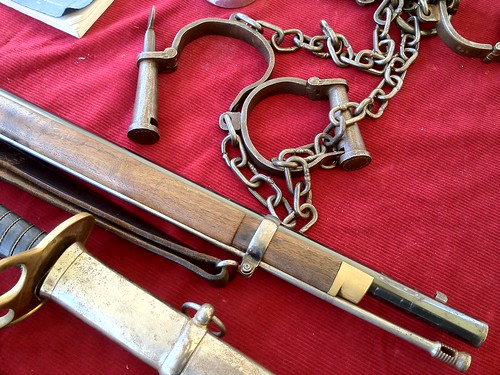
Broken chains and muskets: the very essence of the slaveholder's rebellion. The war was caused by a blind, stalwart defense of slavery. The war hinged upon the future of slavery in America. The war shattered slavery in the United States forever.

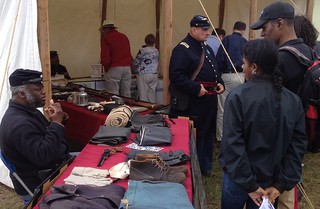
Thanks to the 3rd United States Colored Troops reenacting unit for their excellent impromptu exhibit at Gettysburg College last month (where this photo was taken) as part of the celebration of the Emancipation Proclamation.

If you missed Pennsylvania's Civil War Roadshow in it's final stops before being dismantled, you missed out on excellence. The exhibit explicitly dealt with causes, meanings and race in meaningful detail and to great extent. The touring exhibit will be installed in the Pennsylvania State Museum to, "allow a greater number of people to see and enjoy this important exhibit." Because everyone knows things without wheels reach far more people than things with wheels.

Yup.

Thursday, September 6, 2012

Defining Ourselves: What This War Was All About

For a few moments on one hot July afternoon, the future of the nation, of the very definition of
freedom, hung in the balance above this simple fence. Here white soldiers unknowingly defended a
black man's low slung stone wall, literally defending his property from the tide of an army
wishing to make him property himself. And as the straggling, defeated rebels wended their way
back across the field, the 111th New York and their fellow Federal comrades had not only defended
Abraham Brien's right to be free, but had advanced the very definition of freedom one giant leap
forward in the muggy July air.