Showing posts with label NPS. Show all posts

Thursday, February 28, 2013

Food, Fuel and Fodder: Civil War Carbon Footprints

Thursday morning finds me presenting to a group of fellow NPS folks on the possibilities of the interpretive futures. So I've dragged out some older, weirder interpretive dreaming from a few years back. It's something I worked up for my friend and boss David Larsen to prove that topics like Climate Change can be discussed from any perspective and in any context.  

But this sort of dreaming can't stay locked in drawers, left on the backs of envelopes and stuffed away in digital filing cabinets back at work.

So here's a peek at what I'm presenting. It's a way of visualizing impacts, Civil War and otherwise, on the world around us.


Trains and Horses, integrally tied.
/ PD LOC - NHNYCW
The logistics of the American Civil War were staggering. For example, the Army of the Potomac, in 1863, had 69 individual artillery batteries scattered among its six different Corps. Each of these batteries had, on average, six cannon. These cannon and their limbers were typically towed by 6 horses, giving the typical battery around 36 horses.

The guidelines for field artillery in the United States army called for each horse to receive 14 pounds of hay and 12 pounds of grain (oats, corn or barley) per day. If fed to military guidelines, one battery of field artillery required 504 pounds of hay and 432 pounds of grain each day.

Within the Army of the Potomac, if fed to military guidelines, the entire cadre of field artillery required 34,776 pounds of hay and 29,808 pounds of grain each day. For a sense of scale, a typical modern acre of corn yields about 8,000 pounds per year. A typical modern acre of hay yields between 8,000 to 12,000 pounds per year. Every day of the war, the Army of the Potomac’s artillery required about 3 ½ acres of hay and 3 ½ acres of grain.

If fed to army specifications, in a year, the artillery batteries of the Army of the Potomac would eat 10,879,920 pounds of corn and 12,693,240 pounds of hay. This is 5,439 tons of corn and 6,347 tons of hay each year of the four year war.

The armies in the field often foraged for supplies from the land, using the crops and stores of the country they occupied to feed themselves and their animals. This mass of supply, however, simply was not available. Across the entire state of Virginia in 1860, the state where the Army of the Potomac based much of its operations, cornfields did yield roughly 2 billion pounds (or 1 million tons) of corn. But two armies vied for resources in Virginia, and the theatre of operations encompassed very little of the state in the larger scope.

Suppose that even just half of the fodder required by the Army of the Potomac’s artillery (21,756 tons of corn and 25,388 tons of hay over the course of the war) was shipped to the east from the western states, most likely from a large hub like Chicago. Chicago is around 700 miles from Washington, D.C. by rail.

The amount of coal required to haul one ton of freight one mile with a mid-nineteenth century steam engine was around 6-8 ounces. Hauling 47,143 tons of freight 450 miles requires 198,000,600 ounces or 12,375,038 pounds of coal.

Burning coal emits CO2 gas at a rate of 1/2.93. For every 1 pound of coal burned, 2.93 pounds of CO2 gas are produced. If northern steam engines burned 12,375,038 pounds of coal to haul feed to the Army of the Potomac’s artillery, they produced 36,258,861 pounds of CO2 gas in a four year period.

Today’s coal power plants produce about 3,941,865,250,000 pounds of CO2 gas per year.

There are about 600 plants in the nation. If each produces roughly the same amount of CO2, this works out to 6,569,775,420 pounds per plant, per year. A plant, running 24/7, 365 days a year, produces 17,999,384 pounds a day or 749,974 pounds per hour.

Meaning, the Army of the Potomac’s Artillery’s horses fodder for the entire four years of war required a transport carbon cost roughly equal to just 48 hours of power production from a modern coal burning power plant.

This work contains material based upon or wholly the work of a National Park Service employee, created during the course of official duties. As a work of a federal government agency, such work is in the public domain and free to be redistributed, reused or remixed by anyone for any purpose.

Thursday, July 12, 2012

M'er F'ing History: Speaking in Our Audience's Language

"Share It Maybe?"
Damn skippy, Cookie! I'll share it!
It's good enough for me.
I was talking to Jake the other night about Cookie Monster. Really, we were talking about the theory behind Cookie Monster's latest strategic move and how we could all learn a thing or two from him. Which move was that? The short, furry blue monster's brilliant foray into pop culture with "Share It Maybe," the music video parody of Carly Rae Jepsen's song "Call Me Maybe." In one day, Cookie has racked up 2.3 million hits on the less-than-four-minute video.

"Why," I mused, "can't we (i.e. the National Park Service) do something like this?"

OK, so I might have been a bit more vulgar in that sentence, with an expletive or two thrown in for good measure, but I'm retelling the story so I get to make myself sound a bit more refined and all-sophisticated-like.

I quickly preempted Jake by answering the question myself: "[Expletive Deleted] Agency Voice."

There's this rote answer that folks will give to a question like mine, a question of, "why can't we do this or that cool thing?" It morphs and changes, lengthens and shortens, but it boils down to those two words (minus the Nixonian aside). "Agency voice." As a public agency, as a Federal agency, we must maintain a dignified image. According to many loud voices within the Service, we can't do something that is sly, funny, witty or slightly crude, because we run the risk of belittling the Service's reputation.

Jake shot his own retort back to me: "This is the problem though - we have tons of people who think nature and history aren't pop culture, that they shouldn't be pop culture. Why can't we have a fun agency voice? Why can't we proudly say, 'we take our job seriously, but we have fun?'"

Dignity can be wildly overrated. At times, it can even be a barrier to communications. Speak in too dignified a tone, in too snooty a language, and you'll alienate the very people you'd like to reach most. We have thick style guides in all of our jobs, the approved and set-in-stone language we must always use when speaking with the voice of our agencies or institutions or museums. Sometimes, the bravest and most meaningful thing to do with those books are to burn them to cinders.

What should we be doing more? Compare the two videos below. On the left, a C-SPAN clip attempting to convey the importance and meaning of Alexander Hamilton. On the right, a clip from the White House trying to convey an importance and meaning of Alexander Hamilton.

Go ahead, compare and contrast. Trust me.

Which video do you remember better? Which video inspired more? Which video imparted a meaning to your soul more effectively?

But would this pass a museum's sniff-test for agency voice? I know the answer I'd get from a chunk of my co-workers in the NPS: "no, this is not dignified enough, we must speak with our authority."

But then look at what Lin-Manuel Miranda's rap video has wrought: there are remix slideshows. There are cover versions. There are people finding Alexander Hamilton who more-than-likely never would have encountered him before and internalizing his story. Not simply hearing it, but caring about it, making it their own and expressing it.

When was the last time you saw an average American teenager making a slideshow with eh voice-over of a dry video of a Park Ranger talking direct to camera? When was the last time you saw an average American teenager remixing lethargic video of Shelby Foote or Ed Bearss or any other talking head in front of a wall of books?

What would happen if we all tried to emulate Lin-Manuel Miranda? What if we went out of our way to speak the language of modern Americans? That language is a pop-culture verse, sometimes hip-hop beats, sometimes bubble-gum, sometimes crass and sometimes humorous.

But wouldn't we reach America? Couldn't we tell our stories to all of America, not just the small percentage who can stand boring talking heads seated in front of nondescript bookshelves?

And isn't reaching every single American and helping them find a personal meaning within the past our sacred responsibility as public historians?

**EDIT**:
A parody?
Hell yeah!
Jake pointed out a fantastic parody of Lin-Manuel Miranda's Alexander Hamilton Mixtape produced by a comedy troupe of historical founding fathers. Yeah... nerdsplosion right there. When was the last time some interpretive product you produced was parodied word-for-word by a man in a powdered wig?

I rest my case...

Thursday, June 21, 2012

Lost and Found: Where the Iconic Meet

Gilded icons: brilliant,
striking and with deeper
meanings. / CC Cea
I know exactly when I began believing in the Muppets again. I am a child of the '80s. I was five years old when Jim Henson died. I remember watching the TV with my Mom crying beside me as Frank Oz's Fozzie, Richard Hunt's Scooter and Dave Goelz's Gonzo read to their friends the condolence letters sent by thousands of grieving fans. I remember the slow building of "Just One Person."

But somewhere along the way, I lost the Muppets. Or they lost me. "Or did something break we can't repair?" Every time I heard Steve Whitmire's voice come out of Kermit's felt maw, my heart sank. That wasn't my frog, my Kermit. For over a decade, for the better part of my childhood, the loss of Jim Henson was palpable. I held a grudge against something, someone, for taking away this frog (and the person who he embodied) I cared deeply for away from me.

Then I saw the newest Muppets movie. It was good, but it was still Steve Whitmire. It was a different Kermit, with a different voice and a different personality. Then this new voice told Miss Piggy, "it's time for our song." The crowd in the Muppet theatre applauds, and a familiar banjo patter begins. "Why are there so many songs about rainbows?" Kermit asks in song.

I burst into tears. More of the characters joined in. Eric Jacobson's Miss Piggy, Bill Barretta's Swedish Chef, John Henson's Sweetums all sing along with Kermit on the most iconic of Muppets songs. My heart broke. I sat in the theatre, next to my Mom, and cried. At that moment, Steve Whitmire became Kermit. I couldn't hear the difference in his tone or inflection. He was that frog and the frog was him.

The iconic power of the song, the raw emotional pull of its lyrics about dreams being possible coupled with its lilting banjo line, transformed a ping-pong ball adorned felt puppet into a being, a real living thing. And the iconic power of that song and it's message of hope and perseverance transformed Steve Whitmire's voice into Kermit the Frog's voice, lost for me since Jim Henson died in 1990.

Icon comes from a Greek word meaning image or likeness. But the iconic moments in our lives have more to do with the Greek Orthodox Christian interpretation of that word. Wander through the market stalls of any of the former Soviet satellite states and you will find vendors peddling small hammered metal trinkets with beautiful Eastern European depictions of the Madonna and Child or any one of a number of Saints. The icon has deep spiritual meaning. It plucks at the heart somehow. It represents a larger truth, be it God or the simple beauty of man's artwork, to the believer and unbeliever alike. It encapsulates the essence of something larger than just the sum of its parts, something greater than the wood, tin and paint from which it is made.

Interpreters share many stories. We tell tales of valiant soldiers and courageous protestors, civilian bystanders and student sit-ins. But the stories which resonate the most with an audience are those that touch the heart. Looking for the passingly iconic in history is not hard. Many things in history represent something larger than just the paper they are written upon or the ink spilled to craft them. But looking for the icons which transcend, those which possess the power to pluck the strings of any soul requires skill, practice and a bit of luck. They often hover around those magical human things we call dreams and love.

In the realm of the Civil War and Civil Rights, the transcendentally iconic often lies where these two worlds collide. It is the image of the Rev. Dr. Martin Luther King Jr. standing in the, "symbolic shadow," of the Great Emancipator in 1963. It is the farm owned by a black man where, in 1863, the future of black men's right to citizenship in the nation would hang in the balance during bloody combat. It is the bridge named for a Confederate general and slaveholder where in 1965 the sons and daughters of former slaves were mercilessly beaten for wanting something as simple as a right to vote that had been promised to them a century before.

How do you find the iconic? Sometimes it is as simple as looking for the intersections of history, where two tales crash into each other, forging a broader transcendent meaning. Sometimes it takes stepping outside of your own frame of view, to see the world from a broader perspective. Keep looking. The deep, iconic and meaningful connections are out there waiting to be found and shared.

Or as Kermit the Frog said once. And another Kermit the Frog still says today:

“Someday we'll find it
The Rainbow Connection
The lovers, the dreamers, and me.”

The Iconic floats over New York's streets. / CC Musicwala

This piece originally appeared as part of the pre-course reading material for the recent Civil War and Civil Rights training course I helped organize and conduct at work with the NPS. But that course only reached 19 students over the course of four days. Sometimes icons need to be shared with the wider world.

Thursday, May 17, 2012

"Forever Free": It's Deja Vu All Over Again

Lincoln on the morning of another
historic day in January 2009.
A friend and colleague has a great quip she uses when planning Civil War interpretation in the DC area. "Why," she asks, "would a black single mother with two daughters come to this event? What's here for her?"

It's a strawman argument, but strawmen can be useful. In essence, she's asking why the American People would come to this or that event. Why would the, "Not We," come to this event? Why would anyone who doesn't already care about this place with all their heart come out?

Those are keen questions to ask. The aim of the game here is not simply to hold the line against a setting sun of relevance, but to extend relevance to the American People.

The best example of failure on this front comes out of the Civil War Centennial. Centennial events were coordinated and planned nationally down to the most minute detail. They were structured and organized by a steering committee on high. And the center of their commemorative target was Gettysburg, as it rightly should be. Gettysburg is the cultural icon of the Civil War period, it will forever sit at the heart of the American people chiefly for the consecration of 10,000 dead men Lincoln provided. Gettysburg was an apt symbol the national committee wished to use to push their own concepts of meaning and importance.

Imagine if Kennedy had chosen to say,
"Ich bin ein Gettysburg-er," instead.
The other symbol was at once far more ephemeral and more concrete: the President. John F. Kennedy, the young, vibrant chief executive would add a sense of weight and meaning to the day. The national committee tried to get on Kennedy's schedule for July 4th, 1963, offering him the keynote speech on a day explicitly about linking military conflicts to the meaning of the war.

Kennedy refused. He went to Europe instead.

The national committee was left with a choice: find a new, less shiny headliner or restructure the whole kit-n-kaboodle.

The national planning committee's choice: they cancelled the fourth day of the celebration. They cancelled the entire day. What was the day's proposed theme and tag-line?

"Forever Free."

Fast-forward half a century and look at the coming year of Civil War Sesquicentennial offerings. Look at what we've seen so far. The United States Postal Service picked two commemorative stamps to encapsulate the Civil War in 1862: a smokey battle at New Orleans and a line of nondescript troops marching at Antietam. Tantalizingly, the word, "Forever," dangles up in the corner, as if to taunt me. The quotes splattered across the souvenir sheet of stamps are all about blood and guts.

The docket of real, in-the-flesh events this year is likewise odd looking, considering how monumental 1862 was in shifting the cause for which both sides were, now in stark in actuality, fighting for. The NPS has organized a series of "Signature" events, orchestrated by a national committee, that encapsulate the war. This year's list is blood and guts, just like the quotes on the stamps. The commemorations look just like the ones back in 1962.

You know what's missing? "Forever Free."

Where is the signature event for the Emancipation Proclamation? You can argue that Antietam fits the bill, and if the topic doesn't come up there I would be both surprised and mortified. Still, that place's commemoration will not be about Emancipation. Emancipation will inevitably be the sidelight to the blood and glory.

Where is the stage on the steps of the Lincoln Memorial on September 22nd? Where is the podium where Oprah and Morgan Freeman and (gasp) Barack Obama can celebrate (yes, celebrate!) the simple stroke of a pen that ultimately set into motion a stunning Civil Rights movements the likes of which Lincoln nor his contemporaries could imagine? Where is the massive celebration of freedom where buses can roll in from around the country, pouring forth visitors to join in as we as a nation, one voice now united, sing praise for a document which freed 4 million held in chains?

Without a keystone, signature event to celebrate Emancipation, a giant media spectacle to catch the attention of every man, woman and child in America, we stand to only reach the same old ears. Without an event that CNN, ABC News, the Today Show and BET could send their cameras to, we will be reaching the same people we always do.

Holding the line against the encroaching darkness is simply not enough. We need to spread relevance, we need to expand our tale's audience so that all of America can find meaning in the Civil War story. We should not be happy with visitation numbers that only shrink by small increments each year. They should grown.

One of the first steps toward that goal? A real, live and physical signature event celebrating Emancipation and Lincoln's courage. And who better to host such an event than the folks who guard, protect and cherish the places most integrally linked with Emancipation - the National Park Service?

EDIT / UPDATE:

Credit where credit is due... Allen Guelzo (Department chair in Civil War Era Studies at Gettysburg College and one of my bosses) adeptly pointed out on Facebook that Gettysburg College and Gettysburg National Military Park have partnered to tackle a commemoration on September 20-22nd this year. Kudos to GETT for not making the same mistakes our forebears did 50 years ago.

The challenge and need stills stands, however, for a national signature event that the press and the Hollywood jet-set can underline. The iconic landscapes of the Lincoln Memorial or the White House lawn are the ultimate tangibles when it comes to the Proclamation.

Tuesday, May 15, 2012

Meet Mr. Everyman: Everyone His Own Interpreter

Note: I originally wrote this piece for a NPS training course on Civil War to Civil Rights; I think it correctly characterizes some of my views on the theme(I love it!). Today, I thought I'd share the piece (albeit with a few edits) here as well. Enjoy.

In 1931, Carl Becker, president of the American Historical Association, the largest professional organization of historians, gave a speech in which he tried to distill history to its very essence. In that address, “Everyman His Own Historian,” Becker declared that history reduced to its lowest terms was the “memory of things said and done.” Using that simple definition, Becker argued that everyone, no matter whether they had professional training or expertise, was in some way, at some point in time, an historian. Everyone at some time in their lives did as a historian does – asks a question about the past and researches it, using evidence to come up with the most logical conclusion.

I would make the same argument for interpreters. If we reduce interpretation to its very essence, that interpretation is the facilitation of personal and meaningful connections, then similarly everyone is her own interpreter. Everyone at some point in their lives finds some sort of meaningful connection to some familiar landscape that matters to them.

What do I mean by that? Well, first off, I truly believe that everyone, no matter who they are or where they come from, can find deep meaning and true personal relevance in every historical site that is worthy of preservation. Interpreters are simply there to help them and (in some instances) get out of their way. Historic sites, at their very core, speak of human universals.

But if everyone is his own historian and interpreter, why do we need professional interpreters and or historians? This is of course a logical extension of Becker’s argument. But Carl Becker, realizing this, did not despair. He realized that historians help to serve Mr. Everyman’s emotional needs and work towards his emotional satisfaction. The historian (and interpreter) help to facilitate a connection between Mr. Everyman and the past he craves to connect with. They act as a guide and adviser to Mr. Everyman, offering advice and guidance on what might help him find meaning. As one Civil War blogger has succinctly said, “Everyman’s his own historian, but not every man is very good at it.” The interpreter helps to solve that.

Carl Becker’s piece taken as a whole was an eloquent plea for historians to be responsive to society, to the very people for which they ostensibly wrote history. That is my plea as well – we have to be responsive to the whole society we interpret for – the whole American public and not just those who already visit our historic sites. How do we, as an interpretive corps, accomplish this task? For the National Park Service, it means connecting two core historical eras they interprets – the Civil War and the struggle for Civil Rights. These two historical periods are messy. They frequently intersect, overlap, and cross paths repeatedly. They bounce off of each other too, traveling in different directions for years before finally crossing paths again. Yet too often, our interpretation of these sites is segmented, partial, and too narrow in its focus. Sometimes we miss the bigger picture, too wrapped up in our site’s specific details to see the broad forest of meanings.

Whichever area you interpret; it is history all the same. And I love history. But I love interpreting history even more. Playing with contradictions on a landscape, warping time and chronology, considering multiple and radical points of view and pitting them against each other – these are magical and transformative things you can do while interpreting that historians often frown upon when creating history. But that doesn’t matter. Interpreting is all about helping Mr. Everyman find meaning in a place and promoting his care for it. It’s not about pounding into a visitor’s head what important thing happened at this battlefield, why this historic site is important, or some broad historical thesis about why the events happened the way they did.

It is about the visitor discovering personal value in the landscape. It is about every person becoming their own interpreter.

Tuesday, April 17, 2012

Imperiled Promise: The State of History in the NPS

Imperiled Promise: The State of History in the National Park Service, a joint report between the NPS and the OAH was released a couple of weeks ago. Since then, it has been mentioned on Twitter, other blogs, on the OAH's website, and it figures to be the topic of much discussion when the NCPH and OAH meet up in Milwaukee this weekend for their annual conference. I've read the report several times now, and I have been mulling over it for some weeks. I felt now would be a proper to time to throw a couple of my reactions out there as well.

Generally, I think most of the report is dead on - it confirms much of my feelings about history in the National Parks. It feels somewhat satisfying that your fears and troubles have at least been recognized - I think we have identified in this report the major problems that National Park Service faces as an agency.

Yet, one thing not described in the report is the language barrier. Simply put, professional historians and park ranger interpreters don't speak the same language. The definition of interpretation is different in both professions, one that will be a thorn in everyone's side going forward. To me, interpretation isn't an argument about the past.  Interpretation doesn't answer the question, "Why did it happen, what it means, or why it is important to us today." Interpretation is a opportunity creator. It is speaking the language of the past, in order to help the present visitor connect to it. It offers up no primary argument about why such thing happen, instead, it explores multiple viewpoints to find meaning, never discriminating against any one single meaning. In the end, interpretation's main goal it to promote care, and whatever form it takes. It's hard for academically trained historians to grasp this - as a master's student in history, I wrestle with these conflicting views of historical interpretation all the time. And that's a good thing, wrestling with the idea. But not having the shared language sometimes makes historians and interpreters their own worst enemies.

Three of the report's findings especially rung true to me - going forward, I think fixing these problems are the key to revitalizing history in the Park Service:

#10. The Constraints of Boundaries, Establishing Legislation, and Founding Father Histories.
The Park Service really needs to break out of this mold. No interpreter can ignore meaningful events because they aren't part of the prescribed founding legislation of his/her specific site. We can't build silos at historic sites. The world is interconnected - just like it was in the past. History that happened over here relates to what over there. We need to see our historic sites as a spider web of entangled themes and ideas, that run their course and disappear, then reappear again, slightly different, as they have been transformed and molded once again to fit a different time period. We need to get over the Three Days in July Syndrome.

#11 Fixed and Fearful Interpretation.
As I've said before, give visitors everything. Show them the good, the bad, the terrible, and the unspeakable. Help them to make sense of the country's greatest moments of triumph and darkest days of despair. We need to talk about history - especially history deemed uncomfortable and or controversial.  It's hard, getting over your own fears as interpreter, whether it be over race, gender, discrimination, war, climate change or whatever other controversial subject your site deals with (most likely all of them). The NPS as a whole, has to embrace controversy, welcome it, and relish the opportunity to present the real whole history - the messy, confusing, and contradictory record of human interaction that is history.

#12 Civic Engagement, History, and Interpretation
The NPS has to take up the role of civic engagement mantle - by fostering citizens of democracy everywhere. We need to embrace the mentality of visitor engagement first at historic sites everywhere. Allowing visitors to have agency and voice, allowing them to have their say and to be heard should be mantras. But like finding #11 suggests, the NPS can't be afraid to tell visitors something they don't want to hear either...

All in all, I think the report is a good eye opener and wake up call. All that's left to do is act to keep the promise of excellent history and interpretation alive in the NPS.


Thursday, October 27, 2011

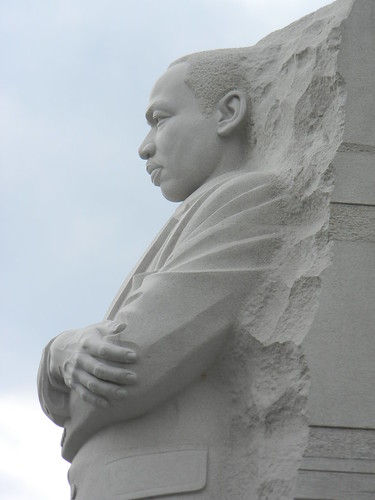
"Sit Down Together at a Table of Brotherhood": Martin Luther King Jr. Memorial

The Stone of Hope: a kind King
As we walked along the tidal basin back toward the Smithsonian Metro Station, I began to cry. Just a few tears, here and there, welled in my eyes. It wasn't the monument or the quotes. It wasn't the deep feelings I had looking at his face. It was overhearing a simple conversation. Two 30-something black women in a group of tourists were talking to one another about photos.

"You need to get your picture taken, girl," one asks the other.
"Why?" she responds, "I've got plenty of pictures."
"To prove you were here," the first woman responds.

That hit me. This place was special and meaningful, far above the power of even its creators to see. The very act of visiting the huge stone monolith needed to be documented and shared with those at home, like evidence of a hajj to a sacred spot where all yearn to stand.

During our visit we walked past an older couple, old enough to have been dating as King embarked on his final campaign for the sanitation workers of Memphis in '68. The woman pushed the gentleman in a wheelchair, both looking up reverently at King's face as they moved forward. His black hand rested on her white skin perched gently above his shoulder.

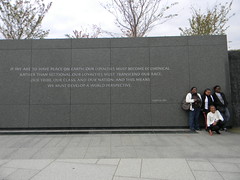
A Family and a King quote
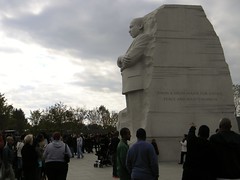
In front of the monument a huge crowd gathered. Many were black, many were white. Everyone seemed enthusiastic to be there. They were elated just to be standing on that spot. Above the crowd arms reached, holding aloft smart phones and cameras.

Along the walls behind King, next to quotes about strength and weakness, about war and peace, about violence and justice, families posed to have their photos taken. Others studied the quotes, pondering for long minutes. Along the pathways, lining every inch of curb, groups sat. They were talking.

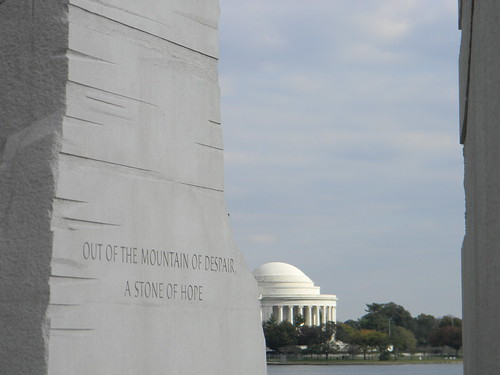
Stepping into the Lincoln Memorial is often like a walking into a wall of silence. Crossing the plain of the columns on the east front, the air becomes deathly still in reverence to Lincoln's gaze. But walking onto the plaza surrounding King's feet, a low murmur permeates the scene. It is not irreverent. It is simply people being people. Some I overheard discussing King or their lives or the meaning of the place. Others were planning where to eat dinner or hashing out the best route to their next stop. Some were simply taking a moment to sit a breathe, looking across the tidal basin toward the white dome in the distance. But everyone was using the park, not simply soaking it up as a static visual landscape to be consumed. They were active participants in the place.

Walking around the site, my girlfriend Jess noticed something I missed. "Look at all the disposable cameras," she remarked. She was right. There were so many people not with the latest Nikon or Kodak camera slung around their neck, or an iPhone snapping quick shots of King, but with $5 and $10 disposable film cameras. "Those people aren't here 'cause they want to be," Jess mused, "they're here because they need to be. They saved money for the Greyhound down from where ever because they had to see this. It is a need, not a want."

Not Diversity: Only A Manifestation of America
All around us, people were there because they each knew they had to be. This diverse crowd was wonderfully unlike anything I've experienced in a National Park before. The crowd didn't feel artificial like it usually does when I visit Civl War parks, with the visitors around me being very white and typically old. It didn't feel like the Martin Luther King Jr. home in Atlanta, where I felt what I can only describe as the good kind of discomfort of being the only white person in the entire park on the first day of my two-day visit. Comedian Stephen Colbert has called Washington, D.C., "the chocolate city with a marshmallow center." The neighborhoods ringing The Mall and the Federal center of the city are predominately black. The crowds on The Mall and in the Smithsonian museums (not to mention the representatives in the hallowed halls on The Hill) are predominately white. Stepping out of Smithsonian Metro Station onto the Mall or walking the few blocks down while waiting for a pull time at NARA, l'Enfant's "grand avenue" feels too lily white for a city with such rich diversity teeming in every street to the north and east.

But at the King memorial, it doesn't feel artificial. It doesn't feel like I'm alone and different. It doesn't feel like anyone is missing. The only thing surrounding me at the King Memorial this past Saturday was what defines America: ordinary people of every stripe and any color.

The most amazing thing, though, is looking beyond King's gaze. Across the tidal basin lies the Jefferson Memorial. On one side of the water stands the author of the immortal, "promissory note," that men are entitled to, "life, liberty and the pursuit of happiness." On the other side, just a stone's throw and two centuries away, stands the man who made it his life's goal to see that the, "promissory note," would be cashed for a race of men yearning to breathe free.

"We hold these truths to be self-evident..."

Tuesday, June 21, 2011

Slavery and Justice Today

On last week's post, the user doubleshotcanister left a great comment:doubleshotcanister makes a great point about being ever mindful of our present connections to past historical atrocities, crimes against humanity, and the other not-so-shining moments of our country's history. I agree with him. Not only do we have to come clean about our nation's past history - equally laying out the bad and good to find a useable past, but also to be cognizant of our decisions and actions today. We need to take into account how our actions relate to history by asking ourselves, "Are we in fact repeating past mistakes?" I think good public history should connect historical events with controversial topics today, for we still struggle with the same basic problems our forefathers did (in the U.S. it's namely civil rights, federalism, and the ideas of freedom and liberty). While on one hand, public history is about finding meaning and relevance in the past, it is also using that knowledge of the past to engage with the present, and its similar situations related to historical events. When we discuss slavery at Civil War sites, the feeling that we as public historians sometimes impart is that the historical issues we are presenting are in the past - and that they have no relation to events that are occurring today.

Nothing could be farther from the truth. For example, this past fall, I had the opportunity to volunteer for Cuyahoga Valley National Park's annual Underground Railroad program they do every October. The program involved conductors (such as me) who took visitors on an approximate 2-mile hike around the park at night, where the visitors had to negotiate meeting 'historic' characters of the surrounding area on their quest for freedom. The visitors met these characters in a series of several vignettes that interpreted the struggle on the road to freedom. Visitors has to ask themselves, "Can this man be trusted?" and "Who should we ask for help?" In the end, the groups are ultimately captured by slave catchers, and boarded onto one of the park trains to be taken 'south' or in the case of the visitors, back to their cars. The train ride is pitch black with the only sound coming from several volunteers singing the freedom songs of the slaves. It is a very moving program that is classic NPS interpretation. It is full of suspense, tension, and fear - all based on sound historical research of the surrounding area.

When the visitors get off the train, the lead ranger running the program is there to met them and debrief with them around a roaring campfire. The interpreter leads the group in a discussion on what the folks just experienced, teasing out of the audience their feelings and thoughts about the journey. The interpreter wraps up and sends the visitors on their way, with a call to action from today. He/she relates the story of a young child who escaped from slavery in India not to long ago and came to America to tell his story. The child went on a national speaking tour raising awareness about slavery today. Unfortunately, on a trip back to his home country, that young child who had accomplished so much, was killed by slave catchers. The interpreter reminds the visitors as they walk back to their cars, the famous words of Margaret Mead, "Never doubt that a small group of thoughtful, committed citizens can change the world. Indeed, it is the only thing that ever has."

Thank you doubleshotcanister and Cuyahoga National Park for reminding us all, that public history should, that public history needs to help visitors connect with the past in the present, and use their understanding of that past to engage with modern and controversial issues their societies face today.