Showing posts with label definitions. Show all posts

Thursday, February 16, 2012

Practical Necromancy: Raising the Dead for Fun & Profit

Spooky (and very fake)!
PD / UK Nat'l. Media Museum
Our profession is a unique and somewhat strange one. We are paid, fundamentally, to give voice to the voiceless. History is taking the people of the past and breathing into their lungs, letting them speak and act again even though they are long dead.

If I ever write a book about historical interpretation, the title Practical Necromancy: Raising the Dead for Fun & Profit is tops on my list. First, what bookstore shelf-surfer isn't going to stop and let their fingers linger on the spine of that book? Second, it describes perfectly what we do as a craft. We are necromancers. We raise the dead. Like Victor Frankenstein, we wield the power of a modern Prometheus. But our spark of life, to make of dead and cold flesh a living, breathing being, comes not from lightning but from the human voice. Our words raise the dead, like a coy incantation coaxing them from moldering tombs.

I am not talking simply about living history and dressing in old-timey clothes here, either. The Park Ranger in her Stetson hat and grey polyester shirt telling the tale of one army clashing with another army does it. The docent at a local historical society wearing a flannel shirt and glasses on a chain around his neck, explaining what this or that was used for does it. The archivist unearthing and displaying a long forgotten letter in a new exhibition does it. We raise the dead and bring them back to life, if only for fleeting moments.

Raising the dead for one last photo.
CC / Paul Townsend
When we speak and share an ancient story of a soldier's loves and hates, his wants and needs, we are helping to reanimate his lips. He explains the world he lived in to the people of today. He helps them feel what he felt, know what he knew.

One of the amazing sources I recently came across is a letter penned by Justus M. Silliman of the 19th Connecticut. The soldier worked as a hospital steward in the months after the battle at Gettysburg. In one of his letter, he explains to his mother that he, "called on Dr. Baugher president of the college and told him my situation and desire to obtain books." The President explained that the college's, "library had been complete scattered by the rebels." The Reverend ushered the soldier into his home, to his own library and offered the man a book or to on personal loan. Silliman took, "Planetary and Stellar Worlds by O.M. Mitchell, and Footprints of our Creator by Hugh Miller," down from the shelf and brought them back to his camp.

He told his mother that a friend and he were using Mitchell's book to look at the stars. You can see them, two soldiers laid out on the trampled fields around the borough, staring into the night sky searching for the Pleiades or gazing at Betelgeuse like Ptolemy had thousands of years before. During the day, death and destruction reign supreme, as men moan and shriek and die. But lying on their backs in the darkness, the possibilities of the infinite universe unfold before two lonely soldiers, desperate for anything which might, "help to pass many hour pleasantly," versus wallowing in the hell that was Civil War.

For a moment, Justus Silliman, late of planet earth, walks once more. He speaks. His fingers leaf through the pages of a long lost book, stopping to read a passage here or there until his mind is bewildered by the sheer scale of the worlds beyond his world. He lives again. And then he sinks back into that undiscovered country from which, as Shakespeare put it, whose bourne no traveller returns.

Only he doesn't fully leave the earth. A piece of him still lives within the souls of those who felt his tale. When they look to the sky and catch a glimmering star, once again he will return. And again. And yet again. He becomes immortal in the memory of man, returned to life by a helpful oratorical necromancer and the souls they reach.

Wednesday, November 23, 2011

Walking Out on the Meaning: Dedication Day 2011

A Wednesday "Extra!" for you about this past weekend's events in Gettysburg...


I am a nerd. Last year on November 19th I was stuck in Las Vegas, attending the NAI conference (the same one Jake and I have been grousing about for the last two weeks). This was the first Dedication Day event I had missed since first coming to Gettysburg in 2003. I was upset. I was disconsolate. I trudged the strip dejected. I toured the Atomic Testing Museum, which was fascinating but unfulfilling. I am one of those dorks who doesn't understand how anyone can schedule anything other than a trip to Gettysburg on November the 19th. The glitz of Vegas only underlined this cold fact.

Like a scene out of the best Ray Bradbury
short story ever: Downwind from Gettysburg.
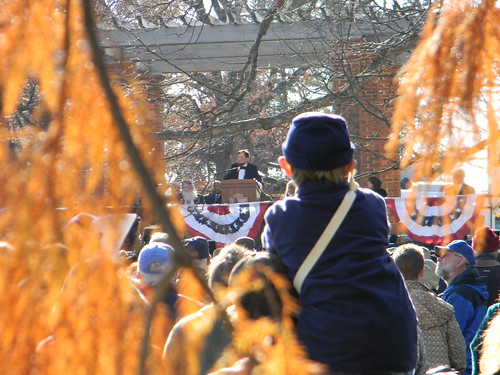
This year, I was excited to once again be in Gettysburg on a chilly November day to celebrate the speech Lincoln gave 148 years ago. The crowd was massive, larger than a typical Dedication Day. This was almost certainly due to the fact that the event fell on a Saturday this year and ended up as a double-bill with the popular-if-gaudy Remembrance Day. I have deep problems with R-day. But I have deep reverence for Dedication Day. It was nice to see some different visitors exposed to the solemn events in the cemetery and not simply the pompous ones along Baltimore Street.

A massive crowd saw Stephen Lang speak. Surprisingly, Lang's speech was good. I thought he made some excellent connections and tried to delve into a deeper meaning of that place. It certainly was not the typical exercise in expounding how little appreciation young people have for history, something which not only comes off as holier-than-thou but is often preaching directly into the choir loft when directed at a Dedication Day crowd.

Why does this video an audience member uploaded
to YouTube abruptly end after Jim Getty speaks?
But I noticed something. When Lang finished, what happened to that massive crowd? About 1/4 of it vanished, trickling away from the cemetery. Next, after a few other pieces of business, Jim Getty was introduced portraying Abraham Lincoln. Jim does a fine job as Lincoln, although I personally find his reading of the Address a bit flawed (my problem has to do with syllabic emphasis, and points out just how pedantic my knowledge of this stuff can be sometimes).

What happened after Getty closed? Another chunk of the crowd evaporated into the cold November air, streaming away. What was left looked like a typical Dedication Day crowd. Only about half of the people in the audience as there ceremony began were still there.

But why does this matter? Simply because of the deep meanings and resonances which unfolded next, after so many had left. The final activity of the day, before the Gettysburg High School band played "America the Beautiful," was a simple ceremony. Sixteen members of the audience were asked to stand as their countries of origin were announced: Armenia, Canada, China, Cuba, Dominican Republic, Germany, India, Kenya, Somalia, Thailand and the United Kingdom. Then Philadelphia district director of U.S. Citizenship and Immigrations Services Tony Bryson rose and approached the podium. He asked the candidates to raise their hands. He swore them in as citizens.

But why was this so meaningful?

No better definition of
the meaning of the Civil War...
Tony Bryson is black. He is an African American. His administration of the oath followed Lincoln's admonition to the nation that it should bloom with, "a new birth of freedom." We were at a commemoration of a speech which helped to redefine a national war fought so that men who look like Mr. Bryson were not held in coffles but were seen as citizens. This man who 150 years ago would have been looked upon by a majority of the American populace as sub-human and inferior, as something less than a citizen, was administering the oath of citizenship to new Americans of every stripe. That is the fundamental definition of an American revolution.

Lincoln's dream of a, "new birth of freedom," was palpable in the cold November Saturday morning. If only more people had bothered to stick around to see it.

Thursday, September 29, 2011

"That all men are created equal...": Universal Relevance and the Civil War

"Time circuits on...
Flux Capacitor... fluxing" /
CC by Anthony Catalano
One of my favorite movies is Back to the Future III. I know that is a terrible choice in some folks' eyes. The response I usually get is an, "ugh!" and a snarl of the lip. Still, I think there is so much going on in that film, from the struggle between fatalism and free will to the themes of love and sacrifice, heartache and heartbreak.

The reason Back to the Future III comes up in my mind today, though, is because of a dialogue within the public history world that appears to be heating up, thanks in part to both Kevin Levin and Ed Ayers (via James Loewen). The "Next Interpretive Challenge," of making the Civil War matter to an increasingly disconnected and diverse audience is crucial to the survival of the War's legacy, chiefly the emancipation ethic.

Levin, Ayers and Loewen see the great divide forming between how we service the traditional American audience (i.e. whiter, Anglo-centric audiences who have either a geographic or genealogical affinity for the war) and the new American audience (i.e. more diverse, recent immigrant populations whose ancestors lived thousands of miles from this country during the war). Their answer seems relatively clear: geography and a global view of the war.

This answer made me think of an exchange between Marty McFly and Doctor Emmett L. Brown on the rim of Clayton Shonash Ravine:

Doc - "You're just not thinking fourth dimensionally."
Marty - "Right, right. I have a real problem with that."

I'm not quite sure that Levin and the rest are thinking fourth dimensionally. They are running under an assumption that the sole barrier standing in the way of relevance for an audience of Pakistani visitors is a matter of geography. They assume that these visitors will instantly find relevance in the Civil War through any connection made between the war and Pakistan. But this forgets the simple fact that 150 years separate the Pakistanis of today from the denizens of the British Indian Empire of the 1860s. The assumption that these visitors (or any visitors) will care about any event or person of the past simply because of it's geographic location is dangerous.

Would telling a group of Pakistani tourists about Syed Ameer Ali and the Central National Muhammadan Association quest in the years after the American Civil War to win independence and freedom from oppressive British rule, and the similarities the quest had with the Abolition movement, instantly make a Civil War landscape matter to them? I'm not so sure. And furthermore, can any interpreter actually be prepared to offer that kind of relevance to any visitor of any nationality who wanders into their site at the drop of a hat? Does the inclusion of a shared geography instantly create relevance? Or is there another dimension (the fourth / time) which complicates this problem?

I'm not sure that pure geography is the right route to relevance. Too many things separate any of us, especially those without a blood connection, from the American Civil War. There seems to be a more unified solution to both the third dimensional and fourth dimensional distance which is far simpler: human universals.

No matter who walks into a Civil War site, be they a twelfth generation American or a new immigrant, we are all human. We all have wants and needs. We all have hated. We all have been proud. We all have been disappointed. We all have lost those we love and we all have found new love in others. We all have dreamed. These human universals are far more effective in helping any audience to access a site's meanings. It is my firm belief that through the lens of the human universal, we can help people see why these places might matter to them.

Why is the Civil War relevant? Certainly it is not simply because it is an American story (or a Chinese story, or a Canadian story or a Pakistani story). No. The Civil War is relevant because it is a human story.

CC by Jay Bonvouloir
That, as Marty McFly would say, is "heavy."

Thinking about how to bridge both the third dimensional gap and the fourth dimensional gap through human universal relevance, rather than trying in vain to make increasingly tenuous connections to each and every geographic locale, seems a far more fruitful endeavour.

I'll have more musings on the universal power of the human story next week, drifting back into that place where so much of our discussion of this War leads: race.

Thursday, September 8, 2011

Holy Writ: Thinking Beyond Enabling Legislation to Modern Relevance


Just a quick one today...

Why trust a bunch of dead guys? I know it sounds trite, but it's very important when we begin approaching how we talk about Civil War sites (or any historic site). Oftentimes, the folks who voted the site into existence and decided its primary reason for being are dead and gone. The world has changed radically since they were here. The pieces of legislation they created (at the federal level they're typically called "enabling legislation," at lower levels they have varied other names) were distinct products of their times. The themes and significances they outline are likewise products of their times.

Take the first military parks for example, founded in the 1890s as a place for the War Department to simply preserve and explain the battle lines of the Federal and Confederate armies. America needed unity in the wake of war (we needed unity so desperately, we went to war again just a few years later with Spain and in the Philippines). Discussing the battle tactics and battle lines, focusing on shared valor, ensured that this unity could be forged. But does this land mean the same thing 100 years later, after successive civil rights movements, social upheavals, political realignments and military conflicts which have altered the American views of war?

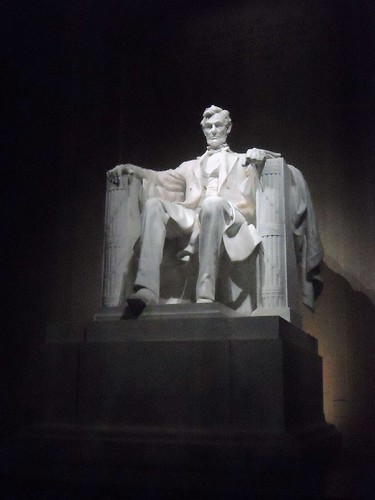
I took this photo the morning of the
2009 inauguration
. Did the meaning of this
simple piece of marble shift somehow that day?
Significance changes... significance even disappears. People change. They shift historical memory through their actions. The meanings of the past change with every successive year. What do we do when significance wanes or shifts? Do we lament? Do we vainly fight the tide and dictate that the old significance is the only valid one, in spite of the fact that it may no longer be relevant to a modern audience? Do we cling to our enabling legislation's statements of meanings as if they are holy writ to be followed for never-ending perpetuity? Or do we instead shift with the significances which Americans see fit to attach to these places and begin embracing their meanings? Do we let the people that own these places decide why they are important?

What are these historic sites and battlefields all about? To me, it has to be about helping visitors find their own personal meaning for the ground beneath their feet. This means that there are no correct resource meanings, only personal resource meanings. My personal meanings for a site are never the only ones I should offer to visitors. A dictatorship of meaning, imposing my views on a visitor, is just as bad as a visitor finding no meanings for a site. In the end, interpretation fails when the visitor is not provoked to think about meaning.

In the end, enabling legislation is not sacrosanct. Only the Visitor is Sovereign. The meanings they find for our battlefields are the only ones that matter. It's about how a modern audience finds these places useful and meaningful. Anything else doesn't really matter.