Showing posts with label Race. Show all posts

Thursday, July 18, 2013

Stewart W. Woods: A Peculiar Casualty at Fort Wagner?

There Be Squalls Ahead: This post deals with historical uncertainty and represents some research-in-progress. This story is still half-researched and needs some more work. Viewer discretion is advised.

Captured in the darkness of July 18th on a sandy beach in South Carolina was a native of Adams County. Stewart W. Woods, born in Heidlersburg around 1836, found himself in the hands of the rebels, among a handful of his compatriots in the 54th Massachusetts. The fighting of Woods' war was over and his fate was unclear. Stewart was a free man, born under the folds of the same American flag under which he now fought. At some point, he had drifted over the mountain range and called Carlisle home when the war erupted in 1861.

But in summer of 1863, Woods' native county was still stumbling bewildered, blindsided by the realities of war. Now Stewart Woods was blindsided by the realities of war too, far from home and excruciatingly vulnerable in the hands of the rebel army. In the 54th Massachusetts, Private Stewart W. Wood was an oddity, perhaps entirely unique.

Stewart W. Woods was white.

Are these the comrades of a white
enlisted man? / PD LOC
In his Compiled Service Record, Stewart W. Woods' complexion is listed as "white." His eyes were blue, his hair was brown. In the 1850 and 1860 census, although Stewart himself doesn't readily appear, there are no black Stewart households in Cumberland County.

One of the larger Woods families in Cumberland County in 1860 was headed by Richard Woods esq, a 56-year-old farmer. According to the shadowy and somewhat insubstantial world of the Underground Railroad in Pennsylvania, Richard Woods was purportedly a local conductor. Richard Woods' son Samuel was the same age as Stewart Woods.

Why might Stewart W. Woods have been marked down as "white?" Was his skin just very light? But it isn't marked as "light" in the CSR, but clearly "white."

Led away from Fort Wagner, Stewart Woods wasn't dragged to Andersonville or any of the other Southern prisons penning in hundreds of loyal American soldiers. Instead, he and his compatriots became the awkward nucleus of a truly weird set of legal circumstances, as he and his fellows were tried by South Carolina's governor that August for slave insurrection. The soldiers were stripped of their uniforms, treated as common criminals and held inside Charleston's City Jail, where forty years before Denmark Vesey and his co-conspirators had been held under identical charges.

But why would a white man undergo such torture? If Woods was white, might he have been in the 54th Massachusetts precisely because he was white? Perhaps as in the South for generations light skinned black men had attempted to pass as white for a measure of freedom, Stewart Woods attempted to pass as black (all it would take was 1/8th of your lineage) in order to fight in a unit truly fighting for freedom.

In August of 1863, a criminal trial was called and the captives of the 54th were charged under South Carolina law for conducting a slave rebellion. But the case fizzled; the court decided that the charges overstepped South Carolina's jurisdiction. The soldiers were marched back to the city's prison and held there like criminals for nearly another year and a half, no real trial or charges. And Stewart Woods got sick.

Whether Stewart W. Woods was a white man on a moral crusade isn't precisely clear. But that Private Stewart W. Woods was on some sort of moral crusade is clear. Just a month before he was captured, the 54th Massachusetts marched through Darien, Georgia. Though Robert Gould Shaw reportedly called the burning of the town a, "satanic act," Woods was content leaving a clear, proud calling card of who had torched the town in slave-holding Georgia. Woods plucked a book from some soon-to-be-charred shelf and scribbled his name in the cover. "STEWART W. WOODS, was born September 21, 1834... Hidlersburg [sic], Adams County, Pennsylvania. 54th Massachusetts Volunteers." He followed those lines with the name of the unit again, content with te flag he fought under and the men he fought beside: "54th regiment, Massachusetts Volunteers, of Col. SHAW." So proud was he of his commanders that he noted all of their names; Shaw, Pope, Higginson and Tucker all were mentioned in the inscription.

Then Woods left the book to be found by the citizens of Darien as they wandered back into their wrecked city, wood framed walls charred black like the slaves their state had brokered in for hundreds of years. The book became his calling card, the signature he wrote on the inferno-artwork.

Months had passed from that day when Woods proudly burned Darien, Georgia, set torch to sin. By the spring of 1865, he was a shell of a man, the swampy and insanitary conditions of a city jail cell in a tropical city did their worst. He and his compatriots were exchanged in March of 1865, but it was too little, too late. Just 10 days after coming back to Federal lines, in a general hospital in occupied Wilmington, North Carolina, Stewart W. Woods succumbed to typhoid fever.

Should one of these faces be white?
What else don't we know about the USCT?
Was Stewart W. Woods white? Was he the only white soldier in the ranks of the 54th Massachusetts? Did he do it for Abolitionist fervor?

He did seem to take glee from a town meeting the torch, a town in a nation fighting to enslave men who looked like those who marched beside him. And Stewart Woods, whether white or black, fought for the destruction of a cancerous institution which had, for centuries, been strangling the vital American organ: liberty.


Special thanks to Chris Barr from Andersonville National Historical Site for some clarification and fascinating info on the men of the 54th Massachusetts who were captured during the battle at Fort Wagner. Andersonville has been doing gangbusters work under leadership of Chief of Interpretation Eric Leonard. Check out their Facebook page later today for more about the weird and amazing story of all of the 54th's captured's odd journey to everywhere but Andersonville.

Undoubtedly, Stewart W. Woods will continue to bother my historian's brain until this story gets more solid evidence. There
is a mother's pension application at the National Archives submitted for Woods. Hopefully that application can help pin down more certain details about Woods' race, life and death. Stay tuned.

Tuesday, April 2, 2013

Wilmington: A World Turned Upside Down

Fifes and drums from Tennessee play
The World Turned Upside Down.
There's an old myth that, as he ordered the flag brought down and the post at Yorktown surrendered, General Cornwallis ordered his fife and drum corps to play The World Turned Upside Down a traditional British Christmas song written in protest of the aristocracy outlawing raucous celebration. In its lyrics, the paupers are made kings and the kings made paupers. The song was more than likely not played during the surrender. But myths are often potent and always telling.

I've been thinking of that tune lately. And I've been thinking of Wilmington, North Carolina. The number of times I've watched (and listened to) Spielberg's Lincoln is now up into the teens. Each run through I'm noticing more and more. I'm now to that stage where you mouth lines along with Mr. Slade and anticipate the coming scenes viscerally.  And the carnage at Wilmington sits central to that film; it's a lynchpin of the plot that embeds itself deeper each time I watch.

Wilmington's also been on my mind because I've made two trips down in as many weeks to see my parents in their new adopted city.

Back in November, when I visited for Thanksgiving, we took a trip over to Fort Fisher. It was an odd site, an odd tour and an interesting experience. We wandered the site with a state park ranger, who was quite folksy and nice. We ended up talking more about Gettysburg than Fort Fisher (the curse of mentioning you're from Gettysburg is that every Civil War person wants to talk about your home rather than theirs), but I picked up enough of the vibe of the place to understand.

Before we left, I told my Dad we needed to visit Battery Buchanan. It was the final fallback position of the retreating rebel forces. It's where the battle at Fort Fisher ended. It's where the world turned upside down.

Dad stayed in the car; rain was beginning to fall. Mom stayed at the wayside; the remains of Battery Buchanan were too steep for her. But I needed to climb it. It's a simple mound of sand. But it was deeply powerful climbing up the dune.

At the top, I looked out. The words of Chaplain Henry Turner still rang in my mind from the fort's museum exhibit: "Indeed, the white troops told the rebels that if they did not surrender they would let the negroes loose on them." The white rebels cowered behind the Battery as the blue soldiers swept in toward them. Behind the sand dune hid a world which was dying. On the other side stood triumphant a world turned upside down.

The rebels from Fort Fisher surrendered to a federal column led by the 27th United States Colored Troops. They were black. Just a few years before, they weren't citizens in the eyes of the law. Now they were soldiers. And they were men.

And if cats should be chased
Into holes by the mouse,
If the mammas sold their babies
To the Gypsies for half a crown,
If summer were spring,
And the other way 'round,
Then all the world would be upside down.

Tuesday, February 19, 2013

In Plain Black and White: Race & Gettysburg, Winter 1863

"Kinkyheads," the Gettysburg Compiler gleefully quipped at the bottom of a column in its February 23rd edition, "is the new title used for Abolitionists." This was, of course, "in contradiction to 'Copperheads.'"

Race was the live wire of Gettysburg's political scene. For the roughly 10% of the borough's population that was black, that live wire must have shocked daily.

Still, the local community soldiered on. "The 'Americans of African descent,' connected with the A. M. E. Church in this place," the Republican Adams Sentinel announced on February 10th, "intend holding a Festival for the benefit of their Church, on the evening of the 23d inst." The meeting would take place, "in a large room on Washington street, near the church." The editor was convinced that the meeting would, "doubtless be patronized by a full house."

What happened in that meeting isn't recorded. But imagining the scene isn't hard. Patriotic meetings abounded throughout the North as the war limped toward its third year. And a people whose fate was tied to the war being fought would have naturally turned toward the struggle just south of their homes. Were there songs? Were there speeches? Was there talk of Lincoln's new Proclamation? Of the Negro Soldier Bill? Of the chance to fight for their own freedom?

Gettysburg's white population, though, was concerned too with the fate of those blacks in the Third Ward and their compatriots held in chains. The Compiler, by Sentinel editor Robert G. Harper's estimation, "raises the cry of 'Abolition—Abolition,' to divert the public censure from his disloyal articles. Still, Harper concluded, "he cannot get clear of the shirt of Nessus, with all his endeavors to do so, by shouting aloud—the Negro—the Negro—Abolition—Abolition!"

How the heads of Gettysburg's black community must have watched dumbstruck as the white establishment blithely debated their fate, like some cosmic tennis match where the ball bandied back and forth was the very definition of freedom and the players were blissfully unaware that the stands were filled with the freed-or-not-freed-depending.

"Our neighbor of the Sentinel," Compiler editor Henry J. Stahle wrote from his new office along Baltimore Street, "is very crusty under the charge of being an Abolitionist." Harper, Stahle wrote, "took passage on the rickety and suspicious vessel, 'Negrophobia,' in the face of the counsels of the best men in the nation, some of them leaders in the old Whig party, and if he goes down with her, he will have no one to blame but himself."

On Washington Street a block over from Stahle's newspaper office, the black community of Gettysburg (like the rest of the, "Americans of African descent,") sat in that selfsame bark, their term for it, "Freedom," and not, "Negrophobia." And for them, if it sank, it meant rack and ruin.

Robert Harper fired back at Stahle, noting that the editor, "appears to have no other day or night dreams, (if we are to judge from the articles in his paper) than the terrible bugaboos, the Negro, and Abolition." Pronouncing Stahle's ramblings, "much wildness, and queer—very gueer language there," Harper tiptoes on the line of rebuffing Stahle's wind but not the accusation of being an Abolitionist. Still, faint praise can also be damnation.

In the same issue where he adeptly avoided confirming or denying an Abolitionist bent, Robert Harper printed a notice of the success of the fair held by the black community. The, "Festival last night," he penned in his pages, "we learn was quite a success, and that a handsome sum will be realized."

Stahle's estimation of the fair was markedly different. Beneath an account of the Quaver Club's Concert held the same night cribbed nearly word-for-word from the Sentinel, Stahle laid into the A.M.E. Fair. "The Festival of the 'Americans of African descent,' on Monday evening, was, we are told, largely and liberally patronized by 'black spirits and white,'" the editor wrote, skillfully making sure to point out this definitely wasn't from first hand knowledge. Still, the support was a farce, put up by the, "Union League," for the express purpose of denigrating and showing up the white community of Gettysburg, "because on the same night 'white folks' had a Promenade Concert at Sheads & Buehler's Hall."

The next week, Stahle ran a piece from the Patriot & Union on black soldiers. "This State is overrun with agents from Massachusetts seeking negro recruits for he unfilled quota of the army," Stahle's pages echoed the Harrisburg newspaper's refrain. The black soldiers were being recruited for the nascent 54th Massachusetts Regiment (Colored). "Massachusetts may have all the negroes she can raise from this quarter," the Patriot & Union blithely concluded.

But in the Third Ward, Gettysburg's citizens weren't passive creatures. They had hopes and dreams. They had fantasies of true freedom for all and a future safe from fear of slave catchers drifting across Pennsylvania's porous border. They were no one's fools. It's just that they didn't have a newspaper to call their own. So the white folks a block away set the type, and the black folks lived their lives, fighting the war in their own way that today is largely invisible.

Still, glimmers of those dreams peak through the darkness.

Later that spring, as the cold of winter was melting into the warm of April, in a camp in far away Massachusetts, a new recruit filled out his paperwork to join the 54th. His name was James T. Russell. He was 35 years old. He stood 5 foot, 8 1/2 inches tall. His skin was dark, his eyes brown, his hair black. His place of birth?

The clerk wrote down the words on the form: "Gettysburgh, Penna."

Thursday, October 25, 2012

The Whole War in One Photo


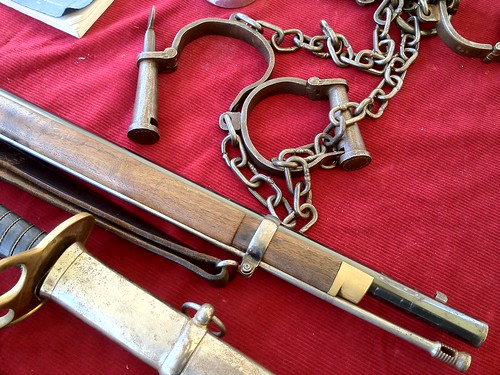
Broken chains and muskets: the very essence of the slaveholder's rebellion. The war was caused by a blind, stalwart defense of slavery. The war hinged upon the future of slavery in America. The war shattered slavery in the United States forever.

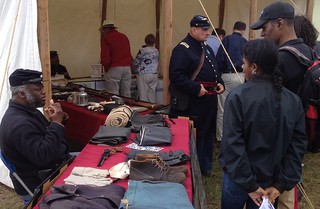
Thanks to the 3rd United States Colored Troops reenacting unit for their excellent impromptu exhibit at Gettysburg College last month (where this photo was taken) as part of the celebration of the Emancipation Proclamation.

If you missed Pennsylvania's Civil War Roadshow in it's final stops before being dismantled, you missed out on excellence. The exhibit explicitly dealt with causes, meanings and race in meaningful detail and to great extent. The touring exhibit will be installed in the Pennsylvania State Museum to, "allow a greater number of people to see and enjoy this important exhibit." Because everyone knows things without wheels reach far more people than things with wheels.

Yup.

Thursday, March 29, 2012

Kingdom Comin': The Largest Slave Rebellion in U.S. History

Violence begets violence; oppress
someone long enough and they
will rebel. / PD LOC LC-USZC4-2523
Over at Present in the Past, Michael Lynch recently posted a provocative question and accompanying video about slave revolt. It got the wheels in my head turning. It also helped that Monday night was my first lecture scheduled on my course syllabus to dig into the "political war." My mind's been swimming with concepts of violence and resistance, freedom and slavery.

So what was the largest slave rebellion in U.S. History? That requires a key definition: what is a slave rebellion?

Toussaint-Louverture and his fellow revolutionaries in the Saint-Domingue rebellion, one of the first truly successful slave revolutions in world history, certainly throw light on one necessary ingredient: blood. The Haitian Revolution's iteration of slave rebellion was truly violent work, undertaken by one race of men against another race in response to their subjugation in spite of the master class espousing the tenants of freedom. For Toussaint-Louverture, that master race were the French. Violence was the first national language of Haiti.

Prosser's slave Gabriel, planning his revolution at the turn of the 19th century amid the growing state capital at Richmond, likewise chose violence as his language. But Gabriel more than likely had fewer than 30 allies. On Bastille Day, 1822, Denmark Vesey planned to rise up with a few more than a hundred slaves to strike Charleston, South Carolina. The plan leaked and it went no where. Just shy of a decade later, down the road in Southampton County, Nat Turner likewise echoed the idea of violence in service of freedom. Nat Turner's rebellion saw an army of as many as 200 slaves rising up to kill over 50 local whites.

The LearnLiberty.org link Michael posted on his blog points to the Black Seminole revolt, claiming that John Horse and his fellows, "led the largest slave revolt in U.S. history." But I'm not so sure that's true.

The largest slave revolt in U.S. history involved nearly 5,000 slaves from Alabama, rising up to strike a blow against their masters. Over 5,000 more joined in from South Carolina. Mississippi saw over 17,000 black folks seize arms and draw a bead on the master class. Nearly 25,000 men from Louisiana joid the fight to secure freedom. All told, nearly 100,000 black men from across the South rose up in this slave rebellion, carried guns and killed those who would see them manacled and sold to the highest bidder. With them were nearly 80,000 black allies from the North, joining the fight alongside their enslaved brethren. This mass of men, in open and hostile rebellion against a government and economic system which would see them reduced to chattel, blows any other slave rebellion out of the water in a test of scale.

Never since the world began was a better chance offered to a long enslaved and oppressed people. The opportunity is given us to be men. With one courageous resolution we may blot out the hand-writing of ages against us."

The American Civil War could be seen, after the Emancipation Proclamation offered black men throughout the United States the opportunity to, "be received into the armed service of the United States," as the greatest slave rebellion in U.S. history. Much like the wildest dreams of John Brown, Nat Turner or Gabriel Prosser, black men were now marching across the South, physically destroying the institution with every bullet they fired and forward step they took. They were grasping manhood, proving their mettle and speaking a language of rebellion.

Striking a blow for freedom.
/ PD LOC LC-USZC4-2519
The hour has arrived, and your place is in the Union army. Remember that the musket – the United States musket with its bayonet of steel – is better than all mere parchment guarantees of liberty. In your hands that musket means liberty...."
-Frederick Douglass, 1863

What happens when we, for a moment, think of the Civil War as the largest American slave rebellion?

It's a familiar, simple game of language, I will admit. These games, though, are instructive. They throw a new perspectives onto the war, forcing us to see the war through fundamentally different eyes and from radically different perspectives. Was that thrilling emotion felt by a USCT soldier donning his uniform and firing his gun for the first time really all that different than the emotion felt as Nat Turner's men swung axes against their masters' skulls? Both times, men were simply responding to a violent system with the only language that system would understand: violence.

Thursday, October 13, 2011

The Race of the Interpreter: "I'm Not Going To Spend My Life Being A Color..."

I am often put into an interesting place when recounting the tales of history. My passion is the history of race and abolition, the Civil War and the development of Civil Rights in the wake of the memory of our great fratricidal conflict. I'm white. Yet I am never afraid to broach the subject of race. Stephen Colbert's character on The Colbert Report often mentions that he doesn't, "see color." I would never be that bold. But I will say that I try to ignore color when I am interpreting to an audience. Put an audience of white visitors in front of me and I'll still tell them about the black characters in the drama of American history. Put a group of black visitors in front of me and I'll help them to see the landscape through any historical eyes, black or white.

Perhaps I'm naive, but I don't think there is such a thing as white history and black history. I think there is history. Some of the characters are white and some are black. All are intriguing.

I am not so naive to think that race has had no bearing on history. In fact, that's quite a bit of what I study. I delve deep into the minds of racists wearing hoods and lighting crosses on Civil War memorial landscapes. Likewise, I try to see the world from the lenses of racial egalitarians on quests to destroy a vial system of slavery based solely on a slight difference in pigmentation. I look at the evil and good in human character. But I can draw inspiration from the black characters in these narratives just as easily as white, in spite of my own skin color.

Why do I bring this up? I've been mulling the concept of black history for a while. Back in January, Kennesaw Mountain National Battlefield Park released a report on prospective black visitors to their site. One of the questions and a few of its answers have stuck in my mind, rolling around.

The survey leaders from Kennesaw State University posed the following question to their focus groups: "If you visited Kennesaw Mountain or another Civil War site today, what would be your expectations regarding the historical and cultural interpretation of the American Civil War?" Two answers stick out to me.

Imagery. We need to see people who look like us - Black people - to feel comfortable. They need to be part of the staff and decision-makers.

&

We keep getting people from, no offense, these big universities up north somewhere to come down and to tell us about the south. We need to invite people who look like African Americans – not just our White friends… We need people from the Talladegas, the Tugaloos, the Tuskegees, because they have kept a record of this history… We really need to bring the people who have lived these experiences.

I've asked the question of who owns black history before. The question still resonates with me. I understand the desire for diversity in the workplace and the world. I want to see every color everywhere. That's the very definition of America.

But can a white face tell a story about a black face and black hands? What did these respondents mean when they said, "we need to see people who look like us," and, "we really need to bring the people who have lived these experiences." In the case of the Civil War and slavery, those who, "lived these experiences," are long lost to us. Instead, we have their stories left. Why does it matter who tells that story?

The report's compilers suggested that Kennesaw, "consult with researchers, local historians and experts at HBCUs for consultancy opportunities to uncover African American history." HBCUs are wonderful resources. I had the pleasure of visiting Tuskegee University last year and sitting down for a chat with a brilliant student Park Ranger with a true passion for Booker T. Washington and the Civil Rights movement of the early 20th century. But even he would not have said that black colleges are the sole arbiters of the history of Americans of African descent.

This past summer, as part of my experimental programming on John Brown, my tour explicitly featured one white and one black character. The twin pillars of Thomas Boerly and Dangerfield Newby can help illustrate the pure tragedy of John Brown's Raid on Harpers Ferry. But I saw tears in the eyes of white folks over Newby's struggle against slavery to free his wife and children in bondage in Virginia. I saw tears in the eyes of black folks as I narrated the tale of Thomas Boerly, struck dead in the streets of Harpers Ferry while trying to defend his family from harm as his adopted home came under attack.

There are no black tears. There are no white tears. There are only tears. In the end, it shouldn't matter whether the characters in our stories are black or white. It should matter that they're human and that their struggles move our souls. Likewise, it shouldn't matter what color skin our interpreters have, but instead we should judge the content of their tales and their ability to move us.