Showing posts with label Controversy. Show all posts

Thursday, October 18, 2012

Why The "Harvest of Death" Doesn't Matter (And Why It Does)

I went on a tour a few Sundays ago. It was very tough to explain exactly what I had done (in sensible terms) with my coworkers when I came into the office the next Monday morning. Not just very tough, but embarrassingly tough.

THEM: "What did you do this weekend, John?"

ME: "Well, Sunday I went on a tour of places on the Gettysburg battlefield where one specific photo wasn't taken-"

THEM: *blank stare*

Garry posing a stand-in at a place
where the photos were not taken.
That conversation really tends to go nowhere, frankly. Tim Smith and Garry Adelman toted around 60 eager visitors as we patrolled the battlefield at Gettysburg, visiting the places that aren't where the Harvest of Death series of photographs, Alexander Gardner's enduring battlefield mystery, could have been taken. We crossed the Sherfy Farm to set foot in Mr. Spangler's fields. We stood just north of the Wentz House and squinted at Little Round Top. We wandered around behind the former Keefauver Elementary site and ended in a driving rainstorm along Reynolds' First Corp Line. And throughout the day, at stop after stop, Garry and Tim unfolded for us why the Harvest of Death could not have been taken at that place.

Much time, hot-air and many electrons have been expended on this topic of late, spurred on by a few publicly expressed theories (many of which end up being rehashes of long discounted theories). Particularly, John Cummings over at Spotsylvania Civil War Bloghas been hammering relentlessly on his theory. In turn, Garry has been urging caution in publicizing new theories before they've been vetted and the author him or herself has vehemently tried to prove themselves wrong.

I spent 5 hours out on the field on Sunday, in a quest to learn about a landscape to better find a photo's true location. But in the end, it doesn't matter at all.

I'll repeat that and emphasize it: the actual location of the Harvest of Death and the other photos taken nearby does not matter at all.

He had eyes and a nose.
He had loves and sorrows and joys...
It might be nice to know. Garry expressed as much during the tour. He said he'd like to lie down where the men lay, in the exact spot. He wants to be able to feel the real. I understand that sentiment. It's part of the reason we preserve these places. We want to touch the proverbial pieces of the true cross.

But in a larger sense, finding the site means nothing. The men are gone. The bodies have long since rotted. Either they were moved to the Soldier's National Cemetery when the bulk of the Federal dead were reburied in the winter of 1863-64, or they rest in an undiscovered and likely never to be found grave somewhere in the Pennsylvania topsoil.

The burial crew has found their own home in the earth as well. Finding the site will yield no evidence of what happened there. It will be a sterile farm field among other sterile farm fields. It is not a tangible reminder of anything in particular.

The pictures themselves hold the true power. Zoom in on that photo. Zoom in really close. Download the TIFF version and hold onto your seat as you dive into the world of 1863. It's the wonder of the Library of Congress' massive scans of these images that makes them into true windows into the past.

Feet that would never walk through
the door of their home again...
The only thing matters is that moment, frozen in time forever by mercury or albumen. It doesn't matter where exactly that photo was taken. In fact, the photo draws some of its power from the very fact we don't know where it was taken. First, it means that the photo still holds sway in the imagination. It isn't simply a dopey scene to reenact for your Mom's camera as you jump from rock to rock in Devil's Den, only to rise up from the morbid spot and go back to the hotel room and watch a re-run of Law and Order before nodding off to sleep. Tourists lay down and pose, then do something these soldiers never could: they go home. And how many of them are reminded of that fact, as they hop back into the comfy, air-conditioned car? When we find the spot, it might simply become a carnival sideshow. While it's a mystery, there is still reverence.

This could be my Grand-Uncle.
Or your Grandfather. Or anyone's.
The mystery also lends raw power to the men within the photo. When we know the place, we can begin to discern who the men actually were. We can make stabs at their regiment;, we can speculate as to which men from which company might be that bearded face or this clenched fist. As long as the photo remains a mystery, the men captured in time are simultaneously no one and anyone. These handful of men stand in as visual reminders, the once-living sculptures who can be any young man who bled and died on these fields. They are an embodiment not of one man, but of every Federal soldier on the field at Gettysburg. Take away that universality, give them names and ranks and regiments, and they lose their deeper meaning and power as stand-ins for every dead United States soldier.

Where the photo was taken doesn't matter. But I guarantee that we'll keep spilling gallons of ink (both real and digital) over the matter for years to come. I have my own theory of where the photo is. I'm not going to say where. I haven't done nearly enough research or meditation to come out an say. It's irresponsible. I'm not going to say where I think Gardner's Harvest of Death series was captured.

In fact, if I discovered with 100% accuracy where that photo was taken, with all the surety available on this earth, I'm still not sure I would say where it was. I might hide the truth from the world and never tell another soul (beyond maybe Garry and Tim, after having sworn them to secrecy). I hope we never find that place. Because when that happens the photo may very well cease to matter. It will simply become a means to an end. It will be the treasure map to a giant red 'X' on the ground, discarded as soon as the shovels (or in this case modern cameras) are whipped out.

While the location is still a mystery, people still stare into those cold, lifeless, sorrowful and twisted faces. And that's the only reason the photos hold any meaning. They're the only reason it matters at all.


Tuesday, April 17, 2012

Imperiled Promise: The State of History in the NPS

Imperiled Promise: The State of History in the National Park Service, a joint report between the NPS and the OAH was released a couple of weeks ago. Since then, it has been mentioned on Twitter, other blogs, on the OAH's website, and it figures to be the topic of much discussion when the NCPH and OAH meet up in Milwaukee this weekend for their annual conference. I've read the report several times now, and I have been mulling over it for some weeks. I felt now would be a proper to time to throw a couple of my reactions out there as well.

Generally, I think most of the report is dead on - it confirms much of my feelings about history in the National Parks. It feels somewhat satisfying that your fears and troubles have at least been recognized - I think we have identified in this report the major problems that National Park Service faces as an agency.

Yet, one thing not described in the report is the language barrier. Simply put, professional historians and park ranger interpreters don't speak the same language. The definition of interpretation is different in both professions, one that will be a thorn in everyone's side going forward. To me, interpretation isn't an argument about the past.  Interpretation doesn't answer the question, "Why did it happen, what it means, or why it is important to us today." Interpretation is a opportunity creator. It is speaking the language of the past, in order to help the present visitor connect to it. It offers up no primary argument about why such thing happen, instead, it explores multiple viewpoints to find meaning, never discriminating against any one single meaning. In the end, interpretation's main goal it to promote care, and whatever form it takes. It's hard for academically trained historians to grasp this - as a master's student in history, I wrestle with these conflicting views of historical interpretation all the time. And that's a good thing, wrestling with the idea. But not having the shared language sometimes makes historians and interpreters their own worst enemies.

Three of the report's findings especially rung true to me - going forward, I think fixing these problems are the key to revitalizing history in the Park Service:

#10. The Constraints of Boundaries, Establishing Legislation, and Founding Father Histories.
The Park Service really needs to break out of this mold. No interpreter can ignore meaningful events because they aren't part of the prescribed founding legislation of his/her specific site. We can't build silos at historic sites. The world is interconnected - just like it was in the past. History that happened over here relates to what over there. We need to see our historic sites as a spider web of entangled themes and ideas, that run their course and disappear, then reappear again, slightly different, as they have been transformed and molded once again to fit a different time period. We need to get over the Three Days in July Syndrome.

#11 Fixed and Fearful Interpretation.
As I've said before, give visitors everything. Show them the good, the bad, the terrible, and the unspeakable. Help them to make sense of the country's greatest moments of triumph and darkest days of despair. We need to talk about history - especially history deemed uncomfortable and or controversial.  It's hard, getting over your own fears as interpreter, whether it be over race, gender, discrimination, war, climate change or whatever other controversial subject your site deals with (most likely all of them). The NPS as a whole, has to embrace controversy, welcome it, and relish the opportunity to present the real whole history - the messy, confusing, and contradictory record of human interaction that is history.

#12 Civic Engagement, History, and Interpretation
The NPS has to take up the role of civic engagement mantle - by fostering citizens of democracy everywhere. We need to embrace the mentality of visitor engagement first at historic sites everywhere. Allowing visitors to have agency and voice, allowing them to have their say and to be heard should be mantras. But like finding #11 suggests, the NPS can't be afraid to tell visitors something they don't want to hear either...

All in all, I think the report is a good eye opener and wake up call. All that's left to do is act to keep the promise of excellent history and interpretation alive in the NPS.


Saturday, December 17, 2011

Saturday Extra: Guerilla Civic Engagement on the Landscape

WTVR-TV in Richmond has all the details
and more photos
of the "vandalism"
Over at Civil War Memory, Kevin Levin brought the community's attention to some installations placed on the fences surrounding a few of the statues along Monument Avenue in Richmond, Virginia. The signs are a redress of sorts to the Confederate narrative told through granite, marble and bronze on the massive monuments. They highlight black citizens of Virginia who challenged the racist establishment of the state throughout its history.

Levin characterizes the signs as "vandalism," while the local CBS affiliate WTVR calls the signs, "street art." So which are they?

The incident reminded me of a clear-cut instance of vandalism which happened back in April on the same street in the same city. On the night of April 6th, someone spray-painted "NO HERO" across the bases of both the Robert E. Lee and Jefferson Davis monuments. This was a destructive act at its core, attempting to permanently change the landscape.

rvanews had excellent coverage of the
vandalism
in April.
But this type of vandalism is weird and different than a simple tag in an alley behind a 7-11. There was true, deep meaning behind both the act in April and the most recent one. The spray painting in April was not a tag or a gang sign. It was simple black block letters, with two words. Those words spoke to the monument. The vandal was having a dialogue with the monument. Yes, that dialogue was destructive, but the thought and meaning behind that act was pure and deeply intellectual. The person working the spray-can could not find themselves represented in that place. They found a way to talk back to it in their own language.

They were engaging with the meaning of the place. The medium they chose was destructive and illegal, but the engagement with the place and the thoughts behind the act were deep.

Fast-forward to this week. Another voice entered the dialogue. The same deep thought took place, the same pure sentiment was expressed. This new artist chose a different mode of expression, that of wood, cheap hardware and mixed-medium. The installations were bolted to the fences surrounding the monuments, not leaving a mark on the outdated marble and bronze. They serve as stark counterpoint to the Confederate narrative. They plaques speak to Davis, Jackson and Stuart. They hold a dialogue with the historical landscape. And, most importantly, they do so without destruction of the landscape.

Are the plaques vandalism? No. They could be best classed, if called a crime at all, as littering.

The newest actions are truly civic engagement through constructive artistic expression. They begin a discussion on the landscape, shift its meanings and help the citizens of Richmond see multiple perspectives in sharp, geographic contrast.

Poll results on wtvr.com as of 12:01am seem to show the community at
large sees the tablets as harmless expression, not vandalism.

Thursday, December 1, 2011

Huck Finn, Robot Jim and John Denver: Language, Young Man!

The "book trailer" for a new edition of Mark Twain's Huckleberry Finn.

I'll be teaching a section of Civil War Era Studies 205, Intro to the Civil War Era at Gettysburg College this spring. I had been puzzling over my book list for the past month or two, trying to decide which tomes to assign to students who need an overview of the era and a firm grounding in the four Civil War historical schools: social, military, political and memory. While Drew Gilpin Faust and Charles Dew have drifted onto and off of and back onto my list as I've been planning, one firm holdout has always been Adventures of Huckleberry Finn by Mark Twain. Like all college survey courses (I believe it is required by Commonwealth of Pennsylvania charter), I needed to include the requisite novel. Instead of Killer Angels or The March, I've decided to punch my ticket with a primary source.

Samuel Langhorne Clemens' birthday was yesterday, so I've been thinking about him a lot over the past 24 hours. Clemens is this particularly troubling character for a modern viewer, specifically because of his transformation. In our age of denigrating flip-floppers and those who periodically reevaluate their views, Clemens strikes an odd chord. An unabashed racist in his youth, a true product of his surroundings, Clemens through the voice of the crafted character Twain overcame his prejudice and became one of the most ardent voices for social reform our nation has ever known.

It is this deep, inside-baseball understanding of the imbecility of the racist system of slavery which gives Adventures of Huckleberry Finn its raw power. Twain turns the entire social order on its head through his use of language, through his subversion of words' meanings and through his conjunction of incongruent thoughts in Huck's simple yet profound mind. The language matters.

All of the above just stands as prologue as to why I am not assigning the NewSouth Books edition of the book. New South's edition, which replaces each use of "the n-word" with the word "slave," destroys the subversive meaning behind Twain's work. Twain's use of language, and his particularly crafted subversion of "the n-word", is critical to the plot of the novel and its deepest meanings. But "the n-word" has such deep and rightly-earned emotional baggage for America, no matter skin color or heritage, that many see that word as unprintable. But "the n-word" is necessary to fully understand Twain's meanings, that Jim is not simply an "n-word", a label attached by an oppressor, but a reasoning and thinking human being.

Annie's Song... the radio edit.
Did you see what I did there? Every time you got to "the n-word" in the above paragraph, what did your mind do? Did it fill in the blank? It is very similar to the psychological phenomenon of pareidolia; your mind fills in the chaos with order. You subconsciously read "nigger" each time I wrote "n-word." Your mind will do the same thing to you when you listen to the John Denver song embedded at the right. This is the classic Annie's Song, but this is the version edited for airplay on national radio. Go ahead, click play. I'll wait right here.

Comedy duo Gabriel Diani and Etta Devine have created an alternate-alternate version of Adventures of Huckleberry Finn, instead replacing "nigger" with "robot." The trailer for their book appears at the tops of this post. The replacement is as meaningless and simultaneously disastrous to the book as replacing it with "slave." The new-new edition is brilliant satire. Your brain will still fill in the word, but now it will be keenly attuned to the absurdity of the matter. The character of Robot Jim, fundamentally altering the entire meaning of the book for the base level comfort of the reader, is the most absurd concept possible and points to the fundamental problem with NewSouth's edition and schools' propensity to censor the book.

The word nigger should be retired, much as the Confederate Flag. Both are hateful symbols, at their core working to deny the humanity of a race of people. But likewise both should still be displayed where they can teach and educate as to their hatred. That means that we can still show the flag in museums, we can still talk about the tough stuff of history in a proper context. We should never call anyone a nigger again as an insult or an epithet. But we can say the word in the right time, place and manner. Adventures of Huckleberry Finn is one of those places. Here the word is displayed in all its hateful meaning, the fallacy of its concepts being slowly unveiled across the novel until finally Huck utters those words which show how absurd the word and its concept is. Jim becomes a man, not the sub-human concept characterized by the word "nigger".

Huck contemplates sending a note he has written to Jim's owner:

Miss Watson your runaway nigger Jim is down here two mile below Pikesville and Mr. Phelps has got him and he will give him up for the reward if you send. Huck Finn.

He hesitates. He realizes that he, "was the best friend old Jim ever had in the world, and the only one he's got now." Huck is left with the choice to either send the note or go to hell for trying to free his friend. His answer:

"All right, then, I'll go to hell"

And he tears up the note; he tears up that word. Which is more powerful, Huck tearing up "nigger" or tearing up "slave?"

...or maybe tearing up "robot" instead?

Tuesday, November 15, 2011

Don't Say Slave: Interpreting Slavery at NAI 2011

Back from the 2011 NAI workshop and back to our regularly scheduled programing! We both have plenty to share from sessions on interpretation, field trips to local history sites, and eating breakfast in a dining car on the national registry of historic places.

Slave, servant, fugitive, runaway, master, slave owner, and farm. What do all of these words have in common? Well, if you went to Angela Roberts-Burton's NAI session, "Overcoming the Obstacles of Interpreting Slavery," you would know that all of these are words that she urged interpreters not to use when interpreting slavery and slave life. Instead, you should use: enslaved, freedom seeker, fled bondage, slave holder, and slave plantation.

Although Roberts-Burton's presentation was overall, highly informative with some great discussion, I had several issues with her presentation, mainly her handout, "Words Have Power". In the handout, she urged the above mentioned restricted vocabulary when interpreting slavery. The reasoning behind not using words such as slave and fugitive is that they are demeaning. The handout argues, referring to the word slave, that:
No one asked to be a slave. This is not what or who they were. When people (especially African Americans) are referred to slaves, it is dehumanizing. they become ambiguous, without feelings, thoughts, or individual personalities.
 Roberts-Burton's handout continues on the words fugitive and runway:
These terms imply that wanting freedom was wrong.
I agree with Roberts-Burton on what these words mean. Words do in fact carry a lot of power and implied meaning - that's their nature as bits of language. And that's precisely why I don't think interpreters can or should restrict their vocabulary when dealing with such a controversial and important issue such as slavery.

I want to use the word slave, fugitive, and slave holder interpretively. I want to be able to point out the fact, or better yet, have a visitor realize how stilted the language we use today and those in the past used to talk about slavery. I want to use the word fugitive to illustrate the paradox of someone who is fighting for their freedom and yet simultaneously breaking the law. I want to use those above mentioned terms to illustrate multiple perspectives, those of the slave holder and the slave, those who benefited from slavery and those who are only know principally for their status as slaves. Using those terms is essential to confronting one of the worst facets of slavery: that although slaves were in fact human beings with emotions, feelings, needs, and wants, they were after all in many people's minds just slaves - pieces of property to be bought and sold by slave owners and masters. I want visitors to respond to the injustice and inherent wrong that is the word slave and all that it represents.

Courtesy Prints and Photographs, LOC.
By not using these words and confronting all the difficulties and layers of meaning represented by these words, we risk losing sight of the nature of slavery, and all of its intricacies. We risk painting it with broad strokes instead of rooting out all of the details that made slavery a degrading, morally corrupt, and overtly hypercritical human system that it was. Slavery is too important an interpretive subject for us to confine ourselves to certain  vocabulary words. Instead, we need to embrace the whole vocabulary of slavery for all its interpretive possibilities and worth.

Thursday, September 15, 2011

In Another Sesquicentennial

On Tuesday, Jake wrote asking who controls the memory of 9/11. The ownership of memory is such an interesting thing. This tenth anniversary was an interesting event, fraught with conflicted memory and different voices. It was intriguing to watch all of the slight conflicts which emerged last week leading up to the ceremonies on Sunday morning.

It has also been interesting to see the Civil War analogies to which a few folks, particularly John Hennessy and Kevin Levin, have pointed, viewing Civil War memory as an interesting case study of how 9/11 might be commemorated and memorialized in coming decades and centuries.

Coincidentally, I have been picking away for a few weeks now on a small thought experiment, inspired by the hot morning I spent at Manassas in July. What could the sesquicentennial of an event like 9/11, an event we have collectively sworn to "never forget," look like? Envision it as a simple piece of science fiction, like reaching forward through a hole in time 150 years and plucking out a news story on the anniversary commemoration of the attack on the Pentagon. And like all Science Fiction, it is more about the events of the present than the events of the future.

As Rod Serling, master of Science Fiction said in his introduction to the Twilight Zone episode "In Praise of Pip":

"Submitted for your approval..."


"The Defining Moment of Modern America"
Attack Anniversary Commemorations Draw Modest Crowds

Thomas Farquad for the Washington Post, Sunday, September 12, 2151

A crowd of about 650 people gathered at the west wall of the old Pentagon on Saturday morning to commemorate the 150th anniversary of the attack of September 11th, 2001. Dignitaries from District government, as well as the Commonwealth of Virginia were present.

"The men and women who fought the fires in these old walls on that day in September were brave, honest and hard working Americans," Virginia Governor Chauncey Williamson told the crowd. The Pentagon was in Virginia in 2001 when the attacks took place. The District of Columbia Statehood Act of 2076 transferred the land back to District control.

"The attack that happened here sent a shock wave through the world," the Governor remarked, "For two decades, wars were fought over the question of what our nation’s role in the world should be." Governor Chauncey said the unity seen in the years after the attack was a "blessing born from the heart of a tragedy."

District of Columbia Governor Samuel Williams, whose great-great grandfather was mayor of the city when the attacks took place in 2001, said that, "the lessons of so long ago are still relevant today." Quoting President Malia Obama, Williams reminded the crowd that, "America is fundamentally a good nation, with good intentions, good people and good morals. But we drift outside of our boundaries sometimes and need to stop to re investigate who we are."

Carter Smithson said he came to the Pentagon to honor his ancestor who died when the plane hit the building in 2001. Smithson, a clerk at the State Department, was dressed in the uniform of a 20th century army officer. "I represent my great-great-great grandfather today. These are the same types of clothes he wore when he died that day."

Smithson saw the small crowd as discouraging. "I wish more people had come out to commemorate both the awful tragedy and the unity that came out of it." Smithson sees America as a "stronger nation, more united" in the wake of 9/11.

On the opposite side of the park, Gerald Willson talked to the public about those who boarded the planes and fought for their freedom. "They were protecting their way of life," Willson told the crowd. "They were fighting for a cause they thought just."

Willson, an investment banker from Rockville, MD wore a headscarf and carried the chosen tool of the Islamic fighters on board the aeroplanes, a small knife called a "box cutter."

"I do this to make sure that the story gets told," Willson said. "Liberal historians want to focus so much on the causes of the war. They say these men were fighting to destroy America." But Willson feels the men were fighting, "in a revolution to ensure that their nations weren't tampered with." Willson said we need to, "remember the bravery of the people who fought on both sides on nine-eleven."

Anne Gerald, a systems analyst from Arlington saw the event differently. "Today is about the Americans who died here," she commented. "The men on the planes were not freedom fighters like some want to portray them, but simple murderers."

The park along the west wall of the Old Pentagon Commercial Park is open daily, sunrise to sunset and accessible from Pentagon Metro station.

Thursday, August 25, 2011

"Gold coast slave ship bound for cotton fields...": Altamont and the American Civil War

Yup, more on this flag...

A couple weeks ago, I put up a post about a flag flying at Manassas during the Sesquicentennial commemoration. It elicited a nice response from a friend of mine, Robby, who hails from the great state of North Carolina. Robby loves to play devil's advocate, so I'm always happy to wade further into a friendly conversation:


...When a historian is unable to understand the southern affinity for the men who fought the war, almost to a person you see the slavery straw man emerge. This action is akin to politicians playing the race card, an easy way out of a confusing and hyper complex situation. In the end, most will not understand the paradoxical nature of southern feelings about the war and its outcome. They will denigrate flags, passion, and the oft-mentioned heritage as hallmarks of a society still stuck in the throes of antebellum histrionics. This is a gross simplification cast as philosophical enlightenment that is in reality a lack of such. Group think feeds group think in the end.

OK, so here's the gist - slavery is at the core of the Confederate cause. It lies somewhere wedged in there wherever you look. It is the fundamental difference between the United States Constitution and the Constitution drawn up in Montgomery in 1861. It is Stephens' "Cornerstone." I take J.S. Mosby at his word in 1907 when he said: "The South went to war on account of slavery." Slavery is the heart of the Confederacy's philosophical reason for being.

Now, it is right that where it gets sticky is in the individual motivations. But here's my deal on that: that uniform is a real sticking point. The uniform of an enforcement officer, military or civilian, is a symbol. Put on a uniform and you are representing something. When a police officer puts on his uniform, he is no longer a citizen; he becomes the voice of the municipality he serves. When a soldier dons his uniform in a war zone like Afghanistan, he becomes the emissary and voice of the United States or Great Britain or wherever he is from. By donning that uniform, he either tacitly admits to agreeing with the policies of his nation or vows to hold his tongue to some greater or lesser extent while that uniform is on his back.

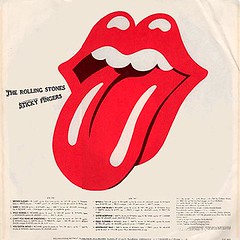
The Rolling Stones perform Sympathy for the Devil
at Altamont in 1969.
I liken it to putting on a Rolling Stones t-shirt. That set of lips and that tongue have a lot of baggage which donning that shirt conveys. That symbol says, at its base, "Goats Head Soup is a damned good album." But when you put on that shirt, you need to realize that somewhere, sometime, you are going to have to make peace with Altamont. If you put on that shirt entirely ignorant of the Hell's Angels and knives and pool cues, you nonetheless are making some minute statement about that violence by wearing those lips. By wearing the shirt you still telegraph a message. That means that if I were to ask you, "what do you think of Altamont?" the question would be both fair and germane.

The Confederate uniform, that grey or butternut tunic and pants that men wore; that Confederate (1st, 2nd, 3rd... take your pick) National Flag they carried; that rifle issued from the gates of the armories at Fayetteville or Richmond: all were potent symbols of a nation. Anyone carrying those hard iron symbols, wearing those wool symbols on their backs or marching under their symbolic cotton folds was becoming a voice of a nation through their action, regardless of their individual beliefs. Just as when seeing a set of lips on a t-shirt, it is a fair question to ask, "what do you think of Altamont?" when you see a historical figure in a gray uniform, it is a fair question to ask of them, "what did they think of slavery?" They have already opened themselves to the topic and started making a statement by their decision to put on that wool coat.

The Tongue and Lips first appeared on the album
Sticky Fingers, which featured the hit single Brown Sugar,
itself publicly debuted at Altamont in 1969.
When someone walks in front of me sporting a t-shirt with the classic Rolling Stones emblem emblazoned across their chest, I can ask them. They can answer. Soldiers of 150 years ago are another story. We need to use the evidence they gave us to give voice to their rotten throats and mouldering mouths. In the case of the flag of the 4th Alabama, we have a tangible symbol which the men left behind. They chose to represent themselves with that symbol, which helps to answer that simple question, "what do you think of slavery?" They have writ large their answer with a cotton bale and boll. They say with that flag that they valued the crops it yielded. They say with that flag that they valued the wealth and prosperity the institution brought their communities. They say with that flag that they valued slavery. They say with that flag that their cause was the property, "sold in a market down in New Orleans." It was why they fought.

So, what do I think of Altamont? That was some screwed up stuff, man. It never should have happened. It's really tough for me to listen to Under My Thumb now. The Stones' music isn't inherently violent. But the Angels and the crowd in 1969 were spoiling for a fight. Nothing could have stopped it, not even the entreaties of the Jester prancing across the stage. Altamont was an irrepressible conflict.

Tuesday, August 9, 2011

Interpreting Controversy: The Atomic Bomb and the NPS


I’m going to step a little outside of our purview today to comment about the recent developments and media reactions to the proposed Manhattan Project National Historical Park. You can read the National Parks Conservation Association’s press release, and the NPS resource studies at their respective hyperlinks. John and I discuss our wider views of public history here pretty often, so I think the issue at hand is still pretty relevant.

Michael Lynch has a great run down of the media reaction to the proposed park, much of the press being negative, over on his blog, Past in the Present. It is a great post and well worth the read. I agree with Lynch on several points, and I thought I would offer a couple more on why we, the United States, need a Manhattan Project National Historical Park. We need a public history park dedicated to the atomic bomb for several reasons, reasons I’m calling controversy, engagement, and democracy. These ideas are all pretty interconnected, so let me explain.

One of the biggest reasons that critics have argued against the project is the fact that they don’t want to glorify the atomic bomb and the human tragedy associated with it. But that, my friends, is exactly why we need a park dedicated to the Manhattan Project. The aim is not to glorify, but to interpret the controversy, the decisions, and the consequences associated with that world-changing event. We need a tangible place that can engage us and remind Americans of the great controversy, power, and responsibility that comes with atomic power. What better place than a National Park? What better than a place that is owned by all Americans, that is for all Americans, and that was created by all Americans and their chosen representatives? That’s democracy at work. That’s some of the greatest ideas of our country at work.

Furthermore, the story of our National Parks and public history sites are not the stories of inanimate objects, war torn landscapes, and historic buildings. As Dayton Duncan, the research historian behind many of Ken Burns’ films, says, “there is no history, only biography.” The story of the Manhattan Project is not just the story of a simple killing device. It is the story of the people who made it, the people who used it, the people it affected (both victims and victors), and the consequences of that decision that we as people have to live with today.

It’s the same with all of our National Parks and public history sites. The great battlefields of the Civil War the NPS and other organizations preserve are not preserved solely because of the landscape itself. It is what happened upon that landscape, and who made that event happen that is the reason the land is preserved. The hope being that future generations, through one of the few tangible connections we can preserve for posterity – the place it happened - can use those sites to remember and to forgive, to struggle with the decisions that were made and the events that happened, and to find meaning for themselves today, and the future as well.