Showing posts with label Current Events. Show all posts

Thursday, April 19, 2012

Crowdsourcing History: When We All Get To Help

Standing above "Freedom,"
looking at Discovery. /
CC NASA/SI/Harold Dorwin
I'm a bit bitter this week. The arrival of the Space Shuttle Discovery to the Washington, D.C. area has got me down. My first dream job as a kid, before I wanted to be a LEGO model designer or National Park Service ranger, was the illustrious position of space garbage man. I think part of that came from my grandfather's penchant for taking me around the neighborhood on trash day during his smoke breaks and picking through the fine assemblages of junk the neighbors had left by the curb. There was some sort of glamour in the idea of seeing the trash of the stars, I guess. But a lot of that desire came from a deep fascination with space. One of my favorite sandbox toys was a die-cast Space Shuttle that sat on a big-rig trailer. The little sticker on its nose read, "Discovery." I had two of the iconic early '90s LEGO Space Shuttles. In the past year, I've acquired two more.

Tuesday put me in a sour mood. For my whole lifetime, from my earliest possible memories, the Space Shuttle has been the embodiment of what America can be. It defined our nation: we fly to space. Sure, it was only Low Earth Orbit, but it was our nation's greatest everyday achievement. Tuesday, the reality that that achievement has evaporated became real when the Space Shuttle Discovery, the same one I had played with in my sandbox, landed at the Udvar-Hazy Center for its permanent dry-dock. It's ironic it happened on Tax Day. One of the reasons I'm proud to pay my taxes each year is that it means we can go to space. Now we can't.

Tuesday was an historic day. And the amazing thing about that historic day was the everyday people who captured it. Twitter was alive with the hashtags #Discovery and #spottheshuttle the whole morning. Amazing photos rolled into the Flickr group created to allow folks to document their experiences. By noon, nearly 1,000 photos had been added to the group, capturing the shuttle and it's 747 ferry winging over DC landmarks as diverse and disparate as The Lincoln Memorial, the Smithsonian Castle and the National Shrine of the Immaculate Conception.

An official NASA photo captured the wonderment the district felt nearly perfectly. Standing atop the scaffolding surrounding the Statue of Freedom crowning the Capitol dome are two construction workers, marveling at the spacecraft winging by. That wonder translated for many into holding their smartphones aloft, to clicking the shutter button on their point-and-shoots, to zooming in with their expensive telephoto lenses. They all became historians of the present, capturing the moment in time they saw history for a future generation, then sending their view out to the world to be processed, catalogued and preserved.

Imagine that impulse for a moment, the impulse to capture this event and preserve it in your heart and on your hard drive. That's the historian's prerogative. We grab the world around us and frantically try to bottle it up, synthesize it, find meaning in it and share it with the world.

Crowdsourcing is not a new concept. SETI@home has been using spare CPU cycles of volunteers' computers to analyze data collected from our radio telescopes since 1999. Folding@home has been doing the same thing since 2000 to analyze protein folding and molecular structures. Science has lent itself easily to these computation ways that individuals can help solve a problem.

The humanities have been a whole other problem to tackle. We are just now, nearly a decade and a half after SETI@home started trolling the skies looking for a cosmic collect call, beginning to think of the general public as valid sources of our analysis.

My grandpa in Europe, 1944.
 Jess says that I have that same
"surly" look in my repertoire of
facial expressions. I can only hope.
Tuesday, just as Discovery was winging overhead, the National Archive's blog NARAtions pointed out a project they've undertaken to create an index for the 1940 census. When the census was released on April 2nd, I was disappointed to say the least. My grandfather's family (the same Grandfather I trash-picked with) bounced around the city of Syracuse, NY like a pinball in the 1930s and '40s. My Mom likes to share the joke he used to make that, for a long time, he didn't know which house to come home to at night 'cause the family might've moved while he was gone.

To find anyone in the 1940 census, you need to know their address, their exact address on April 1, 1940. There is no index for the census, so you need to know the exact location where your ancestors lived when the census taker came knocking. Good luck finding that for the Bullard family. I can't find George and Gladys Bullard or their son, my Grandfather Bob, anywhere in the areas of Syracuse I'd expect them to be.

But amateurs are going to help me. A corps of amateurs, a gaggle of amateur citizen historians, are going to help me find Bob Bullard. A quarter million people have volunteered to help me find Bob Bullard. They will be helping to index the 1940 census, using software provided for free by NARA, and thereby helping me find my grandfather once again. According to NARA, "the entire 1940 census data will be indexed by a community of volunteers and made available for free. The free index of the census records and corresponding images will be available to the public for perpetuity." That means that someday my cousin Leanne's daughters, my 1st cousins once removed, will be able to find the name of the great-grandpa they never met in the 1940 census thanks to a crowd of amateur historians today.

We all make history. We don't need degrees. We don't need robes and mortar boards and dissertations. We just need our wits and a few tools. Sometimes they're our cameras. Sometimes they're the computer sitting in front of us. Sometimes they're our bare hands.

We all can make history.

Thursday, September 15, 2011

In Another Sesquicentennial

On Tuesday, Jake wrote asking who controls the memory of 9/11. The ownership of memory is such an interesting thing. This tenth anniversary was an interesting event, fraught with conflicted memory and different voices. It was intriguing to watch all of the slight conflicts which emerged last week leading up to the ceremonies on Sunday morning.

It has also been interesting to see the Civil War analogies to which a few folks, particularly John Hennessy and Kevin Levin, have pointed, viewing Civil War memory as an interesting case study of how 9/11 might be commemorated and memorialized in coming decades and centuries.

Coincidentally, I have been picking away for a few weeks now on a small thought experiment, inspired by the hot morning I spent at Manassas in July. What could the sesquicentennial of an event like 9/11, an event we have collectively sworn to "never forget," look like? Envision it as a simple piece of science fiction, like reaching forward through a hole in time 150 years and plucking out a news story on the anniversary commemoration of the attack on the Pentagon. And like all Science Fiction, it is more about the events of the present than the events of the future.

As Rod Serling, master of Science Fiction said in his introduction to the Twilight Zone episode "In Praise of Pip":

"Submitted for your approval..."


"The Defining Moment of Modern America"
Attack Anniversary Commemorations Draw Modest Crowds

Thomas Farquad for the Washington Post, Sunday, September 12, 2151

A crowd of about 650 people gathered at the west wall of the old Pentagon on Saturday morning to commemorate the 150th anniversary of the attack of September 11th, 2001. Dignitaries from District government, as well as the Commonwealth of Virginia were present.

"The men and women who fought the fires in these old walls on that day in September were brave, honest and hard working Americans," Virginia Governor Chauncey Williamson told the crowd. The Pentagon was in Virginia in 2001 when the attacks took place. The District of Columbia Statehood Act of 2076 transferred the land back to District control.

"The attack that happened here sent a shock wave through the world," the Governor remarked, "For two decades, wars were fought over the question of what our nation’s role in the world should be." Governor Chauncey said the unity seen in the years after the attack was a "blessing born from the heart of a tragedy."

District of Columbia Governor Samuel Williams, whose great-great grandfather was mayor of the city when the attacks took place in 2001, said that, "the lessons of so long ago are still relevant today." Quoting President Malia Obama, Williams reminded the crowd that, "America is fundamentally a good nation, with good intentions, good people and good morals. But we drift outside of our boundaries sometimes and need to stop to re investigate who we are."

Carter Smithson said he came to the Pentagon to honor his ancestor who died when the plane hit the building in 2001. Smithson, a clerk at the State Department, was dressed in the uniform of a 20th century army officer. "I represent my great-great-great grandfather today. These are the same types of clothes he wore when he died that day."

Smithson saw the small crowd as discouraging. "I wish more people had come out to commemorate both the awful tragedy and the unity that came out of it." Smithson sees America as a "stronger nation, more united" in the wake of 9/11.

On the opposite side of the park, Gerald Willson talked to the public about those who boarded the planes and fought for their freedom. "They were protecting their way of life," Willson told the crowd. "They were fighting for a cause they thought just."

Willson, an investment banker from Rockville, MD wore a headscarf and carried the chosen tool of the Islamic fighters on board the aeroplanes, a small knife called a "box cutter."

"I do this to make sure that the story gets told," Willson said. "Liberal historians want to focus so much on the causes of the war. They say these men were fighting to destroy America." But Willson feels the men were fighting, "in a revolution to ensure that their nations weren't tampered with." Willson said we need to, "remember the bravery of the people who fought on both sides on nine-eleven."

Anne Gerald, a systems analyst from Arlington saw the event differently. "Today is about the Americans who died here," she commented. "The men on the planes were not freedom fighters like some want to portray them, but simple murderers."

The park along the west wall of the Old Pentagon Commercial Park is open daily, sunrise to sunset and accessible from Pentagon Metro station.

Thursday, June 23, 2011

Locks and Cash: Whose Black History? (Part 1)

I have been very excited all spring, looking forward to an event which few Civil War folks had on their calendars. I have.

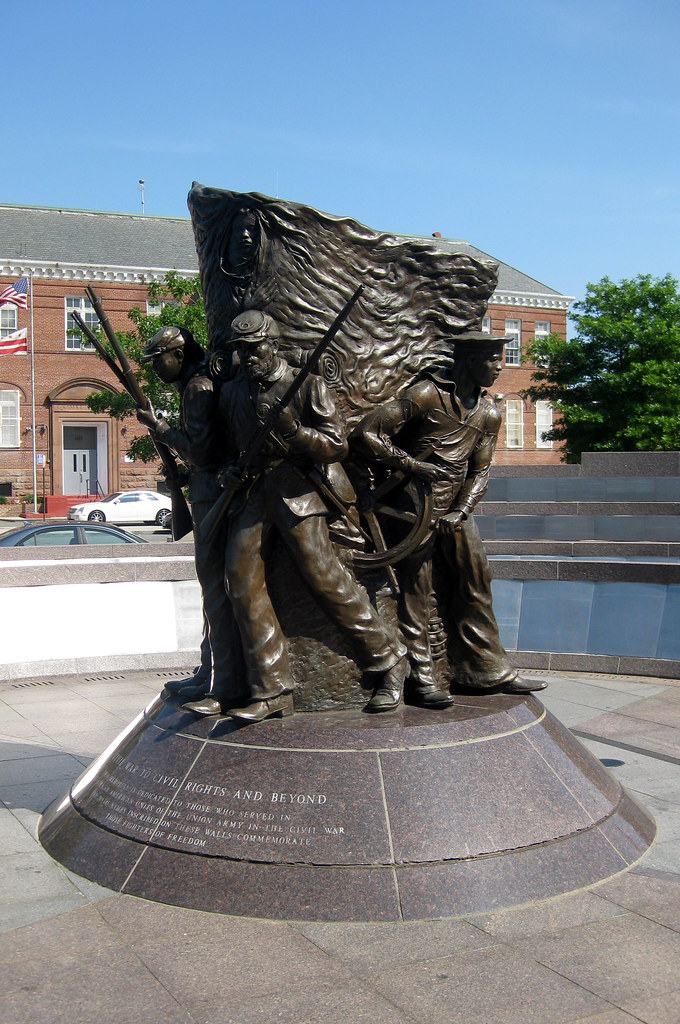
The monument depicts soldiers and
sailors in motion. Their energy is infectious.
CC / WallyG
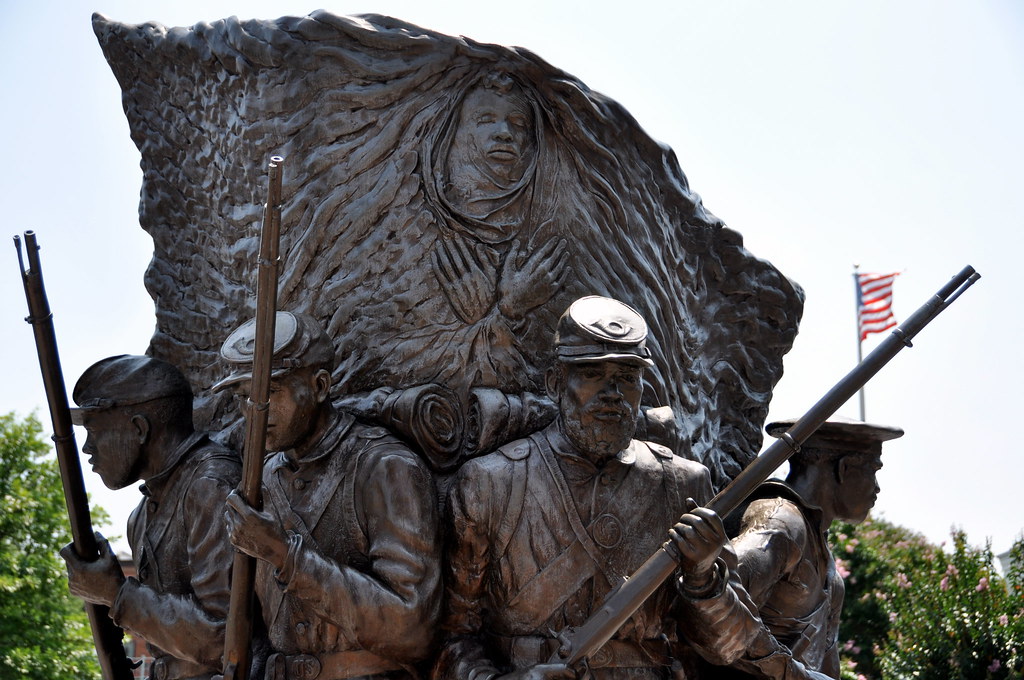
The African-American Civil War Memorial has been a favorite site of mine in DC (and not simply because it's just down the block from the District's best restaurant, Ben's Chili Bowl). It is a monument in the right setting. Instead of being on the mall with the rest of the other monuments, to be easily overlooked like the DC World War I memorial or similar sidelights to the big three of Lincoln, Washington and Vietnam, the African American Civil War Memorial is in a community that can be moved by it.

U street is a key historic community, the heart of Shaw and a community which has been historically black for over a century. Duke Ellington was born there. DC's African American populace found culture and formed community there in the early 20th century, in spite of segregation in the Nation's capitol. Where better to have a monument to honest, hard working Americans of African decent than in the heart of a community where their inspiration can reach out to a modern African-American community?

Starting this summer, the monument will be flanked by a real, professional museum to help buttress and support its interpretive mission. And that museum is opening in July of this year. And they are charging $200 per person to be there for the ribbon cutting.

In the end this is their right. The museum appears to be a private concern. The African-American Civil War Museum can charge an exorbitant fee for participation in their opening programs. It is their prerogative.

But is it wise? Are they preserving history through these actions, or segregating that history away from those who could benefit the most from its inspiration? Whose history is "black history" anyways?

The invitation to the event as it appears on the
museum's website. Click to enlarge.
The African-American Civil War Museum seems to be declaring that history is the domain of the rich. Instead of a public focused event, they are launching the museum with a proverbial black-tie style gala ribbon cutting. The vast majority of DC's African-American population cannot afford $200 per person to participate in the event. Screenings of Birth of a Nation and Glory will be part of the festivities, presumably with interpretive introductions discussing the value and meaning of the films. But will the eyes and ears who need to see them, who would benefit the most from being inspired by Glory and revolted by Birth of a Nation, be in the audience when tickets cost $200 a pop? I understand the need for ticketing when seats might run low and fire codes might be broken. But is the $200 fee blatant fund-raising, with no interpretive mission?

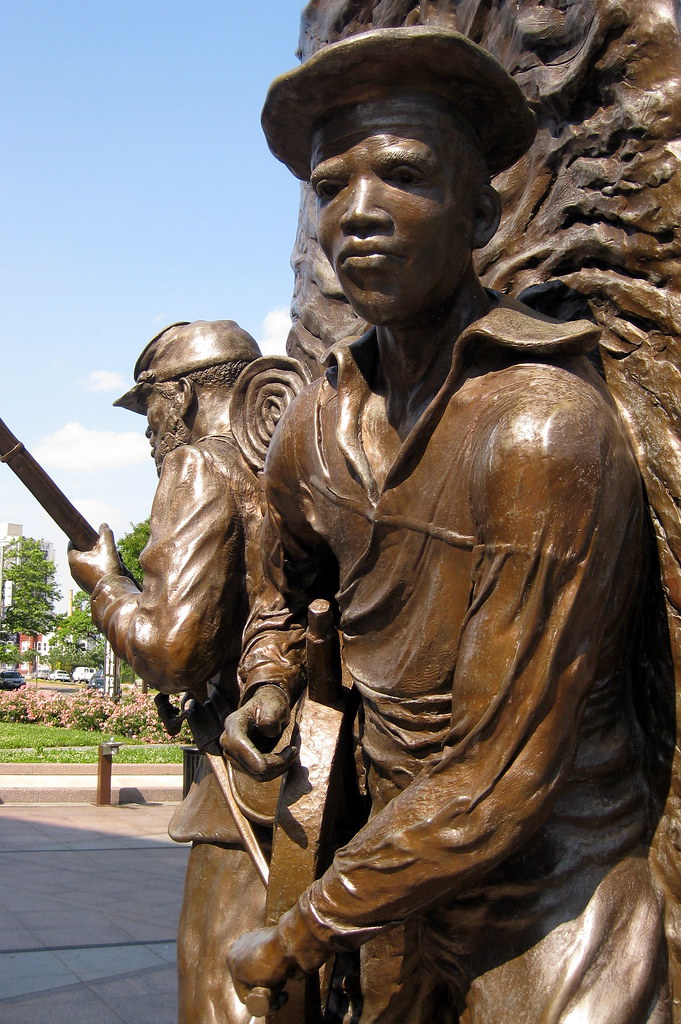
Could this sailor have scraped together $11
(the 1863 equivalent value) to attend
the opening of the museum?
CC / WallyG
DC is the land of the free museum. The Smithsonian museums are free. They collectively reach millions of eyes each year. Rich and poor alike can see the Apollo capsules, Lincoln's hat and the majestic dinosaurs. The National Archives is free. Rich and poor alike can read the promise that they, too, are heirs to the American dream of, "Life, Liberty and the pursuit of Happiness." The Library of Congress is free. Rich and poor alike have unfettered access to the wealth of the ages in the greatest treasury of human knowledge since Alexandria. The Bureau of Engraving and Printing, the Washington Monument, the Lincoln Memorial, the White House and Ford's Theatre all are free to all, regardless of how much spare change they have in their pockets.

Who cares if I, a short, fat white boy from New York, can see the African-American Civil War Museum? I can afford the price if I tried hard enough. If there is an admission fee for the museum, I'll eventually pay it. I care about black history. I see black history as my history too. But I don't need to learn those lessons which can be taught by these men who risked all for freedom. I already have.

I want to see the public history profession preaching to the congregation and not simply the choir.

I want a poor mother of a few kids barely scraping by in some obscure corner of DC to take her family to this place and draw strength from it. I want a homeless man to stumble in off the street and draw inspiration to try again at bettering his life because that's what these men did, again and again, in the face of insurmountable odds. I want a penniless college student, working minimum wage jobs to put themselves through school to think that if those men could face such cruelty and unfairness, maybe they might be able to continue on too. I want everyone, white or black, rich or poor, young or old to have access to this story everywhere it lives in America because it's their history. Anything short and I think we've failed as a society and as public historians.

So, I won't be taking a day off for the grand opening of the museum. I'll be sitting at my desk instead, probably listening to the soundtrack of Glory and daydreaming about those men who inspire me everyday to keep moving forward. They'll be marching across my consciousness. I'll make it to U-Street to see the museum soon, after the expensive hullabaloo is all over. And you can bet there will be a review right here. I hope against all else it will be a positive one.

Next week, I'll try to bring this question of who should have the right to lock up history a bit closer to home. Sometimes it's not cash that stands in the way, but a simple iron gate.

CC / Kevin H.

Thursday, May 5, 2011

One Sunday in America: Echoes of John Brown

“So perish all such enemies of Virginia! All such enemies of the Union! All such enemies of the human race!”
-J.T.L. Preston, Virginia Military Institute at the execution of John Brown, 2 December 1859

“In this man's death, there is no sorrowing, no weeping, but the grimmest joy and sternest satisfaction. So perish all such enemies of the Republic, all such enemies of mankind.”
-a prominent Lincoln scholar's Facebook status upon hearing of the execution of Osama bin Laden, 2011


Just go with me on this. It has everything to do with Civil War era America and the echoes that the 19th century has today, I promise...

I had just walked into the house Sunday night and turned on the television, intent on going to bed early for a change. It was a little after 10pm. CNN was announcing that a speech dealing with a grave national security by the President was imminent in just a few minutes. Wolf Blitzer expounded how the Sunday address was unprecedented and telegraphed that it was big news. But no one knew the topic.

I tend to be a apocalypse hypochondriac. My mind raced. Nuclear war? Asteroid collision? I (no joke) punched up the NASA NEO program's close approach table and scoured it for any hint of the bad news (The fact that I know such a table exists and where to find it hints at the way I can get paranoid sometimes).

Then the news broke, first on MSNBC, then Fox, then eventually CNN. Osama bin Laden had been killed.

I felt relief, not that he was dead, but that the earth wouldn't become a Sunday night rerun of a Michael Bay film. Then the pictures on my screen transformed. From 'pebble beach' where the White House exterior remotes are shot, the camera panned to Lafayette Square. I know that fence pretty well. Living close to DC, I sometimes wander down to stand there in awe of that building where, just a century apart, Lincoln and LBJ both signed documents which altered the nation forever and helped it limp toward its promise.

Outside the fence were revelers. College kids running down from GWU, the reporters intoned, had spontaneously broken out in celebration. People were leaping up and down in front of the gates, waving flags and shouting slogans. "U! S! A!" echoed across the square (like some Olympic hockey stadium) where once Lincoln and Seward walked. Then they began singing a very off-key version of the Star Spangled Banner.

My heart sank. It reminded me so much of the celebrations on 9/11 which we saw piped in from around the Arab world. Pockets of distasteful celebration at the loss of a life.

How can one man engender
so much hatred? / PD / LOC
But I'm an historian of the 19th century. My mind slipped quickly from 2001 to 1859. I saw that crowd rejoicing in the street instead wearing sack coats or top hats, wearing militia uniforms or hoopskirts. The drunken reverie of 2011 gave me a glimpse of the Virginian psyche on the death of John Brown in 1859. When Robert E. Lee entered Harpers Ferry, he came upon a scene of drunken reverie. The militia were drinking down their share of the stores of liquor lining the shelves of the town's taverns. Firing shots at Brown's raiders more likely resembled a drunk day at the gun club than a measured military action. In fact, it more than likely looked like that crowd in front of the White House. People were cheering, chanting and shouting slogans as men like Dangerfield Newby fell dead in the streets.

As the week has progressed, I've been following the existential crisis of celebrating death which has cropped up between the stoic and the celebrant. The public comments have been most telling. One commenter named "westTN" on a story asking how we should feel about bin Laden's death professed having, "no qualms about an enemy being killed. My Marine nephew waiting on new legs is happy, my Marine son-in-law preparing to deploy is happy. Me, an old Marine Sgt, happiness is a warm M-16 and a confirmed kill. Semper Fi." Another commenter named "whadaham" queried, "We're supposed to be happy because now the terrorists have another fallen hero they can use as a recruiting tool." As militia were celebrating the success of the Marines at Harpers Ferry, the "old man," as Shield Green called him, was transforming into a symbol. Brown became a fallen hero and a catalyst for Abolitionists in their continued quest for the freedom of four million. Across the North, in churches on the 2nd of December, 1859, men and women prayed and eulogized as John Brown dangled from a rope in Virginia. And with their prayers they reconsecrated themselves to ending the slave system which killed their martyr.

Another commenter on that same story, "3511danny," noted his confusion at one student who, "stated in the article that we don't have a right to kill anyone. Of course we do." "ghintlian," summed their thoughts up quite succinctly: "I hope the CIA put at least 3,000 bullets in bin Laden's body before they dumped him in the ocean, for the 3,000 lives that were killed at Ground Zero!"

Meanwhile, 151 years earlier in the streets of Harpers Ferry, a black man, a former slave lay dead, his throat pierced with a makeshift bullet from a militia musket. His name was Dangerfield Newby. As townspeople rifled his pockets in front of the Armory's gates, they found a bundle of letters. Newby's wife had written him begging him to free her from slavery. The militia was incensed. They left the body in the streets, defiled it. They walked up to the lifeless corpse and fired off their pistols and rifles into the cold flesh. They filled the body with holes in the name of the four dead citizens whose lives Brown's raiders took. They sought vengeance on a lifeless form which used to be a man. But to them, he was a dog, an animal. To them he was worthless.

Is celebration at any death right or wrong? I don't know the answer to that question. I know what my gut tells me and I know what my heart tells me. The dilemma, though, is nothing new. It dates to the genesis of the war. Can we bluntly compare bin Laden and Brown? No. But the feelings they engendered in their fellow man have some striking similarities. The Civil War's moral crises have deep relevance to today.

----

One final comment from a forum I frequent often, which resonates with the typical neo-confederate argument of why Southern soldiers deserve universal laud (emphasis added). Take it as a word of caution:

"Admittedly, I an overjoyed at his death; Osama has the blood of hundreds of British civilians on his hands, as well as American blood. I will however point out that he died fighting for what he believed in; which is an admirable goal in itself."