Showing posts with label Living History. Show all posts

Thursday, November 17, 2011

Just Interpret to Me: Reflecting on NAI 2011

Last week saw Jake and I in St. Paul, Minnesota for the annual National Association for Interpretation workshop, a week long gathering of professional interpreters from around the nation. I'll guarantee that the next couple of weeks will be filled with recaps from both of us on what struck us the most during the conference. Our reactions ranged from "meh..." to "Dude!"

To quote everyone's favorite viral video
"What does it mean?"
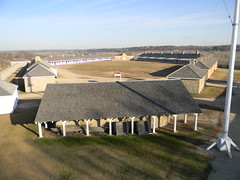
I'm going to begin with one of the "meh..." moments. Friday found us on a field trip to Fort Snelling State Park and Historic Fort Snelling (operated by the Minnesota Historical Society). The fort sits high on the bluffs overlooking the waters of the Minnesota and Mississippi rivers, dating originally to the 1820s. The fort has what seems to have been an amazing and vibrant history, filled with amazing national connections and deeply moving concepts.

Unfortunately, we did not hear that much about the meaning of that place when we toured the site. Our site visit consisted of watching the orientation video (a decent in-house production), a 35-minute PowerPoint presentation on the history of interpretation at the fort from 1970 to today and a very quick visit to the site wherein the staff unlocked doors for us and described the types of programming they do for the public. We were talked at for about an hour on the craft of what they do at the site, but never shown that craft in action to judge for ourselves. Why is Fort Snelling important? Judging only by what we heard inside of the fort's walls, I'm not quite sure.

To be fair, this was only a symptom of a larger impulse which seemed to pervade the conference. Again and again, instead of proving by showing the bulk of the presenters tried to teach their skills by telling. Concept after concept flew by, with little to no actual examples of what works, no attempt to show how meanings can be forged. A convention center full of professional communicators often had a tough time communicating.

We protect our cultural landscapes and interpret them because we believe that the real, the true, the actual is one of the most potent tools. This is the fundamental ethic in interpretation: tie a story to a landscape (what the craft calls a "resource"). But as soon as we step in front of a PowerPoint projector, even interpreters seem to lose this core ethic. Instead of teaching through effective examples, facilitating meanings for our audiences to show them new techniques for facilitating meanings, we begin blathering on about the craft endlessly. We read every word off of our slides and narrate endlessly to crowds quite visibly disengaged from what we are saying to them. We bore our audiences with theory the moment we are told they are interpreters. In short, for some reason we check our interpretive impulse at the door.

If we preach as a profession that interpretation is the most effective type of teaching, why not practice what we preach? Why not show how to interpret well through powerful examples of what is effective instead of simply telling how we think it might work?

Setting foot in an historic fort in Minnesota after flying nearly a thousand miles to get there, we were visitors last Friday. But the staff didn't see that. All we wanted was to see some effective programming that could help us feel why Fort Snelling was important. But the presenters didn't try to understand who their audience was and what they came to the site seeking. We weren't interpreters when we walked through the gates of that site; we were visitors. We came seeking meaning; we left unfulfilled. We walked away with no new tools in our toolboxes, only a vague understanding that Fort Snelling used to do first-person, living history interpretation and now no longer does.
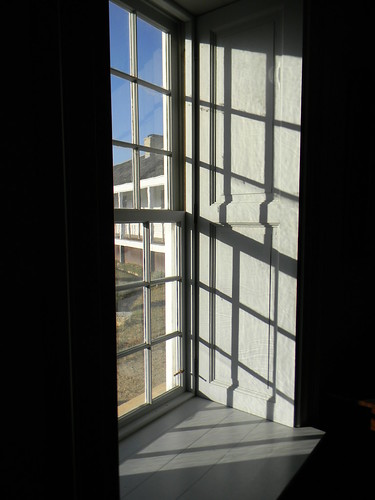
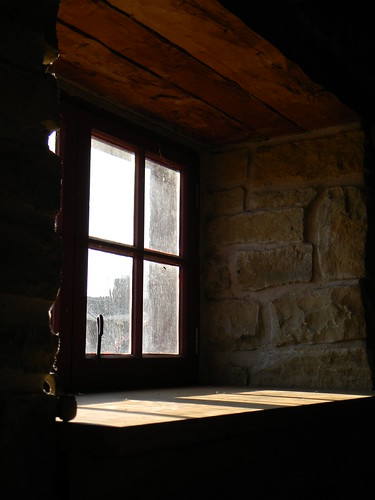
The Post Commander's Window Dred and Harriet Scott's Window
How might the very different people who looked out of these very different windows have seen the world?
Just one of the amazingly provocative questions I was hoping would be asked of me at every turn but never was...

Jake leaned to me at one point during the day and said, "Remind me to never mention that I'm an interpreter to anyone when I visit a site. They immediately stop interpreting for you and just want to talk shop."

Jake, consider yourself reminded in spades.

So, what were the missed interpretive opportunities? Tune in next week when I'll try to give you the interpretive program I didn't receive at Fort Snelling. Just in time for Thanksgiving, I'll share with you the power of an historic landscape to show us the impacts of European colonization of the Americas. And it's a Civil War story to boot.

Tuesday, August 23, 2011

A House Where People Lived: The Schriver House of Gettysburg

Recently a couple of my close friends and I were hanging out in downtown Gettysburg, looking for
trouble, err I mean, fun. We were trying to find something in town that we hadn't been to – something new to add to our Gettysburg experiences. When one of them suggested that we give the Shriver House a whirl, I admit, I was a little uneasy at first.

I mean I hate can’t stand house museums with a passion. They’re sooooo boring. Typically, a house museum is little more than a glorified furniture tour. It is the standard, “Look in this room. This is a parlor. Look at the furniture. See the horsehair couch?” If you are into historic furniture, then by all means, house museums are a must for you. But, if you’re not into mid-19th century furniture, once you’ve seen one, you’ve seen them all. As we walked in to the Shriver House, though, I figured what the hell – if nothing else the house museum might make for a decent blog post.

When we came out about 50 minutes later, I was mind blown. The Shriver House was easily one of the best house museums I’ve ever visited. Reflecting on the tour, I kept asking myself, “What made the Shriver house so interesting and engaging? What made it work?” Well for one thing, the Shriver House pretty much follows John Rudy’s definition of history – namely that, “History is ideas put into action by people on a landscape.” Our tour guide, Kim, gave us a window by which to see a family, the Shrivers, survive during wartime at home in Gettysburg.

Our tour of the house started with Kim explaining that as we stepped into the house, we were actually traveling back into time to see the house as it was during the battle of Gettysburg. The house was like it was then, when its occupants abandon it for safer quarters outside of the town. We stepped into the dining room and Kim mentioned that we could see all the typical wares a middle class family would have had, but to make sure and notice that the table was only set for three. Hmmm…I looked at my companions as I got all excited. “This might be different,” I thought to myself.

Why was the table only set for three? Well, George Shriver, the man who built the house was not here, for he was off fighting in the war. Kim asked us to imagine what the dinner conversations must have been like with George before he left for war. It seems that as soon as he had finally gotten his own house in order and finished building it, the bigger house, the United States, was falling apart. What was the dinner table like now with Sadie and Molly asking mother when father will come home again? Right there, Kim invited us to be part of the story - to imagine ourselves in the house with the people who lived there. It was interpretive. It made the house come alive.

We walked through the rest of the house, Kim leading the way. She pointed out the kids’ toys that were left right where they had been playing with them before the family left. She invited us to empathize with the family, and what it must have been like to leave everything behind, to leave your home behind, not knowing if you will ever see it again and in what condition it will be in. She cautioned us not to miss the candy the kids had left – Necco wafers, “History you can eat,” she said.

Next up was the attic, just how the Confederates who used the house as a field hospital and sniper position had left it. Torn cartridge papers were lying all about, and you could peak through the bricks that were knocked out of the wall for sharpshooter positions. The Shriver family returned to their house after the battle. It was the same house and the same town that they had lived in their whole lives, but it wasn’t quite the same. The house and town had changed.

Our last stop was in the basement, not set up as it had been, but what might have been. It had been George’s dream to run a tavern out of his basement, and the owners of the house have it set up as George’s dream. It was never to be, though, for George died in a prisoner of war camp in August of 1864. While standing in the tavern, Kim motioned to the street level window that looked out on Baltimore Pike. She recalled the procession that marched by in November of 1863 up to the new Soldier’s National Cemetery. It was at that moment that I looked up and saw a car pass by. For some reason, it was then that it struck me, the scene that was once outside, and what was not to be inside. War has its price. The Shriver family was just one family whose lives were shattered by the Civil War. For them, their house tells their story. It is a home - not of furniture, but of people.

In talking with Kim our guide afterwards, I was amazed. I had enjoyed the tour immensely, and Kim, a stay-at-home mom, had made our day. Kim hadn’t given us just merely a tour of the house, she had given us an opportunity – to empathize, a chance to understand, and a chance to feel what war was like for families. She had helped us connect to the past, to history on a personal level. Kudos to Kim and the rest of the staff at the Shriver House for doing great historical interpretation. They get it. Next time you are in Gettysburg, I say check ‘em out and let me know in the comments what you thought!

Wednesday, August 3, 2011

Manassas: Consumer Time Machine


Only a quick post this week, as I'm preparing for a few busy days in Dulles at a conference.

One of the interesting bits of interpretation I found at Manassas' Sesquicentennial event was a rarity in my book.  Oftentimes, living history volunteers place the contents of a haversack or a bedroll out on a gum blanket and simply name off the items for visitors.  Beyond this laundry list, the conversations rarely reach into the realm of drawing personal connections with the visitor's daily life or personal experiences.  The intellectual connection is well lain out, but an emotional connection is often fleeting.

But one of the living historians at Manassas hit an interpretive home run.  Look at the exhibit pictured above.  Under the right side of a fly were some original period food containers.  Then, on the left side, was the spread pictured above.  They are modern brands which find their lineage in the Civil War era.Some were regular consumer goods.  Others made their first fortunes from war.  The gentleman who was interpreting the setup was making connections for visitors.  It didn't take a leap to imagine how many of these goods sat on my shelf at home, artifacts of the Civil War in my kitchen cupboard or on my refrigerator shelves.  The connection between the past and the present was palpable in those simple bags of Eight O'clock Coffee and Lea & Perrins Sauce.

Knowing the soldiers and civilians of the 19th century ate some of the same foods I appreciate, the Civil War was alive in the supermarket of my mind.