Showing posts with label Visitors. Show all posts

Thursday, May 3, 2012

4th and Goal: What is the Interpretive Touchdown?

What is the aim of historic interpretation? That seems like it would be a simple question to answer, but it's simply not. Historic interpretation seems to be a many headed Hydra, with each interpreter seeing their own purpose and their own goals within the craft.

My chips tend to fall somewhere between Freeman Tilden and David Larsen, the two 20th Century sages of interpretation to whom we genuflect quite often here. Tilden adeptly noted that the, “chief aim of interpretation is not instruction, but provocation.” Larsen, likewise, captured the chief role of the interpreter within his Interpretive Dialogue when Nedlit muses that, “You will never prove the importance of this place to everyone. You will only be able to create opportunities for people to realize it on their own.”

Interpretation can never be, must never be rote dictation of meanings, facts or lists of information. It must not be teaching in the typical sense and definition of that word: imparting received wisdom to a student. It instead is something far more sophisticated.

Our job in historical places is not to share a complete historical story, not to educate the public on the practices and craft of the historian, not to simply teach about what happened where and when. We leverage history, we use history, but we never teach history. The job of the interpreter is to help the whole American people connect through their hearts to a place.

At historic sites, we use historical stories to do this, but we don’t teach history. We offer opportunities for people to feel significance within a landscape through the tales of historical characters and their struggles within that place.

In teaching, the outcomes are concrete and rightly should be. They are testable, with students able to recite and restate facts and figures, dates and concepts, arguments and perspectives.

In interpretation, the outcomes are far more ephemeral. Instead of wanting people to walk away from a program knowing what George McClellan’s greatest achievement was or what happened to Sullivan Ballou’s body after he died, interpreters want people to understand what McClellan’s warped and chaotic mind was like to live inside and to feel the heartbreak that Ballou’s scorched skull, desecrated corpse and charred shirt sent home to a wife in Smithfield, Rhode Island.

To do this, we employ facts. We use battle narratives. We use the events that happened on a landscape. But simple descriptions of the events and dispositions of men on that landscape can never be enough to reach deep into the souls of every American and help them to find a personal meaning in a historic place. Our job is not to have people walk away from a place knowing history. Our job is for people to walk away feeling history. We cannot, nor should we attempt to fix the deficiencies in the American educational system. We can only supplement the work of the educational system, not supplant it, as our societal role is fundamentally different from that of ‘teacher.’

The most important concept in interpretation, the part that separates it fundamentally from teaching, is the necessity of layering meaning atop meaning. This can happen in various different ways, but the most effective in my opinion is the concept of the historical echo. Presenting the meanings of a place as they echo and reverberate through time, as different groups at different points add or attempt to subtract meanings from a place, creates a diverse smorgasbord of perspectives, a vast buffet from which every American might find a meaning to fit their personal soul. Stretching the chronology of a place beyond what I’ve called in the past “Three Days in July Syndrome,” offering the shifting meanings of a place, offers that many more windows that the American people can use to find their personal meaning in a place.

This requires courage on the part of our interpreters: courage to discover that their personally held meaning is only one of many vibrant ones, courage to allow the American people to find meanings in a place that the interpreter might not agree with and, most importantly, courage to admit that enabling legislation is only an artifact of the past, a relic of a moment when a park was created, and not a sacred cow of meaning which hovers and triumphs over all others. The concept of a singular meaning encapsulated by Congress forty, sixty or eighty years ago somehow being the ‘end all, be all’ meaning for a place, never to change, shift or morph, is not valid and, more importantly, is in direct violation of the principle that interpreters should hold closest to their hearts: the visitor, and therefore the American people, are sovereign.

How can we from one corner of our mouth declare that the visitor is sovereign, allowed to take from a place any meaning they wish and find relevant, while from the other corner proclaiming that a specific meaning dictated by a group of powerful men now long dead trumps all others?

So let there be intellectual conflict. Let there be open debate in our parks, site, house museums, battlefields and other special places over why these places matter (or don’t). Let the American people come to their own conclusion. In the end, it cannot be about passing along a received wisdom or a received passion, like the wisdom of the ages passed from learned scholars or Congress to the American public as holy writ. We must instead have the courage to let our visitors find their own personal passions.

Because this is the fundamental core of interpretation. And as Larsen’s Nedlit asks in the Interpretive Dialogue: “Do you have enough passion to help visitors develop their passion?... If not, you’ll only communicate with people who already agree.”

You’ll notice I used the phrase, “American people,” a lot this week. I’ll try to have some reflections on why I intentionally did that come next week. Until then, good luck out there on the front lines.

Wednesday, April 4, 2012

Guest Post: Fear and Loathing at Shiloh

In a special guest post today, we offer up some thoughts from friend of the blog Vanessa Smiley. Vanessa is a good and stalwart interpreter and Civil War-geek. When she shared with me her experiences at the Shiloh reenactment this past weekend, I asked her to share them with all of you. -John

A portion of Shiloh's bloody harvest.
Everyone is and has been talking about the Shiloh 150th commemoration, whether it be the NPS event starting this week or the battle reenactment that took place this past weekend. It has been called the 'Antietam of the West.' All the events surrounding its 150th anniversary have been heralded as being one of 'the big ones' this year. Over 23,000 casualties of both sides in two days - a pretty significant and bloody battle.

I made the 14 hour road trip to the Shiloh battlefield this past weekend. I'm attending as many Civil War 150th events as I can and so I've been looking forward to this "big one" for months. My boyfriend Clayton and I decided to attend the reenactment this past weekend instead of the NPS events next weekend. Clayton had the unique opportunity to join nearly 600 reenactors/living historians to portray the 15th and 16th Iowa Infantry. Clayton would have the chance to arrive near the Shiloh visitor center via paddle boat on Friday night and the opportunity for some living history interaction with visitors to the park on Saturday morning before marching 5 miles to the reenactment site and straight into battle. In other words, this was Clayton's chance for his civil war "squee" moment.

I came along for the ride.

I am a living historian and while I enjoy the chance to don my corset and rugged work dress (I usually portray a working/lower class woman), this time I decided to go strictly as a spectator in modern clothes. Mind you, I've never done this - usually if I attend reenactments of Civil War battles, I'm dressed in my Civil War clothes and doing some sort of living history demonstration (cooking, laundry, etc.). I rarely get a chance to watch the battle itself. I wasn't sure what I expected but it sure wasn't what I ended up experiencing.

First, let's quickly crunch some numbers. Historically, over 44,000 Confederate soldiers and over 66,000 Federal soldiers fought in this two day battle. There were over 6300 registered reenactors for the Blue and Gray Alliance 150th Shiloh Battle Reenactment. That number also includes women and children, so probably 300-500 of that number were not actually soldiers. There were approx. 60 artillery pieces and too many cavalry to count. Clayton, who was in the thick of it all, told me that the Confederate reenactors outnumbered the Federals about 3 to 1. I was told that there were an estimated 35,000 spectators that attended the reenactment.

Historically, during the first day of battle, the Confederates had the upper hand. They made a surprise attack early on April 6, 1862 and battle raged all day, leaving many dead, wounded, and dying on the field by night fall. By the following morning, April 7, however, the Union army had received reinforcements and rallied to victory, albeit a costly one with 23,000 casualties. The Confederates eventually retreated from the field.

I ended up not attending Saturday's battle reenactment of the first day, but I did manage to make it to Sunday's fight, which was a reenactment of (what else?) the second day. I sat in the heat and sun with hundreds of other people behind yellow caution tape stretching from one end of the field to the other, all directly behind the Confederate artillery. From my vantage point, I was able to see most of the battle, including the final moments when those boys in blue advanced from the tree line, large United States flags waving at intervals along the immense column, and watched as they overtook the Confederate army and ended the battle.

As I sit here trying to gather my thoughts on all of this, I feel the tears well up and I'm overcome with emotion. The experience that I had was, cheesy as it sounds, life changing and powerful. It's hard to relive it.

The rumble of cannon: something to
cheer or contemplate? / CC Roger Smith
As I sat there feeling the vibrations of the artillery rattling my teeth, I was finally able to grasp just how terrifying this war was for these soldiers. The ground literally shook from the constant artillery bombardment, the smoke from the artillery pieces often obscured the view of the field, the pounding of hooves from the cavalry as they rode by in haste, the explosions of various sized gunfire. If I closed my eyes and aimed my ears at the field, I could get a fraction of a sense of a battlefield 150 years ago.

But that's not what makes me cry as I think about my experience. What was really most powerful were the reactions of the spectators around me - and not in a good way.

Whereas I came to this reenactment looking for a sense of meaning and a sense of understanding about this horrific war, most of the people around me came here for entertainment, for the sport. It puts a sour taste in my mouth now just thinking about it. The people around me only wanted a good show. Whenever the three artillery pieces directly in front of me either all fired at once or in quick succession, the crowd would clap and cheer.

Did you read what I just wrote? They clapped and cheered! I was more horrified at their reactions to this event than I was about my new understanding of war. I was more emotionally affected by their reactions than I was by the meaning I had gone there looking for.

These people were laughing, cheering, talking, clapping, and taking pictures like this was some high school football game. I honestly felt disgust. I was disgusted at them. I was disgusted at myself for being a part of it all.

I had this naive notion that everyone was there for the same reasons I was there. And when that naive bubble was popped, I was so incredibly hurt. I began to question everything.

When John called me and asked how my trip was, knowing I had looked forward to it for some time, I told him that, while it was overall a great trip, I was coming out the other side a changed person.

He listened quietly as I described what I've typed up above. He listened as I also described the women who, towards the end of the battle as the Federals finally broke the Confederate lines, shouted flippantly, "Where's Forrest when you need him?!" I told him about the horror I felt at it all, how I just couldn't believe what I experienced, and how I was still trying to understand it.

I went there to try to find meaning in that place and what happened there. I ended up gaining a better understanding about the way the people who attend these events think.

And it terrifies me.

Thursday, March 15, 2012

Interpretive Vernacular: Pop Culture is a Language

I trust people who sound like me. I trust people who speak the same language as me. Part of this comes from a simple fact of understanding. I speak very little Spanish, even less French.

But I also speak other languages, and trust people who speak to me in those languages.

First, I speak geek. I am an unrepentant lover of science fiction, native to personal computers since the era of the DOS prompt, frequent quoter of nerdy movies and television, admirer of the beautiful simplicity of physics and the amazing symmetry of maths. Geek is a second tongue for me.

I also speak the language of popular culture. Frankly, we all do to greater or lesser degrees. I know what Mad Men is all about. I 'get' a good number of the gags when Saturday Night Live lampoons MTV, BET or Lifetime. I have enough of a working knowledge of the Twilight series, The Jersey Shore and much of modern popular music to understand a passing reference to them (and know they hold no real interest for me).

But when I interpret, I am told to dress up my language. We struggle in the public history world with this awkward concept of 'agency voice.' We quake in fear at the concept that we as individuals speak in some mystical, disembodied voice on behalf of our agencies or institutions. But this gussying up our prose, this abandonment of a cultural vernacular for some perceived cultural high ground could be severely destroying our ability to communicate with a modern audience.

We can't speak to an audience in a language they don't understand. Speaking more slowly and louder doesn't work. Just because an audience might listen to Lady Gaga doesn't make them unable to understand, appreciate and come to care for large historical concepts and truths. Sometimes we need to speak in the very words our audiences share with each other, that we share with each other everyday.

So what might this look like? Simple: imagine if Lady Gaga performed a power-anthem to accompany the women's suffrage movement of the late 1910s...

From the folks who brought you Too Late To Apologize, the latest in vernacular public history.

This video is nothing new per say. Yet it is still powerful. Watch it ten times, twenty times, a hundred times. Each time you'll find another small, powerful detail. Did you catch the note from the Senator's mother telling him, "Huzzah and vote for Suffrage"? Did you catch the doubt in the woman's eyes as she proudly declared she didn't need to vote? Did you notice how the protesters in front of the White House were a spot on match for the real women who stood there fighting for their rights? The piece is outrageously powerful, even on the hundredth viewing.

Add caption
But it is only an evolution, not a revolution. It joins a long lineage of style and straight parody incorporating history and civics into a modern vernacular language. Who from my generation and the one preceding doesn't recognize the line, "I'm just a Bill, Yes I'm only a Bill..."? I learned the preamble to the Constitution thanks to Schoolhouse Rock! as well, and still need to hum the tune to keep the pieces in the right order in my mind. Even Schoolhouse Rock! took on Women's Suffrage, with another power anthem about gaining the right to vote.

How can we foster more creative ways of sharing the vast world of history with the public in the language they speak instead of the stilted and foreign voice we think our institutions should speak with? How can we reach an American public where they already are, instead of fruitlessly demanding of them that they try to understand a language they don't speak natively?

I'm not sure. But I think it looks something like a tribute to Lady Gaga featuring Thriller-esque suffragettes, a brooding Woodrow Wilson and a struggle for freedom embodied by men and women acting to make the world better. I think it looks like Ben Franklin wearing a mock AC/DC tee-shirt and shredding the guitar while Thomas Jefferson sings his grievances to the King. I think it speaks in the language of the modern world, the vernacular of the culture we live within. That history will gain far more traction than anything in 'agency voice' could ever hope to, I guarantee.

Thursday, February 23, 2012

History not Hokum: Learning from Specters

There was a good, provocative question asked by Aaron Urbanski on my post last week:

What are we to make of those who literally try to raise the dead at our nation's historical locations? Can ghost tours ever be a successful medium (pun intended) for interpretation?

If there's one thing I love more than anything else in this world, it's a good, provocative question to chew. I've been mulling it over for the past few days and a few keen points keep bubbling to the surface.

Remember, this spook party is not
recommended for kids under 12 / LOC
The concept of studying ghost tours and why they are so effective was introduced to me this past fall during the Pennsylvania Historical Association annual conference in Johnstown. The keynote address was given by newly christened Gettysburgian Peter Carmichael on relevance at Civil War sites. I don't agree with everything Peter mentioned, and I think we can look even broader for relevance than the techniques of modern analogy that are his (admittedly effective) workhorse, but he raised a good point about ghost tours that has been haunting me since.

Why are they so effective? Gettysburg is swarmed with ghost tours. On a warm summer evening, walking down to my favorite ice cream shop in the battle-period home where a seminary student sheltered in the basement while battle raged around his ears, I find myself again and again shoved either into oncoming traffic or into a brick wall by throngs of visitors hunting 'ghosts.' They follow a Gettysburg College theater major or a local teenager looking to pick up a few extra bucks wearing old-timey looking clothes and carrying the ubiquitous lantern through Gettysburg's brightly lit streets. The newest of these phoney offerings arms visitors as ghost hunters with cheap thermometers and 'laser nets' (dime-store laser pointers with a weird looking lens), the tools that will purportedly help them find ghosts.

You may be an undigested bit of beef, a blot of mustard, a crumb of cheese, a fragment of an underdone potato. There's more of gravy than of grave about you, whatever you are!
-A Christmas Carol, Charles Dickens

I used to mess with ghost tours when I was a student at the college. I lived in Stevens Hall, my window facing out on Carlisle Street. There is a beautiful old sitting room a the front of the building. I would read draped across the couch there nightly.

When a tour was outside and flashbulbs drenched the windows, I would drop to the deck and crawl to the light switch. Flicking it on and off a few times, I would leave it off. Flashbulbs would go off outside incessantly. The poor tour guide would begin to talk louder and more angrily, telling the bogus tale of the 'blue boy.' It was childish, I admit. But I howled with laughter at what I was sure at the time was the best example of Barnum's old adage about the birthrate of suckers.

I'm not so sure now. Those people wanted something they weren't getting out on the battlefield. The hokum of a spirit world offers these visitors something they aren't feeling anywhere else in town: the real. They want to dialogue with the dead, meet them, shake their hand.

When you wander around Gettysburg today, it's so impossible to imagine that place nearly 150 years ago. Flickering gas streetlamps have been supplanted by halogen bulbs. Neon beer signs pour out on a square that once hosted thousands of onlookers, partying for lack of beds and hanging on the words of men like Lincoln and Seward as they addressed the crowd from their doorstep or window. Cars streak down the pavement where ambulances were overtaken and flipped by crowds of men running pell-mell toward a hill with a cemetery on it, fearing for their lives.

The Civil War is not manifest in Gettysburg. Nor should we strive to make it so. I like the bars, shops and restaurants that dot the streets of my town. I like being able to drive down the street to head to the movies or get groceries. I like being able to walk through town on warm summer evening and not worry about being mugged in the gaslight on the way for ice cream. And I'm pretty sure that visitors like these things too.

To hold hands with the dead, to feel
the real presence of the past. / PD LOC
What the ghost tours provide through stories and the tantalizing offer of meeting an incorporeal actor in the famed battle is a taste of the real. Who wouldn't salivate at the opportunity to sit down with the ghost of Lincoln or Reynolds or Henry Hunt and simply ask, "So what was it like way back then?"

How can we learn what our visitors want from our special places by studying their penchant to go on ghost tours in the evening hours? Are they looking for the possibility of feeling the real, of meeting the past? Is that why they pay good money to carry around hokey versions of Ray Stantz' PKE Meter made from duct tape and some fishing wire? Is there something exciting about the prospect of meeting the past?

And most importantly, can we replicate this feeling through interpretation, telling stories of things that actually happened and not simply stories dreamed up by an overactive imagination? How can we help visitors find the real without resorting to to hokum?

Thursday, December 8, 2011

"The Wrong shall fail, The Right prevail, With peace on earth, good-will to men!"

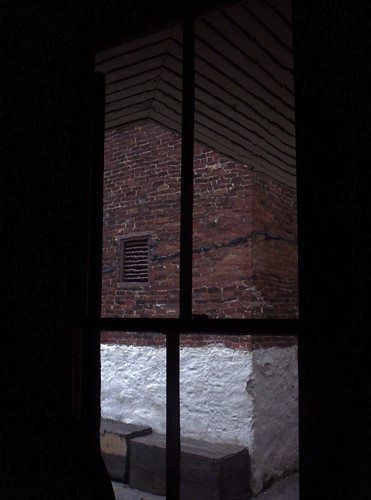
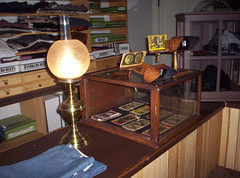
This past Saturday night, I was standing in one of my old haunts. The Dry Goods Store at Harpers Ferry National Historical Park is perhaps my favorite place to be an interpreter, especially at night. Low wattage lightbulbs (simulating whale oil or tallow lamps) and the darkness outside the windows make that building a perfect time machine. Near the end of the night, a family came in with two enthusiastic sons. One wearing a toy kepi and carrying a brand new souvenir envelope of Confederate money rushed around the store asking if he could, “buy that with this.” His excitement at being in the historical space could not be contained.

The other boy was more sedate. He was wearing glasses and bundled in a sweatshirt against the dark cold outside. He quietly looking over each of the objects near the back of the store, studying them.

“Is that a knife,” he asked me.

“Well, there’s some knives in there, but there’s also a razor for shaving your face, and a strop to keep the razor sharp,” I replied.

“And what type of pistol is that,” he continued down the line of windows guarding artifacts.

“I believe it’s a Colt,” I said, “after John Brown’s raid here, thousands of pistols were solid all across Virginia. People were scared of abolitionists and wanted to protect their families from violence. So they bought weapons.”

Then the magic really began.

“I saw a bigger gun than that on Pawn Stars,” the boy excitedly shared, “it had a lever and went like this.” He mimed a lever-action repeater in his hands.

“Oh, it sounds like maybe a Remington repeater?”

“No, it was from the Civil War!”

“Maybe a Henry repeating rifle…”

“Yes!” he jumped, “that’s it!”

“You know, by 1864, soldiers started being issued those guns in Georgia. They were called Bummers. They foraged for supplies and food for the army when Sherman was trying to end the war.”

My friend and one of my mentors, John King, tucked his hand and voice into the conversation. He dropped a chuck on something in front of the boy and it thunked on the glass case like a rock. “You know, that killed more than all of the repeater rifles and pistols combined in the Civil War?”

“Do you know what it is?” I added.

The boy studied it. The hunk of something was pitted with tiny holes, hard and mummified.

“Is it a rock?” he asked puzzled.

I responded, “No, it’s bread.”

His face twisted. “Bread!?”

“This is hardtack, what the soldiers were issued to eat. It’s so tough that they had to soak in it coffee just to bite it sometimes. See those holes there. What do you think caused them?”

“Bugs?”

“Yup.”

“Ewww!” he withdrew, “What’s it made of?”

“Do you have Playdough at home?” I asked.

“Yeah.”

“The same stuff as is in your Playdough: flour, water and salt. Do you think you could live on nothing but this and bacon?”

“Maybe.”

“Don’t you need vegetables?” I asked with a smile.

“I like them,” he responded.

“Good! They keep you healthy,” I said, “If you ate nothing but this bread and bacon, your digestive system would be a big waterslide. Men in the Civil War died of diarrhea. They pooped themselves to death because they couldn’t keep any water or food in their bodies.”

“That’s terrible,” the boy responded.

It is. It’s facts like that, when you say them aloud, that force your body to quite physically commiserate with the people of the past. Your stomach sinks for them; you want to vomit on their behalf. You feel, for just a fleeting moment, the Civil War alive inside your stomach.

He wandered down the counter, still studying every single thing he could touch and see. After a fascinating few minutes spent with a stereo-viewer, imagining visiting Paris or Jerusalem in his own living room, just like he can with his TV remote today, I plunked another photographic technology on the counter in front of him. A small ferrotype photograph of a face in profile.

“You know what that is?”

“It’s a picture of someone.”

“Exactly, do you see anything weird about it?” I asked.

“Well,” he puzzled, “he’s not looking at the camera.”

“No, he’s not,” I encouraged him. The boy’s mother began to hover over his shoulder to catch a peak as well. I revealed the answer: “he’s dead.”

“Oh!” the boy said with piqued curiosity.

His mother exclaimed, “It’s a person! I didn’t even see that until you just said that. Look at the detail!”

“I know, look how detailed it is,” I said. The boy took the picture in his hands, holding it close to his face to inspect every line in the corpse’s face.

“Photographs took a few seconds to expose in the middle of the nineteenth century,” I explained, “but when you’re not shooting a picture of someone who needs to stand still, the detail can be perfect.”

The boy lowered the photo and looked at me again. “I saw a picture like this on Pawn Stars, where the person was dead.; it was easier to take their picture because they had to wait like 10 seconds to make it and they didn’t move because they were dead,” he blurted out fast, like it was all one word spoken in a single breath.

“Why might you want a photo of a dead person?” I asked.

“I dunno,” he replied.

“How many pictures of your Mom do you have in your house,” I asked, looking to catch his mother’s eye.

He replied: “a lot!”

“If your Mom died, and you couldn’t see her anymore, you would still have lots of pictures to remind you of how much she loved you, right? They’d help you if you were sad?” I asked.

“Yeah, I could look at the pictures of her.”

“Imagine,” I said, “if you were in the 1850s. You might get your picture taken every few years, maybe. What if someone you loved died and you didn’t have a picture of them?”

“You could take one of these,” the boy exclaimed.

“And then you’d have at least one picture left to remind you of what they looked like and how much they loved you,” I helped him along.

“Wow…”

A time machine, giving us small glimpses of the 19th century, is an amazing tool. You don’t have to step into a jury-rigged Delorian or a blue Police Telephone Box to travel into the past and try to feel what it was like to live then. You don’t personally need to wear an expensive set of period clothing to wear on an immersion weekend in the backwoods of Georgia or Pennsylvania.

All you need is a heart, some dim lamplight, a good story, a piece of 'the real' and a cold December’s night.

Thursday, October 27, 2011

"Sit Down Together at a Table of Brotherhood": Martin Luther King Jr. Memorial

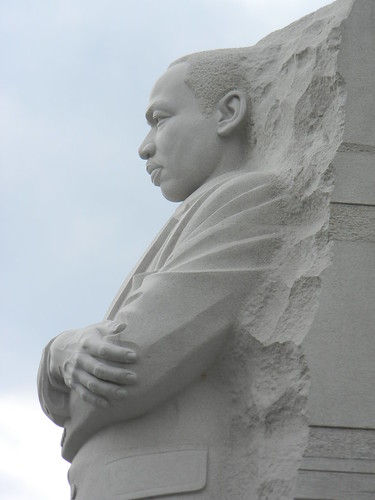
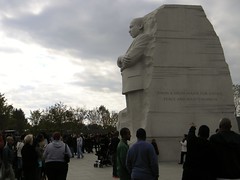
The Stone of Hope: a kind King
As we walked along the tidal basin back toward the Smithsonian Metro Station, I began to cry. Just a few tears, here and there, welled in my eyes. It wasn't the monument or the quotes. It wasn't the deep feelings I had looking at his face. It was overhearing a simple conversation. Two 30-something black women in a group of tourists were talking to one another about photos.

"You need to get your picture taken, girl," one asks the other.
"Why?" she responds, "I've got plenty of pictures."
"To prove you were here," the first woman responds.

That hit me. This place was special and meaningful, far above the power of even its creators to see. The very act of visiting the huge stone monolith needed to be documented and shared with those at home, like evidence of a hajj to a sacred spot where all yearn to stand.

During our visit we walked past an older couple, old enough to have been dating as King embarked on his final campaign for the sanitation workers of Memphis in '68. The woman pushed the gentleman in a wheelchair, both looking up reverently at King's face as they moved forward. His black hand rested on her white skin perched gently above his shoulder.

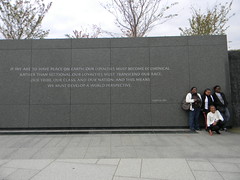
A Family and a King quote
In front of the monument a huge crowd gathered. Many were black, many were white. Everyone seemed enthusiastic to be there. They were elated just to be standing on that spot. Above the crowd arms reached, holding aloft smart phones and cameras.

Along the walls behind King, next to quotes about strength and weakness, about war and peace, about violence and justice, families posed to have their photos taken. Others studied the quotes, pondering for long minutes. Along the pathways, lining every inch of curb, groups sat. They were talking.

Stepping into the Lincoln Memorial is often like a walking into a wall of silence. Crossing the plain of the columns on the east front, the air becomes deathly still in reverence to Lincoln's gaze. But walking onto the plaza surrounding King's feet, a low murmur permeates the scene. It is not irreverent. It is simply people being people. Some I overheard discussing King or their lives or the meaning of the place. Others were planning where to eat dinner or hashing out the best route to their next stop. Some were simply taking a moment to sit a breathe, looking across the tidal basin toward the white dome in the distance. But everyone was using the park, not simply soaking it up as a static visual landscape to be consumed. They were active participants in the place.

Walking around the site, my girlfriend Jess noticed something I missed. "Look at all the disposable cameras," she remarked. She was right. There were so many people not with the latest Nikon or Kodak camera slung around their neck, or an iPhone snapping quick shots of King, but with $5 and $10 disposable film cameras. "Those people aren't here 'cause they want to be," Jess mused, "they're here because they need to be. They saved money for the Greyhound down from where ever because they had to see this. It is a need, not a want."

Not Diversity: Only A Manifestation of America
All around us, people were there because they each knew they had to be. This diverse crowd was wonderfully unlike anything I've experienced in a National Park before. The crowd didn't feel artificial like it usually does when I visit Civl War parks, with the visitors around me being very white and typically old. It didn't feel like the Martin Luther King Jr. home in Atlanta, where I felt what I can only describe as the good kind of discomfort of being the only white person in the entire park on the first day of my two-day visit. Comedian Stephen Colbert has called Washington, D.C., "the chocolate city with a marshmallow center." The neighborhoods ringing The Mall and the Federal center of the city are predominately black. The crowds on The Mall and in the Smithsonian museums (not to mention the representatives in the hallowed halls on The Hill) are predominately white. Stepping out of Smithsonian Metro Station onto the Mall or walking the few blocks down while waiting for a pull time at NARA, l'Enfant's "grand avenue" feels too lily white for a city with such rich diversity teeming in every street to the north and east.

But at the King memorial, it doesn't feel artificial. It doesn't feel like I'm alone and different. It doesn't feel like anyone is missing. The only thing surrounding me at the King Memorial this past Saturday was what defines America: ordinary people of every stripe and any color.

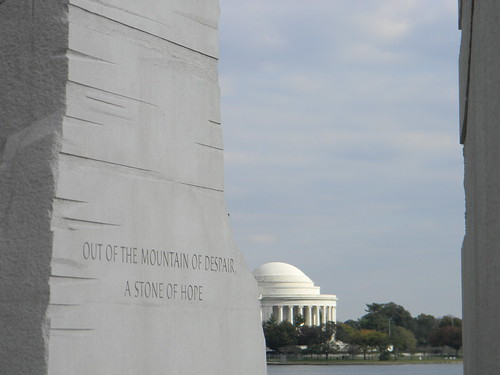
The most amazing thing, though, is looking beyond King's gaze. Across the tidal basin lies the Jefferson Memorial. On one side of the water stands the author of the immortal, "promissory note," that men are entitled to, "life, liberty and the pursuit of happiness." On the other side, just a stone's throw and two centuries away, stands the man who made it his life's goal to see that the, "promissory note," would be cashed for a race of men yearning to breathe free.

"We hold these truths to be self-evident..."