Showing posts with label Harpers Ferry. Show all posts

Tuesday, June 4, 2013

Inside the Resource: Interpreting is Pointing at Things

Ranger Fox pointing at things...
We preserve the places of the past for a very specific reason: they are places. They are physical manifestations of the past, either landscapes where that past was played out or the remnants of the people who made that past happen.

That was clear to me last week as I watched David Fox, one of Harpers Ferry's premier interpreters, twiddle a shaving mirror in the sunlight and shine a twinkling beam on the gravestone of Rev. Alexander Morrell in the cemetery at the end of Fillmore Street.

We preserve places because of their place-ness, their raw physicality. And in that cemetery, David was conjuring Alexander Morrell for us from beyond the grave, using his tombstone as a stand-in for the reverend and teacher who died in 1885. Without that tombstone warmed by a beam of sunlight, Morrell would have remained dead for us as we stood in the cemetery.

This all swims into mind because it's getting to be that time of year, when interpreters head out into special landscapes and talk history with the public. It also means I've been soaking up some interpretive programs over the past few weeks and they've started my gears turning.

I've seen a few programs that used some decent techniques, but lacked the magic of David's tour through the cemetery. Many of the interpreters were telling what could have been compelling stories. They were really trying to show that their landscapes are relevant.

But something wasn't working quite right. I started recognizing it because when I'm excited or "on a roll" I fall into the same trap. The story was drifting away from the resource.

I have to stop myself sometimes and ask that crucial question every interpreter should ask themselves every single moment they are helping people move through a resource: "Why did I choose to stop here? Why am I standing right here?"

Everything in an interpretive program is a choice. And choices are supposed to be deliberate. It's not enough to stand in front of a landscape and lecture. It's not enough to stand in front of a house and talk about the man who lived there. It's not enough to be proximal to the resource while talking history.

We have resources so that we can be immersed in the past. We preserve places so we can visualize the past recreated on those landscapes.

In short, interpreters and rangers need to point at things.

It's not a joke. If the presentation I choose to give in front of the President's House at Gettysburg College or atop the crest of Camp Hill in Harpers Ferry doesn't reference that landscape, use it as my primary tangible to help the people I'm speaking with connect with the past in a visceral manner, I'm not doing my job.

Doesn't that landscape just beg
to be pointed at and interpreted?
So I point when I speak. I move. When I'm in front of the President's House, I intentionally gesture toward the door as I tell the tale of Robert E. Lee's July 2nd visit, touch the doorknob when I mention that a letter arrived at that door in 1862 warning that a beloved son was dying in far-off Illinois, I gaze in the windows as I'm recounting the tale of a College President and his student cum rebel soldier sitting down to a cordial meal in spite of their hatred for the beliefs of the other.

I bend in the National Cemetery and touch the stone of an unknown soldier as I talk about the black men who found opportunity in digging those graves. I grasp the pipe railing of the Rostrum as I tell my students about LBJ's radical 1963 speech advocating a new birth of freedom in a divided nation. I point and use the landscape I'm standing in nearly every sentence of every stop of every tour I conduct.

We have resources for a reason: we should explore them, point at them, imagine inside of them and touch them when we can to feel the past.

Sometimes you touch that landscape with your hands. Sometimes with your mind's eye. And sometimes, it just takes a simple pocket mirror to help illuminate these special places.

Thursday, March 22, 2012

Your Fortune: Fried Rice and John Brown

Fortune cookies usually disappoint me.
I had Chinese food Sunday night and it got me thinking. I know that's a very random thing to say, but it's the truth. We don't usually consider Chinese food to be brain food, but for me it can be very powerful stuff. I like the stuff they serve up from the back of the Giant Supermarket here in town. The people who work the counter are always very nice and it tastes just clean enough. I like a bit of mystery in my pork fried rice.

But the thing that gets me thinking the most in any meal of General Tso's or Sweet and Sour Chicken is the fortune cookie. These little nuggets are always so poorly named. They rarely actually try to tell the future, which bugs me a bit. A fortune cookie never warns me I'm about to trip or about to be hit by a speeding train. Platitudes and weird horoscope mumbo-jumbo can only carry this mind so far. That and a few, "...in bed," jokes made with friends while munching after some Beef and Broccoli.

My fortune cookie on Sunday night had a Franklin-esque aphorism which really got the gears turning in my head: "Listening, not imitation, may be the sincerest form of flattery."

My brain turned back to this past summer. I've mentioned a few times that I piloted some experimental programming down in Harpers Ferry National Historical Park, trying out some wild and different interpretive experiences we don't necessarily see that often when we visit historic sites. I let the visitors speak.

We so often paint our museums and institutions, our historic sites and interpretive programs as passive experiences, where the visitor is either explicitly or implicitly told, "look, don't touch; listen, don't talk" That's one of those phrases I hate, right up there with, "no photography allowed." Nothing makes me want to snap a photo more than a small pictogram of a camera in a no-smoking red circle. And when I hear the words, or get the vibe off of a docent or interpreter that this is a, "look, don't touch," moment, or the dreaded and condescending, "touch with your eyes," my fingers begin to twitch. My understanding of the world is based quite a bit on spacial relations and tactile space. Chock that up to the prime toy in my life having been LEGO.

I'm also a talker. Look over on the right-hand side of the blog for proof: a year's worth of back catalogue of rantings, ravings and my inability to keep my big, fat mouth shut. So telling me, "listen, don't talk," is the surefire way to drive me batty.

How many mes are out there in the world, itching to express themselves in environments we typically rope off for listening and observing only? And what could they have to share?

This past summer, I offered one example of what happens when we shut up for a few minutes and let our visitors talk. The results were simply amazing. I would take the crowd on an abbreviated John Brown program, hitting a few key points but not worrying about being completist. Give them a few key pieces of the story: the tales of Dangerfield Newby and Thomas Boerly, along with a piece about why someone might want to own a human being.

The engine house as it appears in
the MOLLUS scrapbooks at
USAHEC (Vol. 134, p. 6858) / PD
Then we would step into the magical place, the sacred, inviolable space. Every site has that place. At Harpers Ferry, it is the four brick walls of the armory fire engine house, known in later years as "John Brown's Fort."

The key to the whole moment was my demeanor. Over the course of the preceding half an hour, I have mostly presented to the crowd in a typical, everyday Ranger style. Moving into the Fort, I change my mannerisms. I sit down, lean back against the wall. I take my hat off and set it on the bench beside me. I speak more softly, not presenting but just chatting. I ask an open ended question: "Was John Brown right? Was violence the answer?" And then I shut up.

Magic would happen. On one tour, within minutes of the visitors beginning their tentative conversations, one man piped in that John Brown was, "just the same as Osama Bin Laden." I could have jumped in. I could have pushed and prodded. I didn't. The crowd did. Other visitors challenged the man in a respectful way. They pushed and pulled back and forth on Brown and his character. They chewed this man who used violence to try to end violence, this man who killed American citizens in order to make a race of men into American citizens. They truly tried to taste Brown.

On another tour, a nice British couple on holiday in the 'States compared Brown to both Nelson Mandela and the American Revolutionaries. That gave the crowd pause as they took in the moment, stirred it into the melting pot of ideas within their brains, and tried to see Brown from that point of view.

We would spend half hour in the Fort some days. Others, the conversation would stretch more than an hour and a half, with new visitors drifting in and out as the topic suited them. In all that time, I probably said five or ten sentences. That's it. The visitors talked, and I listened.

I listened. I bestowed upon them the same respect they had offered me for the past half hour as I tried to unfold a few key moments in Brown's raid. Then I imitated them and listened as they tried to unfold their personal Brown and wrangle with his meanings in our modern land.

It wasn't hollow flattery, though. I listened, sitting in the calm cool of the Fort to show sincere respect. The marketplace of ideas is a powerful thing, if only we are humble enough to let it flourish. Every time I walk into that Fort now, I don't simply think about Brown in 1859. I think of the faces of those people who went on those journeys with me this past summer. I sincerely hope they're doing well.

And I sincerely hope they are still struggling with the morality of Brown. It flatters and humbles me to think that they might still be thinking of his struggle just because I had the crazy idea to shut up and listen.

Thursday, December 8, 2011

"The Wrong shall fail, The Right prevail, With peace on earth, good-will to men!"

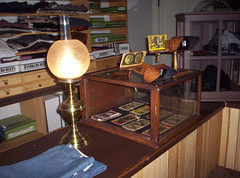
This past Saturday night, I was standing in one of my old haunts. The Dry Goods Store at Harpers Ferry National Historical Park is perhaps my favorite place to be an interpreter, especially at night. Low wattage lightbulbs (simulating whale oil or tallow lamps) and the darkness outside the windows make that building a perfect time machine. Near the end of the night, a family came in with two enthusiastic sons. One wearing a toy kepi and carrying a brand new souvenir envelope of Confederate money rushed around the store asking if he could, “buy that with this.” His excitement at being in the historical space could not be contained.

The other boy was more sedate. He was wearing glasses and bundled in a sweatshirt against the dark cold outside. He quietly looking over each of the objects near the back of the store, studying them.

“Is that a knife,” he asked me.

“Well, there’s some knives in there, but there’s also a razor for shaving your face, and a strop to keep the razor sharp,” I replied.

“And what type of pistol is that,” he continued down the line of windows guarding artifacts.

“I believe it’s a Colt,” I said, “after John Brown’s raid here, thousands of pistols were solid all across Virginia. People were scared of abolitionists and wanted to protect their families from violence. So they bought weapons.”

Then the magic really began.

“I saw a bigger gun than that on Pawn Stars,” the boy excitedly shared, “it had a lever and went like this.” He mimed a lever-action repeater in his hands.

“Oh, it sounds like maybe a Remington repeater?”

“No, it was from the Civil War!”

“Maybe a Henry repeating rifle…”

“Yes!” he jumped, “that’s it!”

“You know, by 1864, soldiers started being issued those guns in Georgia. They were called Bummers. They foraged for supplies and food for the army when Sherman was trying to end the war.”

My friend and one of my mentors, John King, tucked his hand and voice into the conversation. He dropped a chuck on something in front of the boy and it thunked on the glass case like a rock. “You know, that killed more than all of the repeater rifles and pistols combined in the Civil War?”

“Do you know what it is?” I added.

The boy studied it. The hunk of something was pitted with tiny holes, hard and mummified.

“Is it a rock?” he asked puzzled.

I responded, “No, it’s bread.”

His face twisted. “Bread!?”

“This is hardtack, what the soldiers were issued to eat. It’s so tough that they had to soak in it coffee just to bite it sometimes. See those holes there. What do you think caused them?”

“Bugs?”

“Yup.”

“Ewww!” he withdrew, “What’s it made of?”

“Do you have Playdough at home?” I asked.

“Yeah.”

“The same stuff as is in your Playdough: flour, water and salt. Do you think you could live on nothing but this and bacon?”

“Maybe.”

“Don’t you need vegetables?” I asked with a smile.

“I like them,” he responded.

“Good! They keep you healthy,” I said, “If you ate nothing but this bread and bacon, your digestive system would be a big waterslide. Men in the Civil War died of diarrhea. They pooped themselves to death because they couldn’t keep any water or food in their bodies.”

“That’s terrible,” the boy responded.

It is. It’s facts like that, when you say them aloud, that force your body to quite physically commiserate with the people of the past. Your stomach sinks for them; you want to vomit on their behalf. You feel, for just a fleeting moment, the Civil War alive inside your stomach.

He wandered down the counter, still studying every single thing he could touch and see. After a fascinating few minutes spent with a stereo-viewer, imagining visiting Paris or Jerusalem in his own living room, just like he can with his TV remote today, I plunked another photographic technology on the counter in front of him. A small ferrotype photograph of a face in profile.

“You know what that is?”

“It’s a picture of someone.”

“Exactly, do you see anything weird about it?” I asked.

“Well,” he puzzled, “he’s not looking at the camera.”

“No, he’s not,” I encouraged him. The boy’s mother began to hover over his shoulder to catch a peak as well. I revealed the answer: “he’s dead.”

“Oh!” the boy said with piqued curiosity.

His mother exclaimed, “It’s a person! I didn’t even see that until you just said that. Look at the detail!”

“I know, look how detailed it is,” I said. The boy took the picture in his hands, holding it close to his face to inspect every line in the corpse’s face.

“Photographs took a few seconds to expose in the middle of the nineteenth century,” I explained, “but when you’re not shooting a picture of someone who needs to stand still, the detail can be perfect.”

The boy lowered the photo and looked at me again. “I saw a picture like this on Pawn Stars, where the person was dead.; it was easier to take their picture because they had to wait like 10 seconds to make it and they didn’t move because they were dead,” he blurted out fast, like it was all one word spoken in a single breath.

“Why might you want a photo of a dead person?” I asked.

“I dunno,” he replied.

“How many pictures of your Mom do you have in your house,” I asked, looking to catch his mother’s eye.

He replied: “a lot!”

“If your Mom died, and you couldn’t see her anymore, you would still have lots of pictures to remind you of how much she loved you, right? They’d help you if you were sad?” I asked.

“Yeah, I could look at the pictures of her.”

“Imagine,” I said, “if you were in the 1850s. You might get your picture taken every few years, maybe. What if someone you loved died and you didn’t have a picture of them?”

“You could take one of these,” the boy exclaimed.

“And then you’d have at least one picture left to remind you of what they looked like and how much they loved you,” I helped him along.

“Wow…”

A time machine, giving us small glimpses of the 19th century, is an amazing tool. You don’t have to step into a jury-rigged Delorian or a blue Police Telephone Box to travel into the past and try to feel what it was like to live then. You don’t personally need to wear an expensive set of period clothing to wear on an immersion weekend in the backwoods of Georgia or Pennsylvania.

All you need is a heart, some dim lamplight, a good story, a piece of 'the real' and a cold December’s night.