Showing posts with label USCT. Show all posts

Wednesday, June 18, 2014

Slave Revolt at Battery Wagner

What drove these men to fight in
that sand fort in 1863? / PD LOC
The assault on Battery Wagner: we so often look at that tense moment on a beach in South Carolina from the eyes of the men of the 54th Massachusetts. They hailed from all over the United States. Some were from Pennsylvania, Massachusets, Connecticut - born free and willing to risk it all for the freedom of others. Some were from the American South, former chattel property who had seized their freedom of their own accord.

We rarely hop across that sandy embankment and try to get inside the minds of the men defending the works of Battery Wagner against assault on July 18th, 1863. Most of the infantrymen huddled in those sandy dunes, outnumbered by looming Federal forces, were sons of North Carolina.

Imagine sitting with those men, glancing over the battlements at the waves of companies of the 54th Massachusetts forming on the beach, preparing to charge. What is that image?

The 31st and 51st North Carolina hailed from all over low country North Carolina, a smattering of men from this county or that county making up each regiment. If you sat next to some men from Company A of the 51st North Carolina, who were from New Hanover County around Wilmington, the sight likely was a worst nightmare. Those men grew up in a county where 48% of the population was enslaved. When half the county are black men, women and children held in bond through force, a crowd of black men with guns is likely the boogeyman, the childhood fear lurking out behind the house or down the street.

Wander down to Company B or C, whose men were a melange of soldiers from Duplin and Sampson counties likely would have had the same fears. In both Duplin and Sampson Counties, the slaves nearly equaled the free white population. They were an army of disgruntled property, a few abolitionist tracts or a militant Nat Turner-type away from descending on the slave holders and their white friends.

Further down the parapet, the men of the 31st North Carolina glanced at those swarming black soldiers, likely with many of the same thoughts and fears. Their Lieutenant Colonel Edward R. Liles was barely in his 30s. When he joined the army and marched away from Wadesboro, North Carolina, he left behind his wife Helen and daughters Lillian, Inez and Laura. Joseph Wilson lived there with the family as well; his job was likely watching over their 15 slaves - 4 men and 11 women, ranging in age from 50 to 1 year old.

Company D's men were no doubt turning to Captain Ruffin L. Bryant for inspiration and encouragement. The company commander was in his mid-thirties. His wife and three children were still home in Wake County. Whether his one slave, a 23 year old man, was still there isn't clear. Certainly glancing over the sand dune and seeing row after row of 23 year old black men, carrying guns and wearing the blue uniform of the United States government must have looked like all of slavery's sins returning with a vengeance. Somewhere nearby, James E. Todd was looking after his men in Company H. At home near Raleigh his father was still looking after the family's five slaves.

Company G's commander Julian Picot likely glanced at those massing troops and flinched. At home, when the war broke out, he owned seven human beings as property who looked like those men. They were just a handful of his 28 slaves in Hertford County, with still more children and women milling around his no doubt bustling home. And now, his property was returning violence against the soul with violence against the body.

Commanding the fort, looking out on his men and worrying about the odds stacked against him was Brigadier General William B. Taliaferro. The nephew of Secretary of War Seddon, Taliaferro was a distinguished Virginia statesman and veteran of the War with Mexico. He had attended both William and Mary College and Harvard University, but it didn't take an ivy league degree to work out the calculus of the coming battle. 5,000 men and 6 ironclad warships loomed beyond his walls.

Does violence beget violence? / PD LOC
And some of those men were former slaves. Were any escaped from Taliaferro's Gloucester County, Virginia plantations? Certainly some of those men outside the fort's walls looked like the men who he left behind in 1861. There were 17 young men on his plantation in Virginia of the prime military age. And likely every one of them had more than enough reasons to enlist in the United States army and win freedom for four million.

The Battle of Battery Wagner was not simply a battle in a simple civil war. It was, in many real and even more imagined ways, a kind of slave revolt. And for Taliaferro, slave rebellion was something he knew how to deal with well; the Brgiadier General had, just a handful of years before, commanded the militia in Harpers Ferry in the wake of John Brown's Raid.

Fear can be a powerful force in battle. And when the USCT were martialed in battle, the very color of their skin could only serve as a potent multiplier for that fear.

Thursday, December 5, 2013

Obsessive Digging in Carolina Sand and Baltimore Asphalt

Some heroes are buried here... and some aren't.
My parents moved to Wilmington, North Carolina a couple years ago. I have to admit, I am fascinated when I visit the South, for the sheer fact that it is such a vastly different environment than I'm used to. For one thing, the war happened there. For another, the war got very complex and interesting there.

Wilmington has caught my fancy in particular. The campaign to capture that place singled the death knell for Richmond and Lee's defensive line guarding Petersburg. In many real regards, Wilmington ended the war.

But it has also become my own personal United States Colored Troops landscape. Living in Gettysburg, I'm used to the lily-white Civil War, where the combatants were fighting over the fate of the black man in America but were not (save a few choice, irregular exceptions on the field) themselves black. Imagining a landscape with black men literally fighting for their right to be human is such a foreign and often entrancing topic for me.

Last year, it was standing atop Battery Buchanan where the rebel troops from Fort Fisher surrendered to black soldiers, a palpable moment where everything changed.

This year, I wanted to revisit the Wilmington National Cemetery. I'd been one time before, drawn in by the state highway marker posted out front. That first trip I went unarmed, uneducated, just exploring with no foreknowledge.

This time, I wanted to know a bit more. So I began doing a little digging. Using a couple of databases, I began pulling up men in the USCT who died near Wilmington, particularly after the Battle of Forks Road on February 20th, 1865. The 5th USCT began sticking out in particular. Free men recruited in Ohio fighting against slavery in North Carolina was just fascinating.

All of this led, after random probing and hunting into the wee hours as my parents slept off the turkey, to an itinerary. We were going to go where a few of those men were wounded, and then where they were buried.

The problem is that most of the graves of USCT at the Wilmington National Cemetery are unmarked. The Veteran Affairs database yielded only one of the men who died of wounds after the Battle of Forks Road as buried in the cemetery. The rest would be a goose chase.

So, with my parents along for the fun, we began our goose chase.

Turns out, the VA database is right. Most of the men didn't have a tombstone to kneel next to, photograph or leave flowers at had I brought any. These men from Ohio are gone.

One in particular though, was my own mistake. We were looking in particular for William H. Quan. Civil War Data lists that, "he died of wounds on 3/18/1865 at Wilmington, NC." By all rights he should have been in that cemetery somewhere.

Except the database is wrong. After we'd searched nearly every stone in the cemetery for Quan and come up empty handed, I kept digging at home.

Quan was sent out of Wilmington, transferred up the Atlantic coastline to the General Hospital at McKim's Mansion in Baltimore, Maryland. It was there, Army Surgeon Read reported in a letter in the soldier's Compiled Service Record, William Quan died on March 18th, 1865.

Unlike his Wilmington brethren, Quan's CSR even has a record of interment. Private William Quan, formerly of Fayette County, Ohio, aged 31 years, was buried on March 20th, 1865 in Laurel Cemetery at 10am. He left behind a widow back home in Ohio.

I got really excited then. This was my excuse to visit a graveyard in Baltimore. So I began to Google for directions to "Laurel Cemetery" in Baltimore.

And then I hit an even more horrifying truth.

William Quan's Grave Marker
Whereas his comrades who died in Wilmington have small marble cubes with numbers marking their graves, Quan's fate is much worse. In the late 1950s, in the height of severe racial tension in the City of Baltimore, the city and local speculators brokered a deal: Laurel Cemetery would be condemned and sold for real estate development.

Graves would be moved, carted away to a new plot of land in Carroll County. But of the between 5,000 and 7,000 graves which were in Laurel Cemetery when the deal was struck, only about 270 graves made their way to the new plot. William Quan isn't among them.

Quan likely lies buried where he was laid beneath the earth in March of 1865, in what remains of the Laurel Cemetery today: a parking lot. His body sits below the tarmac where shoppers park their cars to go to "Forman Mills" and "Dollar General."

It looks like I have one more obsessive trip to make, this time to Baltimore. Perhaps I'll bring along a chunk of board painted "William Quan, 5th United States Colored Troops, 1834-1865," and a bike lock. I need to leave some flowers at the grave of a true unknown and forgotten hero.

He died serving his nation, serving in the United States army, and fighting for the rights of men who looked just like him. And today he's buried under a parking lot.

Tuesday, December 3, 2013

Buckeye Blood Waters the Longleaf Pines

In the woods south of Wilmington, men in blue uniforms moved forward in a loose skirmish line. They were probing, trying to find General Hoke's last line of defense. Brig. General Charles Paine sent the men forward to develop the enemy. But in the pine thicket ahead, in a thin, ragged line, the bedraggled rebel troops likely had more to fear than bullets as those skirmishers probed and prodded on a February day in 1865.

The skirmishers moved through the sandy soil along Federal Point Road. Behind them, the entire third brigade commanded by Colonel Elias Wright was crashing through the woods. And the color of their skin was the greatest weapon of the war.

The skirmishers of the 5th United States Colored Troops found the enemy strung out in a thin single-file line. But the rebels' fire was strong, a last ditch effort to defend the Confederate capital's final lifeline. The rebels were commanded by Major General Robert F. Hoke.

Hoke, facing off against these black soldiers, must have felt some trepidation. The world was changing. At home in Lincoln County, his mother Frances owned six human beings as property, including two men who by 1865 were old enough to wield a gun for the United States and fight in a war of freedom and revenge. Those skirmishers were a familiar and frightening bogeyman for any southern man: slave rebellion on a grand scale.

When the war broke out, the population of the county where those men now marched was nearly half enslaved. Now, through the pine forests where slaves had once gathered resin, distilled turpentine and harvested straight timber, black men marched for freedom.

And they bled as the rebels opened fire.

John Byrd bled when a musket ball blasted through the flesh around his left knee. He stood, before his knee was mangled by a rebel ball, at 5 foot 8 inches tall, with a shock of black hair and dark eyes. He farmed a field somewhere near Wooster, Ohio before joining the army. And Byrd had never tasted the bitters of slavery. Yet he fought for men with skin the same color as his.

Edgar S. Wright was wounded as well. His finger was hit by a musket ball during the assault. The 19-year-old Wright was born in Fayette County, Ohio. He had already had one close scrape with rebels; just a year before in May, Wright was captured by rebel troops, but escaped their hands. Had he stayed locked behind enemy lines in 1864, he might have been enslaved. Not again, but for the very first time. Wright was born free, risking his safety so that others might be free as well.

The 5th United States Colored Troops was pushed back, one final repulse before Hoke's line gave up the ghost and retreated in the darkness a few hours later. And as the men poured back to the safety of their comrades' line, William Alexander was likely struck in the back by a hunk of hot iron. The 36-year-old farmer from near Hillsboro, Ohio was a slight man, standing only 5 foot 5 inches. He enlisted in August of 1864, and never received a single cent from the Federal Government. Yet still his black skin was good enough to bleed in the North Carolina sand for the freedom of men he had never met.

The 5th United States Colored Troops, formerly known as the 127th Ohio Infantry, marched into Wilmington a few days later. Byrd, Wright and Alexander didn't. The men of the 5th USCT saw, standing on the city's edge, "an aged colored woman," who cradled in her hands an American flag, squirreled away somewhere during the long years of war as a symbol of hope. The men cheered. In the streets, the black men and women swarmed the men of the 5th USCT. "Glory to de Lord," a white officer of the brigade remembered them cheering long after the war, "The blessed day ob salbation am cum. De good Lord bress Massa Linkum."

Byrd, Wright and Alexander likely heard little of the cheering; they were too busy suffering in agony from rebel lead and iron. Alexander had been shuttled back to Fort Fisher to be treated. He died 4 days after being wounded on the skirmish line. Wright and Byrd were brought into Wilmington, suffering in the general hospital in the newly liberated city for weeks. The two men died within hours of one another in mid-March.

And they're buried in sandy, humid graves now, far from their Ohio homes. Private William Alexander has a gravestone, a marker at his head. But Byrd and Wright have none.

The National Cemetery at Wilmington is filled with unknown graves, both white and black. And there, likely, the other two sleep. These men from the Buckeye state, who freed a city and a nation from man's inhumanity to his fellow man, gave all that that nation might live. Because in giving freedom to the slave, they assured freedom to the free - honorable alike in what was given and what was preserved.

Tuesday, September 10, 2013

Shaw's Backside: The Other Side of an Icon

This week I find myself in Boston, one of the couple of American cities which call themselves the cradle of liberty. But I'm not drawn like a moth to the Revolution. It's just not my bean.

Instead, I find myself in the awkward position of standing at a visitor desk and asking a park ranger what will interest a Civil War geek in a Revolutionary-bent city. That dog don't hunt so well.

The Shaw Monument was the ranger's only suggestion. The Shaw Monument was already on my list. So the Shaw Monument it was.


Augustus Saint-Gaudens crafted an amazing piece of art to sit along the edge of Boston Common. Standing in awe staring at the bronze, the 54th Massachusetts came to vivid life as I stood in the waning hours of Sunday evening. I found amazing power in the words at the base of the monument, so much so I needed to trumpet them on Facebook: "Forward as fits a man, but the high soul burns on to light men's feet." That's art.

But somehow, I missed the fact that there is a backside to that bronze statue. Shaw and his soldiers have more to say through their marble resting place.

Every photo I see are those faces, those men, those chiseled jaws and striking brows marching into unknown death and destruction, but also winning freedom. I'd never seen the back of the monument.

The White Officers
taking life and honor in their hands cast in their lot with men of
a despised race unproven in war and risked death as inciters of
servile insurrection if taken prisoners besides encountering
all the common perils of camp march and battle.

The Black rank and file
volunteered when disaster clouded the Union Cause. Served
without pay for eighteen months till given that of white troops.
Faced threatened enslavement if captured. Were brave in action.
Patient under heavy and dangerous labors and cheerful amid
hardships and privations.

Together
they gave to the Nation and the World undying proof that
Americans of African descent possess the pride, courage and
devotion of the patriot soldier. One hundred and eighty thousand
such Americans enlisted under the Union Flag in
MDCCCLXIII-MDCCCLXV.

The text was written by Charles W. Eliot, President of Harvard in the years following the war. It is a powerful epitaph to the regiment made famous in our age by the film Glory and the rising neo-emancipation interpretation of the war. But it is not simply that. It works as an epitaph to the war itself, as a description of what the whole affair meant.

An imperfect partnership, inherently unequal yet striving toward equality, of white men and black men. Here, in this memorial to a war many have eschewed and subverted, ignored or swept under the rug, the two are offered a balanced set of praise.

The consequences are balanced as well. White officers and black soldiers risked not only their lives, they risked their freedom. And together, they proved that black folks were deserving of freedom.

Lincoln took that proof to heart. The faith he had in those black soldiers, the fact that he respected their willingness to step up and fight for a nation which didn't see them fully as men, the thought that because they fought that nation should treat them like men ultimately got that tall man killed.

The bronze on the front of the Shaw Monument at Boston Common is striking and powerful. But so are the words on the back.

Thursday, July 18, 2013

Stewart W. Woods: A Peculiar Casualty at Fort Wagner?

There Be Squalls Ahead: This post deals with historical uncertainty and represents some research-in-progress. This story is still half-researched and needs some more work. Viewer discretion is advised.

Captured in the darkness of July 18th on a sandy beach in South Carolina was a native of Adams County. Stewart W. Woods, born in Heidlersburg around 1836, found himself in the hands of the rebels, among a handful of his compatriots in the 54th Massachusetts. The fighting of Woods' war was over and his fate was unclear. Stewart was a free man, born under the folds of the same American flag under which he now fought. At some point, he had drifted over the mountain range and called Carlisle home when the war erupted in 1861.

But in summer of 1863, Woods' native county was still stumbling bewildered, blindsided by the realities of war. Now Stewart Woods was blindsided by the realities of war too, far from home and excruciatingly vulnerable in the hands of the rebel army. In the 54th Massachusetts, Private Stewart W. Wood was an oddity, perhaps entirely unique.

Stewart W. Woods was white.

Are these the comrades of a white
enlisted man? / PD LOC
In his Compiled Service Record, Stewart W. Woods' complexion is listed as "white." His eyes were blue, his hair was brown. In the 1850 and 1860 census, although Stewart himself doesn't readily appear, there are no black Stewart households in Cumberland County.

One of the larger Woods families in Cumberland County in 1860 was headed by Richard Woods esq, a 56-year-old farmer. According to the shadowy and somewhat insubstantial world of the Underground Railroad in Pennsylvania, Richard Woods was purportedly a local conductor. Richard Woods' son Samuel was the same age as Stewart Woods.

Why might Stewart W. Woods have been marked down as "white?" Was his skin just very light? But it isn't marked as "light" in the CSR, but clearly "white."

Led away from Fort Wagner, Stewart Woods wasn't dragged to Andersonville or any of the other Southern prisons penning in hundreds of loyal American soldiers. Instead, he and his compatriots became the awkward nucleus of a truly weird set of legal circumstances, as he and his fellows were tried by South Carolina's governor that August for slave insurrection. The soldiers were stripped of their uniforms, treated as common criminals and held inside Charleston's City Jail, where forty years before Denmark Vesey and his co-conspirators had been held under identical charges.

But why would a white man undergo such torture? If Woods was white, might he have been in the 54th Massachusetts precisely because he was white? Perhaps as in the South for generations light skinned black men had attempted to pass as white for a measure of freedom, Stewart Woods attempted to pass as black (all it would take was 1/8th of your lineage) in order to fight in a unit truly fighting for freedom.

In August of 1863, a criminal trial was called and the captives of the 54th were charged under South Carolina law for conducting a slave rebellion. But the case fizzled; the court decided that the charges overstepped South Carolina's jurisdiction. The soldiers were marched back to the city's prison and held there like criminals for nearly another year and a half, no real trial or charges. And Stewart Woods got sick.

Whether Stewart W. Woods was a white man on a moral crusade isn't precisely clear. But that Private Stewart W. Woods was on some sort of moral crusade is clear. Just a month before he was captured, the 54th Massachusetts marched through Darien, Georgia. Though Robert Gould Shaw reportedly called the burning of the town a, "satanic act," Woods was content leaving a clear, proud calling card of who had torched the town in slave-holding Georgia. Woods plucked a book from some soon-to-be-charred shelf and scribbled his name in the cover. "STEWART W. WOODS, was born September 21, 1834... Hidlersburg [sic], Adams County, Pennsylvania. 54th Massachusetts Volunteers." He followed those lines with the name of the unit again, content with te flag he fought under and the men he fought beside: "54th regiment, Massachusetts Volunteers, of Col. SHAW." So proud was he of his commanders that he noted all of their names; Shaw, Pope, Higginson and Tucker all were mentioned in the inscription.

Then Woods left the book to be found by the citizens of Darien as they wandered back into their wrecked city, wood framed walls charred black like the slaves their state had brokered in for hundreds of years. The book became his calling card, the signature he wrote on the inferno-artwork.

Months had passed from that day when Woods proudly burned Darien, Georgia, set torch to sin. By the spring of 1865, he was a shell of a man, the swampy and insanitary conditions of a city jail cell in a tropical city did their worst. He and his compatriots were exchanged in March of 1865, but it was too little, too late. Just 10 days after coming back to Federal lines, in a general hospital in occupied Wilmington, North Carolina, Stewart W. Woods succumbed to typhoid fever.

Should one of these faces be white?
What else don't we know about the USCT?
Was Stewart W. Woods white? Was he the only white soldier in the ranks of the 54th Massachusetts? Did he do it for Abolitionist fervor?

He did seem to take glee from a town meeting the torch, a town in a nation fighting to enslave men who looked like those who marched beside him. And Stewart Woods, whether white or black, fought for the destruction of a cancerous institution which had, for centuries, been strangling the vital American organ: liberty.


Special thanks to Chris Barr from Andersonville National Historical Site for some clarification and fascinating info on the men of the 54th Massachusetts who were captured during the battle at Fort Wagner. Andersonville has been doing gangbusters work under leadership of Chief of Interpretation Eric Leonard. Check out their Facebook page later today for more about the weird and amazing story of all of the 54th's captured's odd journey to everywhere but Andersonville.

Undoubtedly, Stewart W. Woods will continue to bother my historian's brain until this story gets more solid evidence. There
is a mother's pension application at the National Archives submitted for Woods. Hopefully that application can help pin down more certain details about Woods' race, life and death. Stay tuned.

Tuesday, April 2, 2013

Wilmington: A World Turned Upside Down

Fifes and drums from Tennessee play
The World Turned Upside Down.
There's an old myth that, as he ordered the flag brought down and the post at Yorktown surrendered, General Cornwallis ordered his fife and drum corps to play The World Turned Upside Down a traditional British Christmas song written in protest of the aristocracy outlawing raucous celebration. In its lyrics, the paupers are made kings and the kings made paupers. The song was more than likely not played during the surrender. But myths are often potent and always telling.

I've been thinking of that tune lately. And I've been thinking of Wilmington, North Carolina. The number of times I've watched (and listened to) Spielberg's Lincoln is now up into the teens. Each run through I'm noticing more and more. I'm now to that stage where you mouth lines along with Mr. Slade and anticipate the coming scenes viscerally.  And the carnage at Wilmington sits central to that film; it's a lynchpin of the plot that embeds itself deeper each time I watch.

Wilmington's also been on my mind because I've made two trips down in as many weeks to see my parents in their new adopted city.

Back in November, when I visited for Thanksgiving, we took a trip over to Fort Fisher. It was an odd site, an odd tour and an interesting experience. We wandered the site with a state park ranger, who was quite folksy and nice. We ended up talking more about Gettysburg than Fort Fisher (the curse of mentioning you're from Gettysburg is that every Civil War person wants to talk about your home rather than theirs), but I picked up enough of the vibe of the place to understand.

Before we left, I told my Dad we needed to visit Battery Buchanan. It was the final fallback position of the retreating rebel forces. It's where the battle at Fort Fisher ended. It's where the world turned upside down.

Dad stayed in the car; rain was beginning to fall. Mom stayed at the wayside; the remains of Battery Buchanan were too steep for her. But I needed to climb it. It's a simple mound of sand. But it was deeply powerful climbing up the dune.

At the top, I looked out. The words of Chaplain Henry Turner still rang in my mind from the fort's museum exhibit: "Indeed, the white troops told the rebels that if they did not surrender they would let the negroes loose on them." The white rebels cowered behind the Battery as the blue soldiers swept in toward them. Behind the sand dune hid a world which was dying. On the other side stood triumphant a world turned upside down.

The rebels from Fort Fisher surrendered to a federal column led by the 27th United States Colored Troops. They were black. Just a few years before, they weren't citizens in the eyes of the law. Now they were soldiers. And they were men.

And if cats should be chased
Into holes by the mouse,
If the mammas sold their babies
To the Gypsies for half a crown,
If summer were spring,
And the other way 'round,
Then all the world would be upside down.

Thursday, March 28, 2013

Tool of Revolution, Piece of the True Cross

One of the treasures on display in Special
Collections, a receipt for a slave's labor on the
defenses of Richmond.
One of my former students, brilliant researcher and Gettysburg College Senior Lauren Roedner has been pulling together an exhibit from the private collection of Angelo Scarlato, displayed in the display cases in Gettysburg College's Special Collections. The exhibit, Slaves, Soldiers, Citizens: African American Artifacts of the Civil War Era opens officially on Monday. But I was able to sneak a quick peak on Wednesday night of the exhibit-in-progress.

There are some amazing artifacts, from freedom papers to slave collars, which pluck at the very heart of the 19th century's driving institution and struggle.

But one in particular caught my eye on Wednesday night. It is a rifle musket, like any other used in that war to preserve the United States. Carved in the stock are the initials, "I.J.W." and a unit, "CO. F 43." But the inscription doesn't have a state.


The gun was carried by Isaac J. Winters as he marched through Virginia during the war with the 43rd United States Colored Troops. Winters was a native Pennsylvanian, a free farm laborer from the outskirts of Philadelphia. As the war began, the 32-year-old man had a wife Margaret and two children, a daughter named Eliza and an infant son named Charles. As the war progressed, Winters' fledgling family continued to grow; his wife Margaret was pregnant with a girl as the calendar turned over from 1862 to 1863.

That flip of the calendar was important for all of America too. The war which the nation had been mired in for nearly two years was transforming. America began fighting, quite literally overnight, for a new goal: the freedom of 4 million held in bondage in the South. The Emancipation Proclamation opened the floodgates of freedom, transforming the war's aim. It also opened the United States military for men of a darker hue. They could start becoming real citizens.

Isaac Winters found himself, like many other citizens, caught in the new concept of conscription. He was drafted and subsequently mustered into the 43rd USCT in the late summer of 1863. The 5 foot, 9 inch tall black man was suited in a uniform and issued a weapon to fight on behalf of his nation, the new-found freedom of the citizen and, for Winters, the new-found obligation as well. He left Margaret and three children behind, his newborn daughter Anna cradled in the arms of his wife. And he fought.

The 43rd plunged through Virginia, part of a new American revolution. These were black men marching to tear men, women and children who looked just like them from the grip of slavery. According to an account from one member of Winters' unit, as they marched through Virginia, the 43rd was, "instrumental in liberating some five hundred of our sisters and brothers from the accursed yoke of human bondage." As the men crossed the Virginia countryside, the soldiers could, "see them coming in every direction, some in carts, some on their masters’ horses, and great numbers on foot." The slaves saw black faces and black hands carrying the tools of revolution and freedom, and said the sight, "seemed to them like heaven, so greatly did they realize the difference between slavery and freedom."

Winters carried that gun, that sainted relic, while he and his comrades freed their fellow human beings. He marched with it at his side while the roadsides teemed with the newly joyous, newly hopeful, newly free men and women of Virginia.

And he carried it on July 30th, 1864 as well, as the 43rd USCT watched a cloud mushroom from the rebel lines as a mine exploded beneath their feet. And into the maelstrom of the Battle of the Crater, Winters and the 43rd USCT plunged. As the battle progressed, Winters was wounded. He would spend months in the hospital before returning to his unit late that fall. He made it home safely to Margaret, Eliza, Charles and Anna by the fall of 1865.

But that gun is not simply a relic of Isaac J. Winters; it is a relic of a revolution. That weapon freed slaves. It is not a metaphorical object, though it certainly is that as well. It is a true relic, a piece of the true cross in the sacrificial struggle to bring freedom to the slave.

And for now, at least for the next few months, you can visit Gettysburg College and pay Isaac J. Winters' gun its proper homage. You can kneel at this small shrine to freedom and thank Winters for taking a step forward on that road toward equality which we're still walking today.

Thursday, November 15, 2012

Living Fortress of the Heart: Resonance of Emancipation

Under the spreading Emancipation Oak
a band of interpreters stand...
Jacob dragged me somewhere again. I really should learn to say, "no," because no matter where I get dragged by Jake, it always ends up wrecking my brain for months and making me obsess about some amazingly minute interpretive experience. But I'm a glutton for interpretive punishment.

Last year during the National Association for Interpretation annual workshop it was an historic diner. This year, with the conference being held in Hampton, Virginia, there are far more Civil War related speed bumps to roll over.

Yesterday it was the Emancipation Oak. "It'll be amazing," Jake assured me, "It's a living thing that's a National Historic Landmark."

I made a snide remark about, "living history," and joined him in the car along with Clayton and Travis, two more whip-crack interpreters.

The tree is on the campus of Hampton University and is massive. It's an impressive Southern Live Oak, an evergreen tree that seems to envelop the sky with it's sheer mass.

Under the tree 150 years ago, former slaves sat in rapt attention as the words of the Emancipation Proclamation were read aloud to them for the first time. Lincoln exclaimed in neat strokes of ink upon a page, translated into living words for the contraband gathered at the foot of the tree, that the slaves of the Southern states in rebellion, "henceforward shall be free; and that the Executive government of the United States, including the military and naval authorities thereof, will recognize and maintain the freedom of said persons."

These poor shards of humanity, shivering in the shade of a even-then sprawling tree, saw new light as Lincoln took a massive step toward their freedom and equality. The fort that loomed on the horizon, the bastion of freedom named after James Monroe, now stood explicitly as a bastion to protect their freedom from the slave power.

OK, so Jake was right. It was worth the stop.

But then we went on another wild goose chase. "Now we're going to see the Hampton National Cemetery!" Jake declared. Into the car we piled again. After discovering there are two Hampton National Cemeteries, and that we had arrived at the wrong one, we hightailed it over to the correct one, again within the campus of the historically-black Hampton University. Four white boys in an SUV were waived past an incredulous security guard. She was sure we weren't going to cause trouble, but it was an odd sight at sundown.

We wanted to find someone, and had our sights set on a few USCT soldiers. Travis produced his phone and listed off the names of some Medal of Honor winners resting within the cemetery's brick walls.

We hunted down the grave of Color-Sergent Alfred B. Hilton. Hilton served in Company H of the 4th United States Colored Troops. He enlisted in August of 1863 at Baltimore. He listed his residence as Harford County, Maryland. He was married and in his twenties. He was 5 foot, 10 and a half inches tall. His complexion was black.

Standing over the sod beneath which lay Color-Sergeant Hilton, we read a quick biography of his heroic act. Our glowing screens told the tale in the growing darkness.

In late September of 1864, as the 4th USCT charged the rebel works during the Battle of Chaffin's Farm outside Richmond, the Color-Sergeant carrying the Regiment's flag was struck down by a bullet. Standing next to him was Sergeant Hilton, the United States flag tight in his grip. As his comrade fell, Hilton grabbed for the flag and, according to the Official Records, "struggled forward with both colors, until disabled by a severe wound at the enemy's inner line of abatis." Hilton urged his fellow soldier onward, passing the flags on to another man, "his thoughts were for the colors and not for himself."

Hilton, bleeding from a severe wound in his right leg, was brought to the United States Hospital at Fortress Monroe. His leg was amputated at the knee.

He lingered, sickness taking hold. Hilton died on October 21st, 1864.

A package was returned to his company commander in the field from the hospital. Inside were simple things: a cap that had sheltered his head from rain or sun as he marched forward for freedom, a wallet with $4.50 worth of paper money, and two ambrotypes. Who were the faces in those pictures? Were they his wife? Was one a photo of him, waiting for a spare moment to send it home to loving hands waiting for a warm embrace that would never come?

I looked up from the gravestone, a tear staining my right cheek. I swear it was from the cold. A tree caught my eye. Its leaves looked familiar. Behind Hilton's grave, shading his final resting place, is a Southern Live Oak. The branches don't spread as wide as the Emancipation Oak, but they're still strong.

Color-Sergeant Hilton rests now, forever a free man under the shade of a cousin of the tree of first freedom, a stone's throw away from Freedom's Fortress.

He is the Civil War in microcosm more than any other man.

I'm glad I got the chance to meet him.

Thursday, October 25, 2012

The Whole War in One Photo


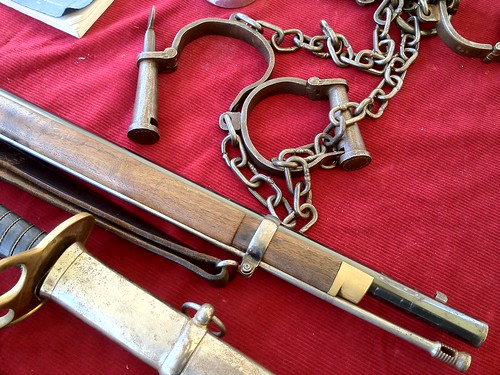
Broken chains and muskets: the very essence of the slaveholder's rebellion. The war was caused by a blind, stalwart defense of slavery. The war hinged upon the future of slavery in America. The war shattered slavery in the United States forever.

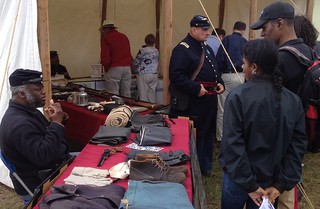
Thanks to the 3rd United States Colored Troops reenacting unit for their excellent impromptu exhibit at Gettysburg College last month (where this photo was taken) as part of the celebration of the Emancipation Proclamation.

If you missed Pennsylvania's Civil War Roadshow in it's final stops before being dismantled, you missed out on excellence. The exhibit explicitly dealt with causes, meanings and race in meaningful detail and to great extent. The touring exhibit will be installed in the Pennsylvania State Museum to, "allow a greater number of people to see and enjoy this important exhibit." Because everyone knows things without wheels reach far more people than things with wheels.

Yup.