Showing posts with label Cold Harbor. Show all posts

Wednesday, July 2, 2014

One Year On: Preparing a Somber Holiday

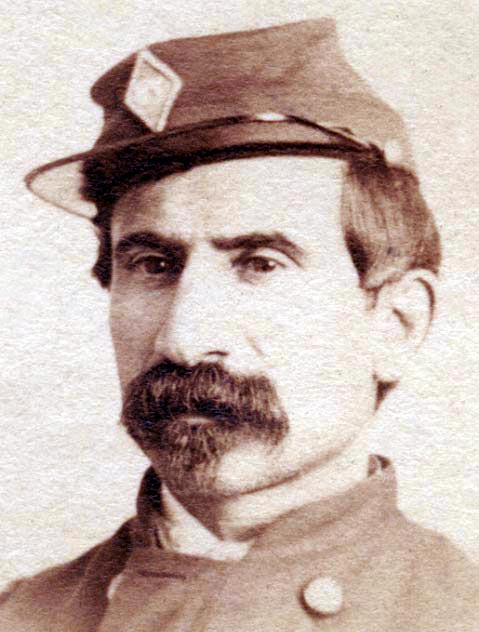
Lieutenant Colonel James Alonzo Stahle,
whose brother managed Gettysburg's fiercely
Democratic Compiler, sometime before March 1864.
Newspapers are built by bits and pieces. Type is set all throughout the week, long before the paper in Gettysburg goes to press. July's first edition in 1864 was cobbled together in the last few days of June and the first few days of July. Dropping sorts into the frames must have been agonizing work. It was labor intensive, requiring the meticulous placing of each letter and every space into the plate for every single word.

But laying out the paper in those first few hot days in July must have been agony for reasons far beyond the raw labor. The words themselves were distressing.

In the neat columns of type sat a letter. Henry Stahle, the Gettysburg Compiler's editor had received it a few days before. Though it was signed simply, "Zoo-zoo," it was likely from Stahle's own brother, James.

Lieutenant Colonel James Alonzo Stahle fought with the 87th Pennsylvania. When war broke out in 1861, James Stahle organized a local milita unit, York's own version of the "Ellsworth Zouaves." By 1864, he had risen to the upper eschelons of the 87th, commanding men mostly from York and Adams County.

Zoo-zoo, that nom-de-plume of the prolific correspondent to the Gettysburg Compiler was an obvious nod to the flamboyant Zouaves. And Editor Henry J. Stahle reprinted the neatly set letters prolifically.

But dropping these letters into the frame, laying out these sorts, must have been harrowing for a loving brother. Zoo-zoo's letter in the July 4th edition was full of such palpable grief.

"The last rays of the sun are still glimmering up the evening sky," Zoo-zoo wrote, "faintly throwing their fading light upon the tall pines that skirt the borders of these swamps, whose dirty, sluggish waters find an outlet in the ever memorable Chickahominy." The cratered moonscape of Cold Harbor stretched before his eyes. "Looking toward the west, and strong strong earth-works, trenches and bomb proofs are all that meet the eye," he wrote. But turn around and the landscape changed. It was scattered with graves, the final resting places of, "many who yesterday were among the busy thousands that were battling for their common country."

Zoo-zoo knew that mothers across America, in Ohio and Pennsylvania, New York and Vermont were mourning. And he was mourning too.

"Among the hundreds of little boards that mark the simple graves, my eye rests on one that calls back to memory the face of one who but a few days ago was among us, in the full enjoyment of vigorous health and strength." That tiny board read, "Isaac Sheads."

Sheads joined Stahle's 87th Pennsylvania in September of 1861, after it was obvious this spat might last for not months but years. But most of the 87th's war was in garrison duty in Western Virginia, dancing around Harpers Ferry and Winchester for the better part of two years. It wasn't until 1864 that they began seeing war's cruelty in spades.

Sheads survived the raging fires of the Wilderness. Sheads watched as the other regiments from his Corps charged forward under Emory Upton in an awkward and new formation, forever changing warfare at Spotsylvania. War was becoming very real and very raw as 1864 crept on.

Then, at Cold Harbor, Isaac Sheads' war ended.

"Isaac Sheads was but an acquaintance of few years' standing," Zoo-zoo wrote to his brother the newspaper editor, "yet in this time he so endeared himself to many of us that an unbidden tear will spring up from the heart at the thought that he is no more with us." As Stahle and his pressmen transcribed the letter into lead type did they need to decipher ink through tear stains on that sheet of paper? What had this private, this invisible man in the ranks, done to endear himself to an entire regiment, to its Lieutenant Colonel?

Isaac Sheads avoided the fate of many from the
Cold Harbor battlefield. He has a named grave,
and was eventually reinterred in Gettysburg's
Evergreen Cemetery
. / PD LOC
"Brave and suffering hearts have been passing on stretchers since the sun rose this morning, and even now the battle goes on," Zoo-zoo wrote to his brother and the citizens of Gettysburg, "But amid all the noise and din of battle I pause to write this article, in memory of one who was dearer to me than all the rest."

Henry Stahle needed to keep going, needed to build this week's paper. But his brother's words must have at least given him pause, made him yearn to comfort his flesh and blood. It would have made any man's brother pause.

"Birds will warble their sweet matin songs," Zoo-zoo imagined amid the din of battle, "over no braver man than Isaac Sheads." Even in a blasted hellscape like Cold Harbor, as the final shots of a battle found their mark, a soldier's eyes could imagine a new dawn through bitter tears.

And as all of Gettysburg unfolded their newspapers on the glorious Fourth of July in 1864, everyone saw those tears and knew the costs of this cruel war.

The Fourth might be a memory of victory from last year, but war still raged on just shy of two hundred miles south to disastrous and heartrending ends one year on.

Tuesday, June 3, 2014

Gettysburg's Tragedy in Virginia

The 138th's VI Corps fighting
through the Wilderness
Jacob and John Kitzmiller were brothers-in-arms, fighting through the thickets of Virginia with the 138th Pennsylvania. And spring of 1864 was one hell of a slog.

The two boys were the youngest members of their family. When the war erupted, their mother and father, Samuel and Jane, lived alongside their daughter Catharine. Jacob was an apprentice blacksmith in B.G. Holabaugh's shop. John still lived at home with his parents.

August of 1862, the brothers joined the army alongside dozens of other men from Adams County. Company B of the 138th was chock full of names which still bedeck Adams County's mailboxes and backroads.

But while battle raged at home in July of 1863, while rebel bullets threatened mother, father and sister, the Kitzmiller boys found themselves guarding quartermaster stores en route to Washington alongside the Potomac. While men proved their mettle in the streets where the Kitzmillers grew up, they were guarding crates of hardtack and shelter halves.

But the two brothers eventually found the war. The 138th Pennsylvania bounced around the Army of the Potomac, finally landing in the 6th Corps in time for the battle in the Wilderness in 1864.

The men from Adams County charged through a tight bramble just north of Saunder's Field, while the forest roiled with smoke and fire in the chaotic battle. And somewhere in the fray, the two Kitzmillers stood in line of battle.

Were Jacob and John near each other? Did they stand shoulder to shoulder, to brothers on an adventure. The blacksmith Jacob and his little brother John were somewhere in that hellish scene, the scent of brimstone from charred gunpowder curling through their nostrils.

Then Jacob felt a sharp pain in his strong left arm. That muscle which had steadied hot iron against an anvil, learning the trade of the noble blacksmith, dangled limp and shattered. Tragedy had struck.

Jacob lost his arm after being dragged to a field hospital. His war was over. But so was his life as he had imagined it.

And John fought on alongside the Bieseckers and McCrearys and Deardorffs. His brother was no longer there. Was it harder? Where did he find the strength to keep on marching forward? War had stolen his brother's arm. And here John stood, still on the front line.

He didn't have to fear for long.

Almost as an afterthought, in the Compiler in the first few weeks of June, the notice ran. "A letter just received from Lieut. Earnshaw, of Co. B, 138th Reg., states the casualties in the company as follows: - Killed, John Kitzmiller."

Just two years earlier, Kitzmiller's death might have warranted a full column of text, a eulogy for a young man destroyed in his prime. It might have called for fanfare, for pomp and circumstance. But reality had struck Gettysburg with a vengeance. For a town which had witnessed the deaths of 10,000 men, who had watched as three times that many others limped or rolled through their streets, what was one more lifeless form to be added to the grotesque pile?

But the two boys weren't just lifeless forms. They were a son shattered and a son killed. For the Kitzmiller family in Gettysburg, 1863 may have been tough. But 1864 was an absolute tragedy. One insignificant name in a newspaper, hearing your son has lost his left arm, is enough to shatter a mother's heart, leave a father crippled with grief. Worrying over that young man, now missing his trade and writhing in pain in a Washington City hospital must be sheer agony for a mother. And agony becomes inconsolable when a second name, dropped nonchalantly by a typesetter in a newspaper office on Baltimore Street, reaches the Kitzmillers' eyes.

Gettysburg might have been deadened to tragedy, but that didn't stop tragedy from squeezing its way through the tough exterior to shatter heart after heart in 1864.