Showing posts with label Letter. Show all posts

Wednesday, July 2, 2014

One Year On: Preparing a Somber Holiday

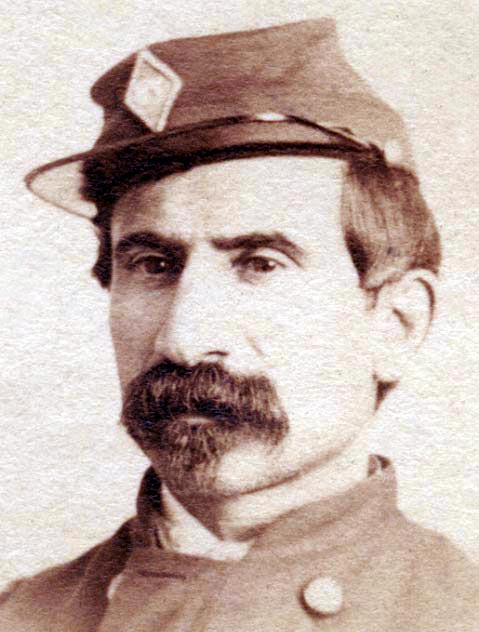
Lieutenant Colonel James Alonzo Stahle,
whose brother managed Gettysburg's fiercely
Democratic Compiler, sometime before March 1864.
Newspapers are built by bits and pieces. Type is set all throughout the week, long before the paper in Gettysburg goes to press. July's first edition in 1864 was cobbled together in the last few days of June and the first few days of July. Dropping sorts into the frames must have been agonizing work. It was labor intensive, requiring the meticulous placing of each letter and every space into the plate for every single word.

But laying out the paper in those first few hot days in July must have been agony for reasons far beyond the raw labor. The words themselves were distressing.

In the neat columns of type sat a letter. Henry Stahle, the Gettysburg Compiler's editor had received it a few days before. Though it was signed simply, "Zoo-zoo," it was likely from Stahle's own brother, James.

Lieutenant Colonel James Alonzo Stahle fought with the 87th Pennsylvania. When war broke out in 1861, James Stahle organized a local milita unit, York's own version of the "Ellsworth Zouaves." By 1864, he had risen to the upper eschelons of the 87th, commanding men mostly from York and Adams County.

Zoo-zoo, that nom-de-plume of the prolific correspondent to the Gettysburg Compiler was an obvious nod to the flamboyant Zouaves. And Editor Henry J. Stahle reprinted the neatly set letters prolifically.

But dropping these letters into the frame, laying out these sorts, must have been harrowing for a loving brother. Zoo-zoo's letter in the July 4th edition was full of such palpable grief.

"The last rays of the sun are still glimmering up the evening sky," Zoo-zoo wrote, "faintly throwing their fading light upon the tall pines that skirt the borders of these swamps, whose dirty, sluggish waters find an outlet in the ever memorable Chickahominy." The cratered moonscape of Cold Harbor stretched before his eyes. "Looking toward the west, and strong strong earth-works, trenches and bomb proofs are all that meet the eye," he wrote. But turn around and the landscape changed. It was scattered with graves, the final resting places of, "many who yesterday were among the busy thousands that were battling for their common country."

Zoo-zoo knew that mothers across America, in Ohio and Pennsylvania, New York and Vermont were mourning. And he was mourning too.

"Among the hundreds of little boards that mark the simple graves, my eye rests on one that calls back to memory the face of one who but a few days ago was among us, in the full enjoyment of vigorous health and strength." That tiny board read, "Isaac Sheads."

Sheads joined Stahle's 87th Pennsylvania in September of 1861, after it was obvious this spat might last for not months but years. But most of the 87th's war was in garrison duty in Western Virginia, dancing around Harpers Ferry and Winchester for the better part of two years. It wasn't until 1864 that they began seeing war's cruelty in spades.

Sheads survived the raging fires of the Wilderness. Sheads watched as the other regiments from his Corps charged forward under Emory Upton in an awkward and new formation, forever changing warfare at Spotsylvania. War was becoming very real and very raw as 1864 crept on.

Then, at Cold Harbor, Isaac Sheads' war ended.

"Isaac Sheads was but an acquaintance of few years' standing," Zoo-zoo wrote to his brother the newspaper editor, "yet in this time he so endeared himself to many of us that an unbidden tear will spring up from the heart at the thought that he is no more with us." As Stahle and his pressmen transcribed the letter into lead type did they need to decipher ink through tear stains on that sheet of paper? What had this private, this invisible man in the ranks, done to endear himself to an entire regiment, to its Lieutenant Colonel?

Isaac Sheads avoided the fate of many from the
Cold Harbor battlefield. He has a named grave,
and was eventually reinterred in Gettysburg's
Evergreen Cemetery
. / PD LOC
"Brave and suffering hearts have been passing on stretchers since the sun rose this morning, and even now the battle goes on," Zoo-zoo wrote to his brother and the citizens of Gettysburg, "But amid all the noise and din of battle I pause to write this article, in memory of one who was dearer to me than all the rest."

Henry Stahle needed to keep going, needed to build this week's paper. But his brother's words must have at least given him pause, made him yearn to comfort his flesh and blood. It would have made any man's brother pause.

"Birds will warble their sweet matin songs," Zoo-zoo imagined amid the din of battle, "over no braver man than Isaac Sheads." Even in a blasted hellscape like Cold Harbor, as the final shots of a battle found their mark, a soldier's eyes could imagine a new dawn through bitter tears.

And as all of Gettysburg unfolded their newspapers on the glorious Fourth of July in 1864, everyone saw those tears and knew the costs of this cruel war.

The Fourth might be a memory of victory from last year, but war still raged on just shy of two hundred miles south to disastrous and heartrending ends one year on.

Thursday, October 10, 2013

Martin L. Stoever: Moving His Abolition Needle

Two letters appeared in the Lutheran and Missionary in the late summer of 1864 signed, "M.L.S."

The summer session had ended at Pennsylvania College. The campus was quiet, the classrooms were empty. For professors at the college, the brief breaks between semesters were a much-needed respite from the daily grind of professorial life. Any sane professor would use the few brief moments to unwind.

But for Martin Luther Stoever, who had begun the war as a simple professor of Latin, Literature and History, too much had gone by to sit idle. Witnessing the work of the United States Christian Commission in the month after the battle of Gettysburg, operating out of the vacant store on the first floor of his home, Stoever saw firsthand how Christian precepts might ease the pain of the suffering soldier. By 1864, Stoever was heading up Gettysburg's new local chapter of the Christian Commission, organizing supplies and coordinating donations.

But in the summer of 1864, he might have done more.

During Pennsylvania College's break that summer, an aid worked arrived on the outskirts of Petersburg, Virginia. "You will no doubt be surprised to receive a letter from me at this point," the correspondent opened. "I have been here for some days, among the wounded and the dying."

Martin Luther Stoever had seen suffering on a battlefield before. In the months after the battle at Gettysburg, Stoever moved from field hospital to field hospital, aiding the wounded and praying with the dying.

The letter in the Lutheran and Missionary noted all of the valorous shows of courage by the Federal soldiers as they suffered after the assault on the Weldon Railroad. TIn their sufferings, these men were, "showing the spirit of our noble soldiers who are willing to endure so much for the cause of freedom. It is a costly sacrifice. Many victims are required to secure the end. But it is only through tribulation, that great results are achieved."

Before the war, Martin Luther Stoever made a last ditch effort (as did many Americans) to stave off war. He signed a set of petitions from citizens of Adams County supporting compensated emancipation and forced colonization. America's sundry colonization societies were the most lackluster of abolitionist, believing that black shouldn't be slaves, but also shouldn't be Americans.

But something shifted for Stoever as the war dragged on.

In 1864, the correspondent to the Lutheran and Missionary noted he was, "very much interested in what I saw of our colored troops. They are noble, brave men, their hearts earnestly in the work, and many of them sincere Christians." One he met was from nearby Hagerstown, Maryland and knew some of the author's friends. When questioned whether he was afraid of battle, the black soldier responded resolutely, "No! God will take care of me. When I started in defence of my country I determined to stand by her till I died."

"This," M.L.S. noted, "is the spirit which I have seen exhibited by many of these men. God, in his wondrous providence, is doing marvellous things by means of this war... One of the results will be the elevation of the African race, in the confidence it has isnpired in themselves, in making them, as well as others, feel that they have capacities, that they are immortal beings, that they can accomplish something for the good of their fellowmen."

The following year, when Abraham Lincoln was murdered by a bloodthirsty zealot, Professor Stoever confessed in a eulogy to Lincoln that, "we must now admit, even if we did not before, that there is a barbarism in slavery."

Slavery, made incarnate in the rebellious Southern nation, had, "showed its real character in the various atrocities committed during the war, in the heartless treatment of our prisoners, in the brutal massacre of our colored troops, in plotting arson, in attempting to diffuse malignant disease, in commissioning its secret emissaries to burn and pillage our large towns and cities, in striking at every thing that opposed its progress and perpetuity, and crowned its wicked career in the perpetration of a crime unknown in our history," the murder of the President.

Stoever was quite clear on how America could best remember their fallen chieftan:
It is a duty, then, we owe to the memory of the illustrious dead, that this evil be utterly eradicated, that the letter and spirit of the Emancipation Proclamation, be fully acknowledged and faithfully executed; that domestic slavery be forever obliterated from American soil, that the great principles which underlie our Government be vigilantly guarded, that hereafter all, who live beneath the folds of the American flag, be protected in their inalienable rights and treated as freemen, and every human being occupy the position assigned him by his Creator."

Something made that historian's mind shift and change, morph and progress. Perhaps that something was a trip south in 1864, and an opportunity to see black men fighting valiantly for their nation, and kindly shake their hands.

Thursday, September 19, 2013

Things Never Change: Piecing Together College Life

Sometimes you stumble on something on eBay you just can't pass up. It's that $6 buy that is awkward, odd and just a little out of your scope. But it's only $6. If you'd buy a burger for $6, you shouldn't pass up an original letter from 1835.

Every letter has a story. And each of those stories has its own drama, its own meaning, its own power. The mundanities of human life can be just as powerful as the battles and charges.

In the waning days of August 1835, George Heilig set pen to paper to send a message off to his brother William. His motives were two-fold. His pastoral duty called him to let a local Gettysburgian, a man named Buehler, know that his sister-in-law was in dire straights near Norristown. A widow and her two children suffered in destitution without their husband and father. But George wasn't quite sure how to contact Buelher. "I could not for certain tell," George wrote to his brother William, "whether he was a black smith, or Dr. or Bookseller or what." William's task was simple: "see to it that he may get the letter in calling upon him & asking him whether he has rec'd an epistle from me."

But George seems to be practicing pretense; he didn't mince words to his beloved brother William. "Why don't you write to us," George pleaded to William, "as an affectionate brother who has more time to engauge in such matter than we."

William Heilig was away at college in Gettysburg, studying at the newly minted Pennsylvania College. His school wasn't north of town; it sat smack dab in Gettysburg's bustling streets at the corner of Middle and High streets. Pennsylvania Hall and the sprawling campus where decades later soldiers would suffer were all just a pipe dream of delusional Lutheran church fathers.

And like every young man far away from home, he forgot to write. "I have been looking for a letter long since but in vain," George told his brother. And news from Gettysburg back toward Philadelphia's outskirts was important to George, pastor of a congregation in Centre Square. "I'm always pleased to receive some intelligence from your place since it is the head quarters of our Lutheran Zion."

That Gettysburg was someone's Zion long before a battle was fought here is hard to imagine. Pilgrims make annual hajjes to the sacred shrines scattered across the town's fields like lost words. They genuflect at altars and offer supplication to violent and, perhaps, Christ-like sacrifices.

Before the Lutheran Theological Seminary and Lutheran College were hospitals and charnel houses, they were the heart and soul of the Lutheran church in America.

Before the violence, before the blood, before the Civil War Zion, there was the Lutheran Zion.

George Heilig walked to the post office to mail his brother the letter. He entered and paid the 12 1/2 cents to mail his letter. The clerk mentioned he had a letter for Heilig, perhaps he said it as he neatly penned the postage rate in the letter's corner. The pastor tore open his own letter, one from Mr. Buehler in Gettysburg. Enclosed was cash for the widow and her orphan children.

His pretense foiled, George asked for his letter back. He ripped open the wax seal and grabbed a pen, scribbling hurriedly. He explained that the letter was unnecessary, that the Buehler's were sound. William needn't bother the blacksmith or doctor or bookseller but to give him the family's thanks.

Then George Heilig carefully resealed the meaningless letter to his brother William and handed it back to the clerk. It traveled the long road to Gettysburg.

Perhaps George never cared about the Buehlers at all. Perhaps news from Lutheran Zion didn't matter. Perhaps he only longed to hear from William.

Perhaps we all have Williams who we long to hear from.

Monday, May 30, 2011

"...never forget what they did here": Memorial Day 2011

As I get ready to head out into town today, for a big parade and the typical festivities here in Gettysburg, I wanted to make sure we put up something special for Memorial Day here.

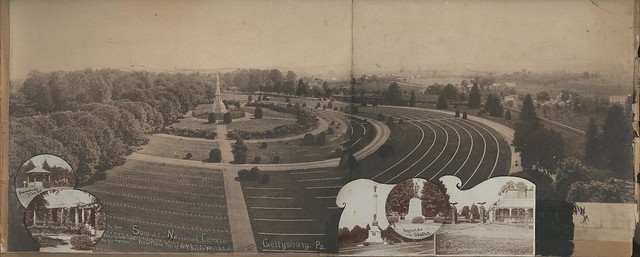
PD / A Tipton cabinet card layout depicting the National Cemetery in the collection of GNMP

One of my pleasures on this holiday is to buy and place a flag on the monument to the 14th U.S. Regulars in the valley of death. Along the banks of Plum Run, the Regulars held back an onslaught from a pell-mell group of charging Confederates in what would be the final phase of the fight in the Wheatfield and Devil's Den area on July 2nd, 1863. As they retreated back across the swampy lowlands, Confederates hot on their heels, their own gunners on the slopes of the hill had no choice but to fire into the mangled mess of friend and enemy. Canister whizzed through the blue and butternut uniforms alike.

At the end of the day, my Great-Great-Grand Uncle lay dead in that field. William Henry Francis, killed at Gettysburg. We have no photo of him. He has no marked grave in the cemetery. He has no marked grave at home. He most likely sleeps beneath the sod in plum run valley where he fell. That's the only tangible place I have that can connect me to him.

So today I'll be heading down to place a flag there to honor him. He was an average soldier. He had his doubts. Nonetheless, he died that they might be free. He died that we might be free. He died that we might be free.

I'd like to share his words with you today, as he wrote them. This is a letter he wrote home in November of 1862, as the army was changing and the war seemed so uncertain to the men in the field:


Camp near Warrington Nov 13th12th /62
Dear Father
Your letter received to day
and glad to hear your were all
well. but sorry to hear of cousin
death. I feell verry well at
present. I presume you see
by the head of this that
we have changed positions
since I last wrote.
we started from Sharpsburg
the 29th and came here via
Harpers Ferry Snickers Gap
and White plains arived
here on the 9th where our next
trip is for I do not know
I hope it is for Washington
our leader is gone you cannot
immagine the disapointment
of the men by the loss of Mc Clene
--------
all of their trust was placed in
him they fo wouled follow
him through worse than fire
and water. yes through the
regions of lower blacknes.
most of the small Officers
in the 5th group, (ours) are
resigning. what it will
amount to I do not know.
I am afraid I shall be tempted
to shoot Baxter when I get
home. with Martha Rixon I
think she done well. Emma
Gray I think is an equal
mateh, as reopeets your neighbors
I must say you have a splendid
set I wish I was there.
what ails old Stanton he must
be in a bad way.
By the way did you ever hear
whether Aunt Pulia got
that money three or four months
a go I sent you some I never
--------
heard from I will send
more and if that does not
go I will stop sending enny
more I have no more to write
as I think of now
hopeing you will write soon
I remain you
son
W H Francis

PS I received a letter from
John the same day I got
yours
I have seen the 157th NYSV
Kenyon Gleason and the boys
are well I believe they think
Soldiering is rough.==
send us a paper occationly I
dont care what it is.

yours
H F